
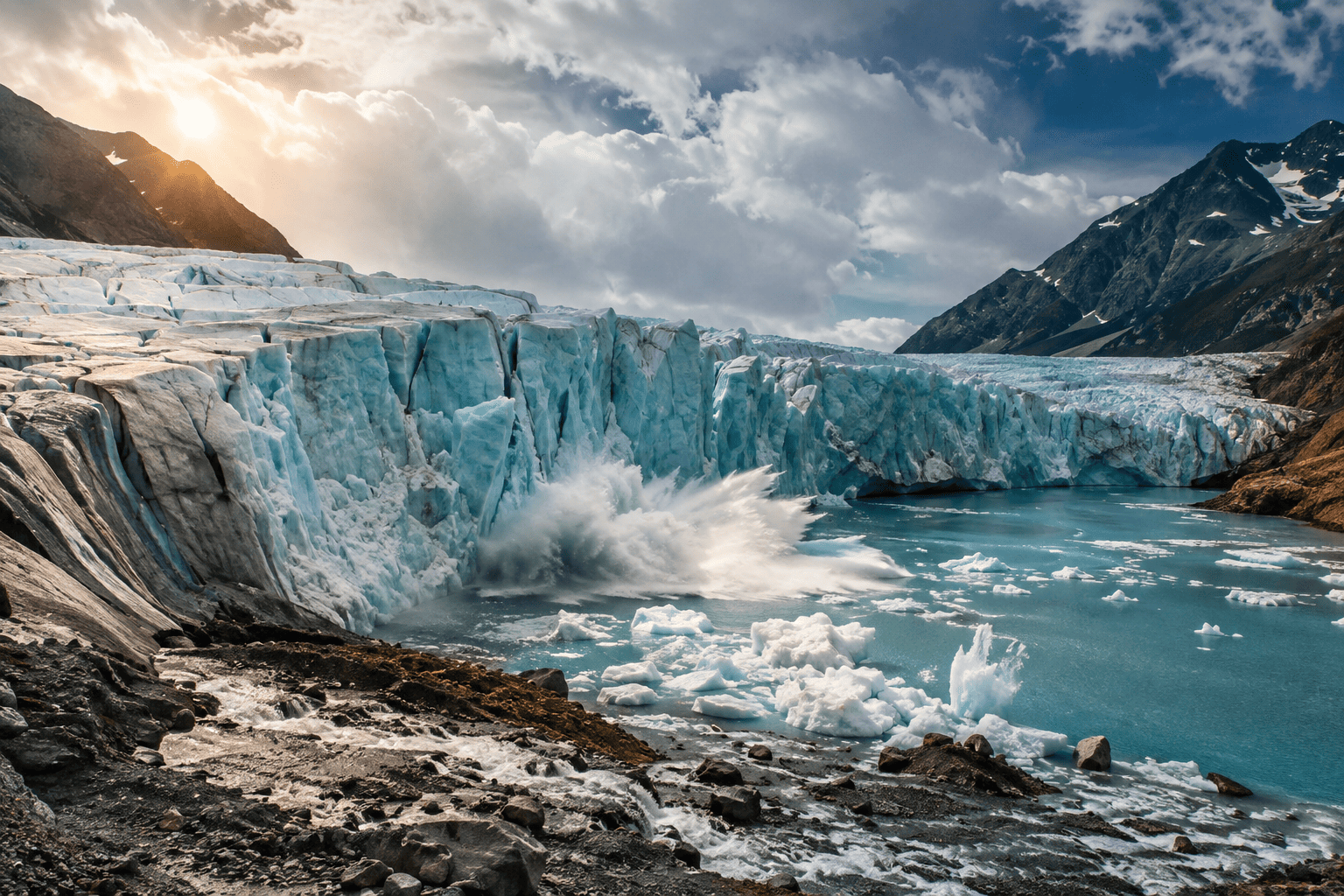
Satellite arrays and global monitoring networks have recorded a startling climate threshold. Groundbreaking research from the World Glacier Monitoring Service reveals that Earth’s mountain glaciers lost a staggering 408 gigatonnes of ice in 2025 alone, contributing over one millimeter to global sea level rise in a single year. Six of the most severe ice loss years in recorded history have all occurred within the past seven years. From the Alps to the Himalayas, scientists warning the international community agree that understanding why glaciers are melting faster is essential to preparing for unprecedented global shifts.
What Is Happening to Earth’s Frozen Reservoirs?
Understanding Massive Glacial Mass Loss
A glacier forms over centuries as annual snowfall compresses into dense, moving ice bodies. In a balanced system, winter snow accumulation replaces summer melt. Today that balance is broken. Satellite data shows that world glaciers have surrendered over nine thousand five hundred gigatonnes of ice since 1975, with annual loss rates nearly quadrupling compared to the late twentieth century. Mountain ranges in Western North America, Svalbard, Central Europe, and High Mountain Asia are suffering the most severe retreats ever documented .Climate-related disruptions can also influence global commodity markets, prompting investors to seek safe-haven assets. Read our analysis on Gold Price Prediction: Will Gold Hit a New Record? to understand how economic uncertainty can affect gold prices.
Why Glaciers Are Melting Faster in the Modern Era
The Primary Drivers Behind Accelerated Melting
The rapid acceleration of glacial decline stems directly from human activity altering the atmosphere. Fossil fuel combustion releases high concentrations of greenhouse gases, locking extra heat inside Earth’s climate system. Air temperatures are rising rapidly, extending summer melt seasons and turning historical snowfall into rain.
Ocean warming plays a destructive secondary role. Oceans absorb over ninety percent of excess global heat, which warms coastal waters and melts marine terminating glaciers from beneath. At the same time, dark particles like soot, industrial dust, and wildfire ash settle on pristine snow surfaces. This dark layer lowers ice reflectivity, causing glaciers to absorb far more solar radiation and melt at an accelerated pace. The rapid retreat of Himalayan glaciers has consequences far beyond rising temperatures. It also threatens the long-term availability of freshwater, a challenge explored in When Will India Run Out of Clean Drinking Water Permanently?, which examines the growing risks to India’s drinking water security.
What Is the Impact of Rapid Glacial Disappearance?
Rising Seas and Threat to Global Fresh Water
The global consequences of this ice loss are immediate and far reaching. Rapidly melting glaciers serve as a primary engine of sea level rise, threatening low lying coastal communities, degrading shorelines, and making storm surges far more destructive.
Inland populations face a different crisis. Glaciers act as natural water towers that feed major river systems supplying drinking water, agriculture, and power to over one billion people. As these ice reserves shrink, communities encounter acute water insecurity during dry seasons, alongside heightened risks of catastrophic flash floods when melting ice destabilizes high altitude lakes.Rising global temperatures are increasing the intensity of extreme rainfall events, which can trigger devastating landslides in vulnerable regions.Tragic Surge: The Escalating Crisis of Landslides in Kerala to learn how climate change is contributing to more frequent natural disasters in India.
How Darker Ice Makes Glaciers Melt Faster
The physical transformation of glaciers extends beyond rising ambient air temperatures. As surface ice melts, it reveals darker layers beneath while accumulating airborne soot, dust, and wildfire ash. This process severely lowers the ice surface reflectivity, causing the glacier to absorb vastly more solar radiation rather than bouncing it back into space. The resulting feedback loop accelerates internal thawing and creates meltwater channels that lubricate the glacier base, allowing massive ice masses to slide into lower, warmer altitudes at unprecedented speeds.
Why Is Glacial Melt Accelerating?
This rapid acceleration of glacial thaw is primarily driven by human activities that release high concentrations of greenhouse gases into the atmosphere, creating a global warming effect that extends summer melting seasons and turns historical snowfall into rainfall. As global air temperatures climb, warmer ocean waters undercut coastal glaciers from below, eroding their foundations and causing massive ice sheets to collapse into the sea. At the same time, industrial soot, wildfire ash, and dust particles settle across pristine ice, forming a dark surface layer that dramatically lowers the ice’s reflectivity. This causes glaciers to absorb significantly more solar energy rather than reflecting it back into space, creating a self-reinforcing feedback loop that melts ice at an unprecedented speed.
Global Preservation Protocols and Emission Commitments
Responding to this planetary crisis, international research consortia and climate leaders emphasize that slowing glacier loss requires immediate, decisive global action. The primary strategy focuses on enforcing strict global carbon reduction mandates, which remain the most direct way to stabilize atmospheric temperatures and protect remaining polar and mountain ice reserves. Under major global initiatives like the United Nations International Year of Glaciers’ Preservation, led by UNESCO and the World Meteorological Organization (WMO), world leaders are working together to improve climate policy, expand scientific monitoring, and support vulnerable mountain communities dependent on meltwater.
Rising greenhouse gas emissions are not only warming the atmosphere but also accelerating ice loss across mountain ranges and polar regions. This trend is closely linked to broader environmental issues discussed in Why Delhi Air Pollution Is Getting Worse.
At the same time, scientists and engineers are testing localized preservation strategies to slow down melting in high-risk zones. In places like the Swiss Alps, communities have used geotextile thermal blankets during warm summer months to protect specific glaciers, reflecting solar radiation and saving up to sixty percent of local ice mass. Researchers are also expanding high-tech satellite tracking arrays and AI-driven monitoring systems to predict destabilizing ice collapses and issue early warnings for downstream areas.Scientists warn that prolonged heatwaves are causing glaciers to shrink at unprecedented rates. You can also read How Extreme Heat Is Silently Rewriting Everyday European Life to understand how record temperatures are affecting communities across the globe.
A Critical Turning Point for Global Climate Action
The rapid retreat of Earth’s glaciers provides unmistakable evidence of a planet undergoing swift transformation. International climate researchers stress that while historical ice loss cannot be undone, immediate reductions in global carbon emissions can slow the pace of future thawing. Protecting these vital frozen landscapes is no longer a challenge for future generations, but an urgent operational imperative for the world today.
Leave a Reply