
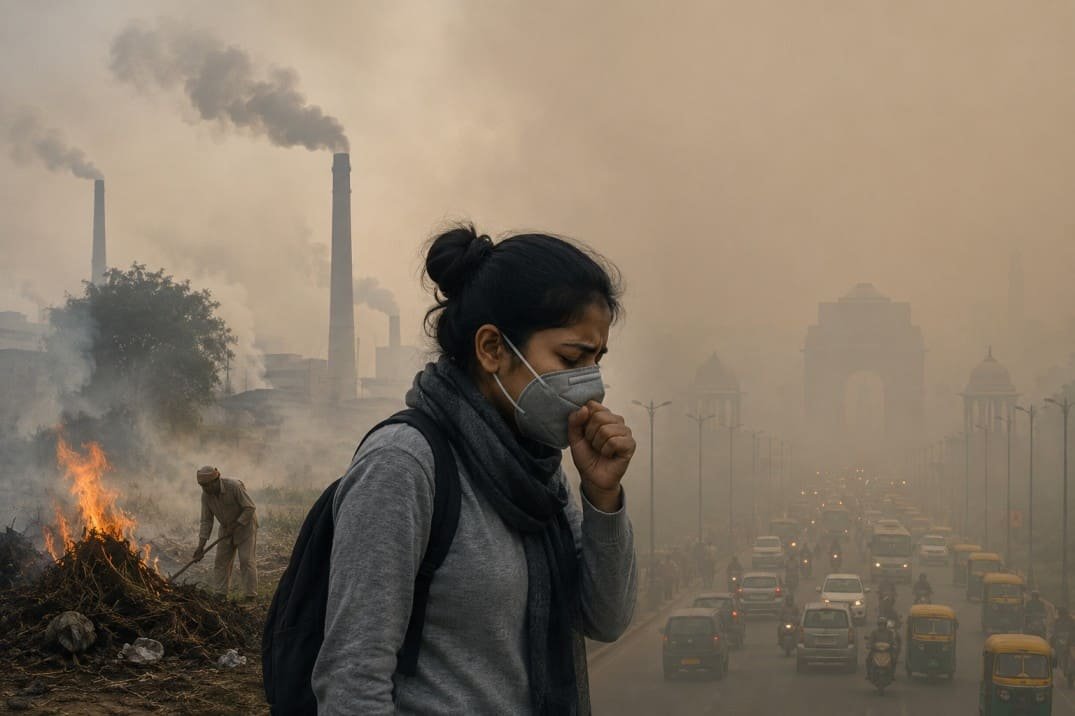
Delhi air pollution refers to the hazardous accumulation of toxic airborne contaminants, fine particulate matter like PM2.5 and PM10, nitrogen dioxide, and carbon monoxide in the atmosphere of the National Capital Region.
Fine particulate matter consists of tiny solid particles or liquid droplets that are 2.5 micrometers or smaller in diameter. These microscopic particles are small enough to pass through throat passages and enter deep into human lungs and bloodstreams.
The measurement of this contamination relies on the Air Quality Index, which categorizes air safety from good to severe and hazardous. During peak winter months, the Air Quality Index in Delhi frequently breaches 400 or 500, which represents levels over ten times higher than safe international guidelines. The air becomes a dense mixture of vehicular exhaust, industrial fumes, road dust, and smoke from agricultural burning. Air pollution and greenhouse gas emissions contribute to global warming, which is accelerating the loss of ice worldwide. Read Why Glaciers Are Melting Faster Than Ever Before to understand how rising temperatures are transforming glaciers and affecting global sea levels.
Why Is Delhi Air Pollution Getting Worse?
The primary reason Delhi air pollution keeps escalating involves a combination of geographical features, weather patterns, and human activities. Delhi sits in a landlocked basin within the Indo Gangetic Plain. During colder months, temperature inversion occurs, where a layer of warm air traps cold, heavy air near the ground.
Air pollution is no longer just an environmental issue,it has become a major public health crisis, increasing the risk of respiratory and cardiovascular diseases, especially among children and older adults
Wind speeds drop significantly, preventing airborne pollutants from dispersing. It is a culmination of various reasons that have been listed below. We often, Blame that delhi is the most polluted city but we never deep dive into the reason why it is happening. Be it from burning of crops,Construction and dust particles or it being one of the most over poppulated cities in the world.
- Vehicular Growth: Millions of private cars and commercial diesel vehicles hit the roads daily, constantly releasing high levels of tailpipe emissions.
- Construction and Dust: Uncontrolled construction activities across the expanding metropolis generate massive volumes of ambient road dust.
- Crop Residue Burning: Neighboring agricultural areas clear millions of tons of paddy straw during autumn harvests, carrying heavy smoke plumes directly into the capital.
- Industrial Emissions: Brick kilns and manufacturing units around neighboring suburban towns burn fossil fuels continuously.
Impact of Delhi Air Pollution
The human and economic cost of deteriorating air quality is devastating. Prolonged exposure to toxic air significantly reduces life expectancy for residents across all age groups. Medical studies indicate that breathing Delhi’s winter air for a single day can be equivalent to smoking up to twenty cigarettes. Rising temperatures, changing wind patterns, and prolonged heatwaves are making it easier for pollutants to accumulate over urban areas.
Children and senior citizens face the highest risk of developing chronic respiratory conditions such as bronchitis, asthma, and reduced lung capacities. Beyond physical health, daily business operations, outdoor labor, tourism, and school schedules suffer frequent disruptions when emergency lockdown measures are enforced to control emergency smoke levels.
- Physical Discomfort: Residents frequently voice distress over constant throat irritation, stinging eyes, and breathing difficulties. Parents report anxiety over sending young children to outdoor sports, while morning walkers find themselves abandoning routine exercise to avoid breathing toxic air.
- Social Media Outrage: Keywords like “gasping for air” trend online every winter as people post photos of near zero visibility around landmark sites. Citizens actively demand policy action, emphasizing that breathing clean air is a basic necessity rather than a privilege.
- Forced Lifestyle Shifts: Middle class households invest heavily in indoor air purifiers and specialized masks, while outdoor workers and daily wage laborers bear the direct burden of prolonged exposure without dynamic protection options.
Government Actions: Enforcement, Policies, and Interventions
In response to public demands and environmental directives, state and central authorities implement multi-pronged strategies aimed at controlling pollution sources across the National Capital Region.
- Strict Emission Regulations: Authorities enforce stringent vehicle checks, barring non-compliant older vehicles from entry and implementing strict “No PUC, No Fuel” policies at refueling stations.
- Dust Control Measures: The administration deploys fleets of anti-smog guns, mechanical road sweepers, and water sprinklers across high-density hotspots to suppress airborne particulate matter. Construction activities face temporary bans during peak hazard windows.
- Long-Term Transition: Long-term measures include rapidly expanding the electric bus network, scaling EV charging infrastructure, closing polluting industrial units, and promoting non-chemical alternatives to crop burning in neighboring agricultural zones.
Lessons from Beijing’s “War Against Pollution”
Beijing stands as the most prominent example of a city that successfully battled an air pollution crisis identical to Delhi’s, transforming its heavy “Airpocalypse” smog through a massive $120 billion “War Against Pollution” launched in 2013. Facing a similar combination of coal reliance, rapid vehicular growth, and geographical air-trapping terrain, China aggressively replaced domestic coal heating with natural gas, capped new vehicle registrations, relocated heavy industries outside the city, and enforced strict accountability for local officials. As a result, Beijing cut its fine particulate matter (PM2.5) levels by over 40% in less than a decade, proving that targeted policy enforcement, heavy green investment, and structural regional changes can dramatically reverse severe atmospheric degradation.
Road Ahead for battling Delhi’s air pollution
Despite ambitious government policies, the ground reality of Delhi’s air pollution reveals a profound execution gap, where anti-smog measures are largely concentrated in high-profile areas while dense neighborhoods, landfill fires, and nighttime construction go unmonitored. This creates a severe socio-economic divide that leaves street vendors, daily wage laborers, and outdoor workers breathing toxic air for twelve hours a day without access to purifiers or protective equipment, proving that seasonal advisories and paper-based restrictions cannot protect the capital’s most vulnerable residents without rigorous, citywide enforcement.
Leave a Reply