
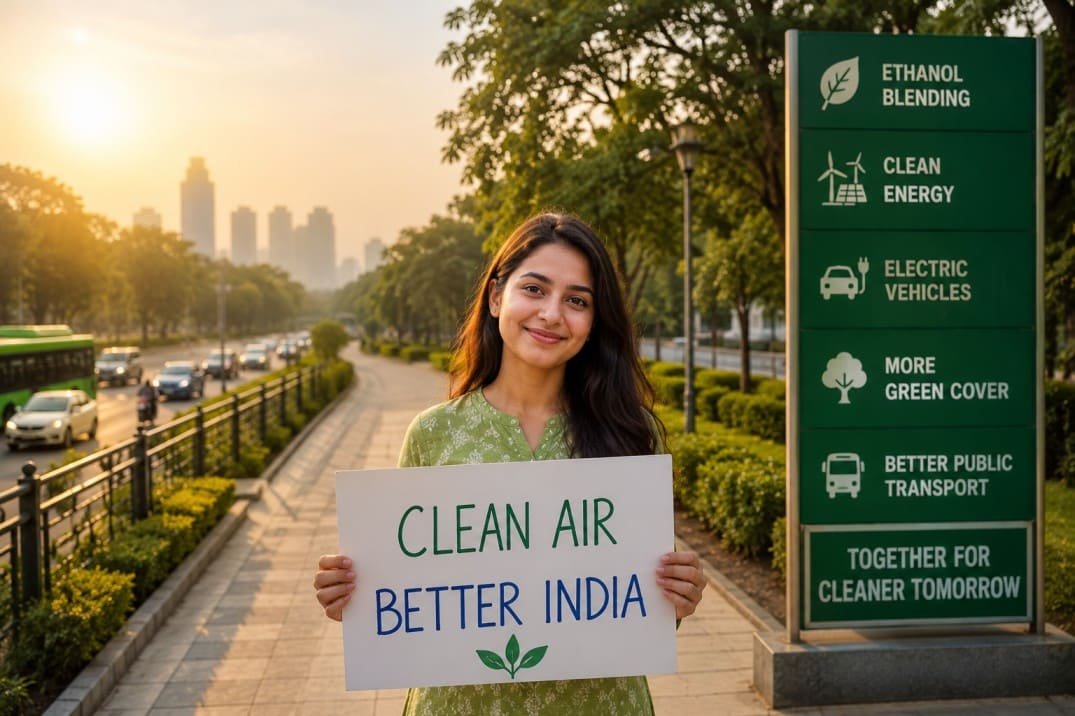
Air pollution has become one of India’s biggest public health and environmental challenges. Every winter, cities like Delhi dominate global headlines for hazardous air quality, while smaller towns and industrial regions quietly battle rising pollution levels throughout the year. Vehicle emissions, coal-fired power plants, construction dust, agricultural stubble burning, and industrial activities all contribute to poor air quality.
Yet India is not standing still. Over the past decade, the government has introduced several ambitious initiatives aimed at reducing pollution while supporting economic growth. These include increasing ethanol blending in petrol, adopting cleaner fuel standards, expanding electric mobility, investing in green energy, and implementing the National Clean Air Programme (NCAP). At the same time, India is building thousands of kilometres of highways, expressways, bridges, and tunnels to improve connectivity.
This has created an interesting paradox. Can a country reduce pollution while simultaneously constructing massive infrastructure projects that generate dust, consume natural resources, and sometimes trigger environmental concerns such as landslides?
The answer is more complex than a simple yes or no. Some initiatives are already delivering measurable benefits, while others raise important questions about balancing development with environmental sustainability. Environmental factors are increasingly contributing to chronic illnesses among younger populations, particularly in heavily polluted urban areas. Learn more about the causes and long-term health impacts in Why Delhi Air Pollution Is Getting Worse
Why Air Pollution Remains One of India’s Biggest Challenges
According to the World Health Organization (WHO) and reports from IQAir, several Indian cities continue to record some of the world’s highest concentrations of PM2.5 particles, which are small enough to enter the bloodstream and damage vital organs. Air pollution affects far more than the environment. It contributes to respiratory illnesses, heart disease, reduced agricultural productivity, and significant economic losses through higher healthcare costs and lower workforce productivity. The primary sources of pollution vary across regions but commonly include vehicle exhaust, coal-based electricity generation, industrial emissions, construction activities, road dust, waste burning, diesel generators, and seasonal crop residue burning. Recognising these challenges, India has adopted multiple policies designed to tackle emissions from different sectors rather than relying on a single solution.
For more environmental and technology updates, visit PrabhNews Technology section
The National Clean Air Programme Is India’s Biggest Air Pollution Mission
Launched in 2019, the National Clean Air Programme (NCAP) represents India’s first nationwide strategy to improve air quality across hundreds of cities.Rather than focusing on a single source of pollution, NCAP encourages cities to prepare local action plans based on their specific pollution profile.These plans include increasing green spaces, improving public transport, reducing construction dust, monitoring industrial emissions, modernising waste management, and strengthening pollution monitoring networks.The programme also encourages greater cooperation between state governments, pollution control boards, municipal authorities, and research institutions.
Although implementation varies across cities, NCAP has significantly increased awareness and investment in urban air quality management.
How Ethanol Blending Helps Reduce Vehicle Emissions
One of India’s most important fuel reforms has been the rapid expansion of ethanol blending.Instead of relying entirely on petrol, India now mixes increasing amounts of ethanol produced from sugarcane, maize, and other agricultural feedstocks.Because ethanol contains oxygen, it promotes cleaner combustion inside vehicle engines, helping reduce emissions of carbon monoxide and certain harmful pollutants.The government has accelerated its Ethanol Blended Petrol (EBP) Programme with the goal of reducing dependence on imported crude oil while supporting farmers through additional income opportunities.The initiative also contributes to India’s climate commitments by lowering lifecycle greenhouse gas emissions from transport fuels.However, experts caution that ethanol is not a complete solution. Large-scale production requires land, water, and agricultural resources, making sustainable feedstock management essential.
Learn more about India’s biofuel initiatives that have officially launched in the recent times by government of India.
Cleaner Fuel Standards Have Already Reduced Vehicle Pollution
Another major success has been the nationwide implementation of Bharat Stage VI (BS-VI) emission standards. BS-VI fuel contains significantly lower sulphur levels than previous standards, allowing modern engines to emit fewer harmful pollutants.Compared with older diesel vehicles, BS-VI compliant engines produce substantially lower emissions of nitrogen oxides and particulate matter.This transition required massive investments by oil companies, automobile manufacturers, and fuel distributors, making it one of India’s largest environmental upgrades in the transport sector.Combined with stricter vehicle emission testing, BS-VI has helped improve urban air quality despite increasing vehicle ownership.
Electric Vehicles Are Becoming an Important Part of the Solution
India’s electric vehicle market is growing rapidly.Government incentives under schemes such as FAME have encouraged manufacturers and consumers to adopt electric two-wheelers, buses, and passenger vehicles.Electric mobility offers significant advantages in densely populated cities because electric vehicles produce zero tailpipe emissions.When combined with cleaner electricity generation through solar and wind energy, electric transport can substantially reduce urban pollution. However, experts note that the environmental benefits depend on how electricity is generated. As India’s renewable energy capacity continues expanding, electric vehicles are expected to become even cleaner.
Prabh News more on business and infrastructure developments.
Highways Improve Traffic Flow but Create New Environmental Questions
India is building highways at an unprecedented pace. Projects such as the Delhi-Mumbai Expressway and Bharatmala Pariyojana aim to improve connectivity, reduce logistics costs, and shorten travel times across the country. Better roads can reduce traffic congestion, allowing vehicles to spend less time idling in slow-moving traffic. This can lower fuel consumption and reduce emissions per journey.
However, transportation researchers point to a phenomenon called induced demand.
When road capacity increases, more people begin using private vehicles because travelling becomes easier. Over time, this can increase total traffic volumes, offsetting many of the initial environmental gains.Highway construction itself also produces considerable dust, consumes large quantities of cement and steel, and often requires tree removal.As a result, highways can simultaneously reduce local congestion while increasing broader environmental pressures if not accompanied by strong public transport policies.
Bridges and Flyovers Are Not Always the Pollution Solution
Urban planners have long debated whether flyovers and bridges genuinely solve congestion.In the short term, they often reduce bottlenecks and improve traffic flow at busy intersections.But over time, many cities experience renewed congestion because improved roads encourage additional vehicle ownership. Several studies have shown that sustainable urban mobility depends not only on road expansion but also on reliable public transport, cycling infrastructure, pedestrian-friendly streets, and mixed-use city planning.Without these complementary measures, flyovers alone cannot permanently solve air pollution.
Himalayan Highways, Bridges and Landslides: The Environmental Trade-Off
India’s infrastructure boom has transformed connectivity in remote regions, particularly in the Himalayas. Projects such as the Char Dham Highway, new railway tunnels, and mountain bridges have reduced travel time, improved tourism, and strengthened border infrastructure. These projects are also essential for disaster response and national security.
However, construction in fragile mountain ecosystems comes with significant environmental risks. Widening roads often involves cutting slopes, blasting rocks, and removing forests that naturally stabilize hillsides. During the monsoon, these disturbed landscapes become more vulnerable to landslides, soil erosion, and flash floods. Scientists have repeatedly warned that climate change, combined with rapid infrastructure development, increases the likelihood of slope failures in the Himalayan region. This does not mean development should stop, but it highlights the need for environmentally sensitive engineering, better drainage systems, and stricter geological assessments before construction begins.
The challenge for policymakers is finding a balance between improving connectivity and protecting one of the world’s most fragile ecosystems.
Construction Dust Remains a Major Source of Urban Air Pollution
While vehicles often receive most of the attention, construction activities contribute significantly to air pollution in India’s rapidly growing cities.
Dust generated during road construction, metro expansion, flyover projects, and real estate development releases large amounts of particulate matter into the atmosphere. Fine dust particles can travel several kilometres, affecting nearby residential areas and increasing respiratory illnesses.
Many cities now require construction sites to install dust barriers, sprinkle water regularly, cover construction materials, and monitor emissions. Authorities have also introduced penalties for developers who fail to follow environmental guidelines.Although enforcement remains inconsistent, stricter regulations are gradually improving construction practices in several metropolitan areas.
Renewable Energy Is Helping India Reduce Pollution
One of India’s biggest environmental achievements has been the rapid expansion of renewable energy.
Over the past decade, the country has become one of the world’s largest producers of solar power while significantly increasing wind energy capacity. Every megawatt of renewable electricity reduces dependence on coal-fired power plants, which are among the largest contributors to air pollution.
India has also launched the National Green Hydrogen Mission, aiming to produce clean hydrogen using renewable electricity. Green hydrogen has the potential to reduce emissions in industries such as steel, cement, fertilisers, and heavy transport, where electrification alone may not be sufficient. As renewable energy becomes a larger share of the electricity mix, cleaner transport options such as electric vehicles will also become more environmentally beneficial.
India’s renewable energy initiatives launched by the government to take a step towards cleaner environment.
Trees and Green Spaces Are Still One of the Best Pollution Filters
Infrastructure development often requires the removal of trees, raising concerns among environmentalists and local communities.
To offset this impact, governments and project authorities carry out compensatory afforestation programmes, where new trees are planted to replace those removed during construction. While these initiatives are important, newly planted forests cannot immediately replace the ecological benefits of mature trees.
Urban green belts, parks, roadside plantations, and restored forests help absorb carbon dioxide, trap dust particles, reduce urban heat, and improve overall air quality. Experts increasingly argue that future infrastructure projects should integrate green corridors rather than treating environmental restoration as an afterthought.
Is India Actually Solving Its Air Pollution Problem?
The answer depends on how success is measured.
India has undoubtedly introduced several ambitious policies that are moving the country in the right direction. Ethanol blending, BS-VI fuel standards, electric mobility, renewable energy, cleaner industrial regulations, and the National Clean Air Programme have created a stronger foundation for improving air quality. At the same time, rapid urbanisation, rising vehicle ownership, expanding infrastructure, industrial growth, and increasing energy demand continue to place enormous pressure on the environment.
Air quality has improved in some cities during certain periods, while others continue to experience severe pollution episodes, particularly during winter months. Rather than viewing India’s efforts as either a complete success or a failure, it is more accurate to describe them as an ongoing transition. The country is making meaningful progress, but sustained implementation, stronger enforcement, and greater public participation will determine long-term outcomes.
For more global environmental and policy developments,
What More Needs to Be Done?
Reducing air pollution requires coordinated action across multiple sectors. Experts believe India should continue expanding public transport, accelerate the shift to cleaner energy, strengthen pollution monitoring, encourage sustainable farming practices, improve waste management, and promote cleaner industrial technologies.
Equally important is greater public awareness. Citizens can contribute by using public transport, maintaining vehicles properly, avoiding waste burning, conserving energy, and supporting local environmental initiatives. Clean air cannot be achieved through government policies alone. It requires cooperation between policymakers, businesses, scientists, and the public.
Conclusion
India’s fight against air pollution is one of the most ambitious environmental challenges in the world.
Policies such as ethanol blending, BS-VI fuel standards, renewable energy expansion, electric mobility, and the National Clean Air Programme demonstrate that the country is actively investing in cleaner technologies and sustainable development. At the same time, rapid construction of highways, bridges, and urban infrastructure illustrates the difficult balance between economic growth and environmental protection. While improved transport networks can reduce congestion and support development, they also create new environmental pressures that must be carefully managed.
Ultimately, India’s air pollution strategy is not defined by a single policy or project. It is the combined impact of cleaner fuels, smarter cities, stronger regulations, greener energy, and environmentally responsible infrastructure that will determine whether future generations breathe cleaner air.The journey has begun, but solving air pollution will require continuous innovation, scientific planning, and long-term commitment.
Leave a Reply