
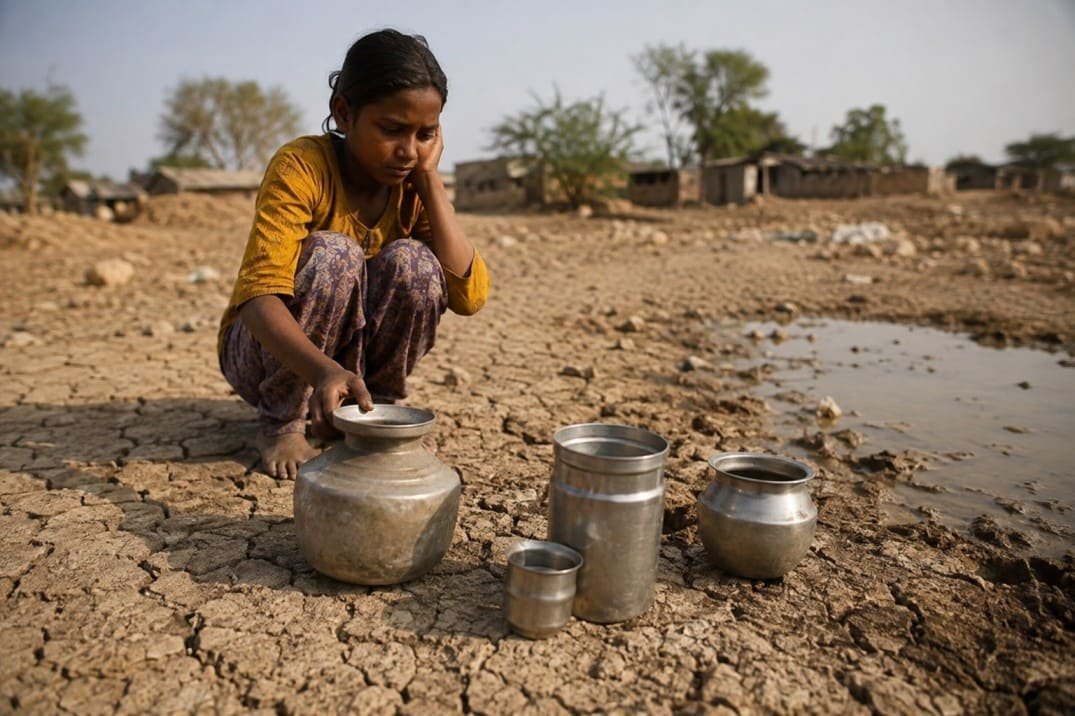
The morning sun rises over quiet streets where millions of citizens line up with empty containers, waiting for water tankers that arrive irregularly. Taps across rural villages and metropolitan hubs are running dry, confirming that freshwater access is diminishing rapidly across the nation.The question of when safe water will completely disappear hinges on current depletion rates. With current trends, major aquifers could reach irreversible exhaustion within decades if structural shifts are not enacted immediately.
What is the Freshwater Crisis and the Data Behind It
India supports nearly eighteen percent of the global population while holding only four percent of global freshwater resources. According to national water management studies, over six hundred million people face high to extreme water stress. Approximately two hundred million citizens lack access to safe drinking supply, while nearly seventy percent of the country’s surface water remains severely polluted. India has become the world’s largest consumer of groundwater, extracting more than twenty five percent of the global total. Furthermore, annual per capita water availability has dropped below fifteen hundred cubic meters, pushing the nation into severe water stress territory.
Unsustainable extraction for agricultural activities accounts for more than eighty percent of total freshwater consumption. Government subsidies for electricity encourage deep pumping for water intensive crops like rice and sugarcane in naturally arid regions. Unregulated private borewells continue to drill deeper into fossil aquifers that take thousands of years to recharge .One of the biggest threats to India’s long-term water security is the rapid loss of Himalayan glaciers. Our article, Why Glaciers Are Melting Faster Than Ever Before, explains how rising temperatures are reducing one of the country’s most important sources of freshwater.
At the same time, rapid urban expansion replaces natural wetlands and lakes with concrete surfaces, blocking rain percolation into the ground. Climate variability accelerates this shift as erratic monsoons, prolonged drought spells, and warmer temperatures reduce overall groundwater recharge rates.
Repercussion and Impact on People and Economy
The human toll of this crisis is devastating. Inadequate access to safe drinking water leads to roughly two hundred thousand deaths annually from waterborne diseases. Toxic contaminants like arsenic and fluoride build up in deep groundwater, causing permanent health conditions.
Socially, the burden falls disproportionately on women and young girls who spend hundreds of hours annually collecting water from distant sources, leading to reduced school attendance and lost economic output. From an economic perspective, severe water scarcity threatens agricultural productivity, risks food security for over one billion people, and could result in up to a six percent contraction in national gross domestic product. Climate change is not only increasing water scarcity but also intensifying extreme weather events, as discussed in Tragic Surge: The Escalating Crisis of Landslides in Kerala, highlighting the growing environmental challenges facing India.
Which Indian Cities Face the Highest Risk of Reaching Zero Water Status
Major urban centers including Bengaluru, Chennai, Hyderabad, and Delhi face severe risks of running out of usable groundwater.
Rapid population expansion combined with severe over extraction has severely depleted local aquifers in these metropolitan areas. During summer months, municipal authorities rely heavily on distant reservoirs and emergency water transport to meet basic daily human requirements. However, when the climate change has been occuring at a pace where essential needs are also not met in times of crises. Recently many incidents have happened in metro cities like Mumbai the residents even did not have even enough drinking water. Since the pressure of population is more on these metro cities, lack of awarness, Strict Implementation by the government makes the matter even worse.
What Roles Do Individual Citizens Play in Mitigating National Scarcity
Every individual can contribute to water conservation by implementing household rainwater harvesting systems and minimizing daily waste. Installing low flow plumbing fixtures, fixing leaks promptly, and adopting water efficient lifestyle choices reduce pressure on municipal supplies. Community participation in restoring local lakes, ponds, and green spaces helps replenish neighborhood groundwater tables naturally. If an Individual Starts taking precaution from their home, slowly and steadily the practices can bring a huge change is restoration of water.
How Can India’s Clean Drinking Water Be Restored?
Although the challenges are severe, India can still protect and restore its clean drinking water resources through sustained action. Large-scale rainwater harvesting, groundwater recharge projects, wetland and river restoration, and stricter regulation of industrial pollution can significantly improve water availability and quality.
Modern irrigation methods such as drip and sprinkler systems can reduce agricultural water waste, while wastewater treatment and recycling can lessen the pressure on freshwater sources. Protecting forests and Himalayan ecosystems is equally important, as they play a crucial role in maintaining rivers and groundwater recharge.
Public awareness, responsible water use, and stronger enforcement of environmental laws will also be essential. By combining government policy, technological innovation, community participation, and sustainable water management practices, India can slow the depletion of its freshwater resources and secure clean drinking water for future generations rather than facing permanent scarcity.
The Strategic Path Forward for saving India’s water resources
The path forward requires immediate adoption of circular water treatment, rain harvesting, and crop diversification, as protecting natural aquifers today is the only way to ensure future generations retain access to life-giving water. Because agriculture accounts for roughly eighty percent of total national freshwater consumption, shifting away from water-guzzling crops like paddy rice which consumes up to five thousand six hundred liters of water per kilogram producedand expanding micro-irrigation could deliver twenty to forty-eight percent in overall farm water savings. However, with only about sixteen percent of the country’s total micro-irrigation potential realized so far, scaling adoption through schemes like Pradhan Mantri Krishi Sinchayee Yojana remains critical.

Leave a Reply