
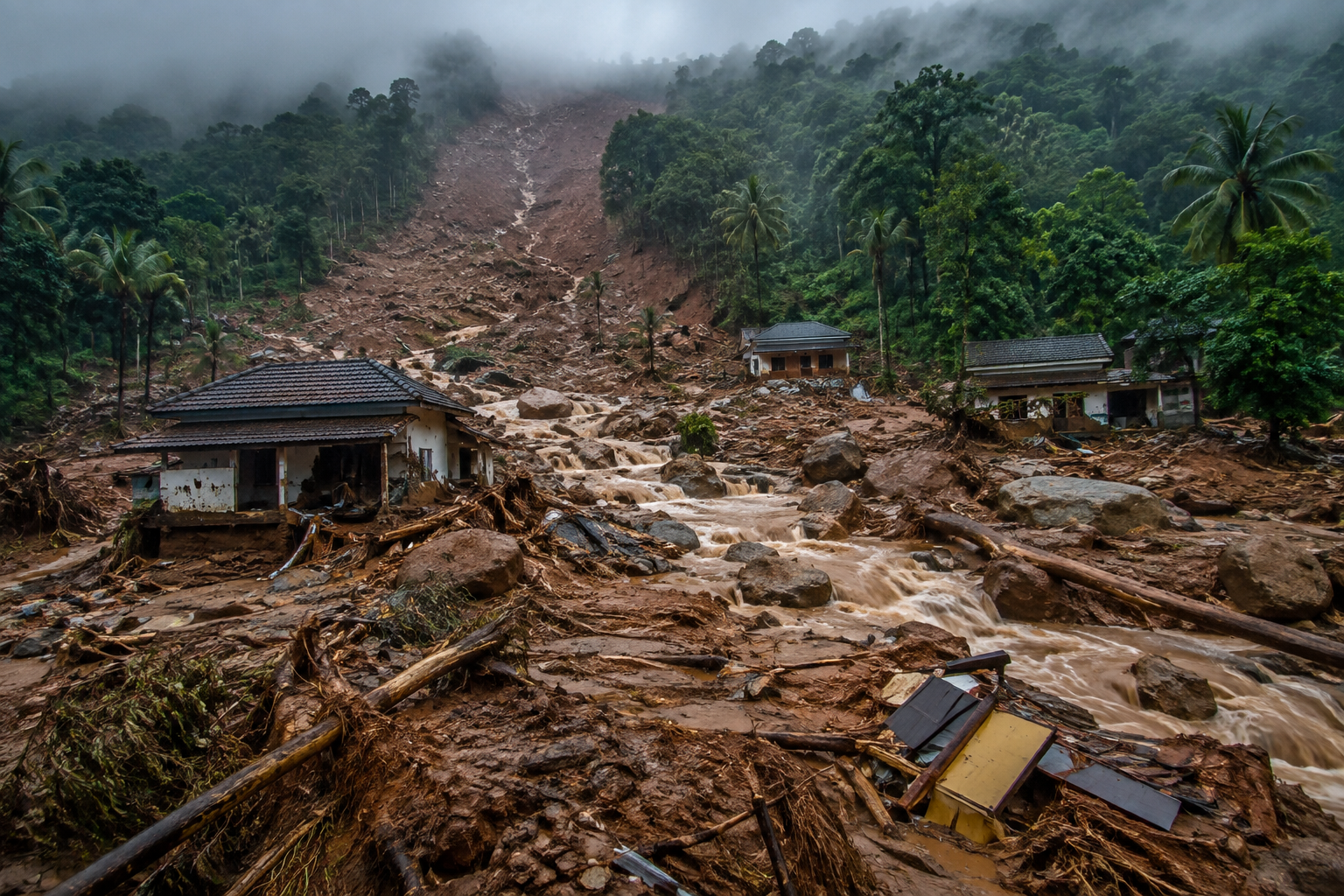
Under monsoon skies, tragedy repeatedly strikes the Western Ghats as massive hillsides collapse onto vulnerable communities below. Recent catastrophes have transformed scenic landscapes into emergency response zones, forcing authorities, scientists, and citizens to confront a rapidly growing ecological and humanitarian crisis.
What Are Landslides in Kerala?
Landslides in Kerala are sudden, destructive downward movements of soil, boulders, mud, and organic debris triggered primarily by heavy, continuous precipitation along steep terrain. The high-altitude regions of the Western Ghats, spanning districts such as Wayanad, Idukki, Kozhikode, and Pathanamthitta, feature steeply sloping hills capped by weathered soil layers resting atop impermeable bedrock. When rainwater completely saturates this top layer, friction disappears, causing millions of tons of earth to rush downhill at terrifying speeds.
The catastrophic disaster in July 2024 served as a stark reminder of this geological hazard. Severe twin debris flows swept through the villages of Chooralmala and Mundakkai in Wayanad district, resulting in over four hundred fatalities, leaving hundreds missing, and completely eradicating thriving rural settlements. These occurrences are no longer isolated events; rather, they represent a recurring environmental hazard across northern and central Kerala during every major monsoon season.Environmental challenges in India extend beyond air pollution. Tragic Surge: The Escalating Crisis of Landslides in Kerala explores how changing weather patterns and heavy rainfall are increasing the risk of deadly landslides across the country.
On the night of July 30, 2024, a massive series of landslides struck the villages of Punjirimattom, Mundakkai, Chooralmala, and Vellarimala in Wayanad district:
- Scale of Impact: It was one of the deadliest disasters in Kerala’s history, resulting in over 420 fatalities, hundreds of injuries, and significant property destruction.
- Velocity & Debris: According to the Geological Survey of India (GSI), the debris flow originated at an elevation of 1,544 meters and surged at speeds up to 57 m/s (~200 km/h), sweeping away homes, bridges, roads, and tea plantations.
- Isolation of Communities: Crucial access bridges collapsed, leaving hundreds of families stranded in Mundakkai and nearby hamlets until rescue teams (NDRF, Indian Armed Forces, local volunteers) constructed emergency crossings.
Why Are Landslides in Kerala Occurring Frequently?
The accelerating frequency of landslides in Kerala stems from a volatile mixture of changing global climate patterns and regional land manipulation. Scientists point toward rapidly warming surface temperatures in the southeastern Arabian Sea as a primary catalyst. This oceanic warming creates atmospheric instability, leading to cloudburst-like events where extreme rainfall is concentrated over small geographic areas within very short windows. During the Wayanad tragedy, affected zones received over five hundred millimeters of rain within forty-eight hours, far exceeding the structural capacity of the soil .Scientists warn that climate change is intensifying rainfall patterns, making landslides more frequent in vulnerable regions. To understand another major consequence of global warming, Why Glaciers Are Melting Faster Than Ever Before.
Simultaneously, human activities have compromised the natural resilience of the hills. Unregulated slope excavation for construction, extensive quarrying operations using heavy explosives, and widespread deforestation have destabilized fragile mountain zones. The historical replacement of deep-rooted native rainforest vegetation with commercial cash crops like tea, coffee, and rubber has significantly altered natural root networks that once held topsoil firmly in place. Furthermore, blocked natural stream paths and unscientific drainage systems prevent proper runoff, building extreme pore water pressure within mountain slopes until they inevitably burst.M ajor natural disasters often create economic uncertainty, which can drive investors toward safer assets like gold. Learn more in our article Gold Price Prediction: Will Gold Hit a New Record? to see how global events can impact gold price trends.
What Is the Impact of Landslides in Kerala?
The structural impact of landslides in Kerala stretches far beyond immediate physical destruction, creating deep socioeconomic and ecological ripples across the state. The primary toll involves heavy human mortality, widespread physical trauma, and the sudden displacement of entire township populations into relief camps. Families lose generations of built wealth, ancestral homes, and agricultural properties overnight.
Economically, these natural disasters paralyze local financial networks. Key infrastructure, including bridges, highways, power grids, and drinking water supply networks, suffers total destruction. The tea and coffee plantation sectors, which provide employment for thousands of daily wage laborers, face severe disruption as topsoil washes away alongside agricultural machinery. The regional tourism industry, a major pillar of Kerala economy, experiences sharp downturns following publicity surrounding landslide risks.Kerala’s landslides are part of a larger environmental crisis affecting India. Learn more about another pressing issue in Why Delhi Air Pollution Is Getting Worse, which explores the impact of pollution and greenhouse gas emissions on the country’s climate.
Rebuilding Security in High Risk Zones
As massive rehabilitation and rescue efforts continue across impacted districts, long-term safety demands immediate and decisive intervention. State planners must strictly enforce eco-sensitive zone guidelines, restrict heavy developmental activity along vulnerable mountain contours, and implement advanced early warning radar systems to monitor localized rainfall intensity. Sustainable land management, reforestation of critical catchments, and community-based disaster response frameworks will ultimately determine whether high-risk hill communities can survive future extreme weather events.
The escalating crisis of landslides in Kerala serves as a stark reminder of the delicate balance between human development and fragile ecosystems. Mitigating this risk requires moving beyond reactive disaster response toward proactive, long-term resilience. Extreme weather events such as landslides, floods, and changing rainfall patterns can severely impact freshwater resources and water quality. Learn more in When Will India Run Out of Clean Drinking Water Permanently?, which explores the long-term challenges facing India’s water supply and the steps needed to protect i
By combining scientific hazard mapping and early warning systems with sustainable land-use policies, bio-engineering drainage solutions, and active community participation, Kerala can build a robust defense against climate-induced disasters. Protecting the Western Ghats is not just an environmental imperative,it is fundamental to safeguarding lives, infrastructure, and the future of the state.

Leave a Reply