
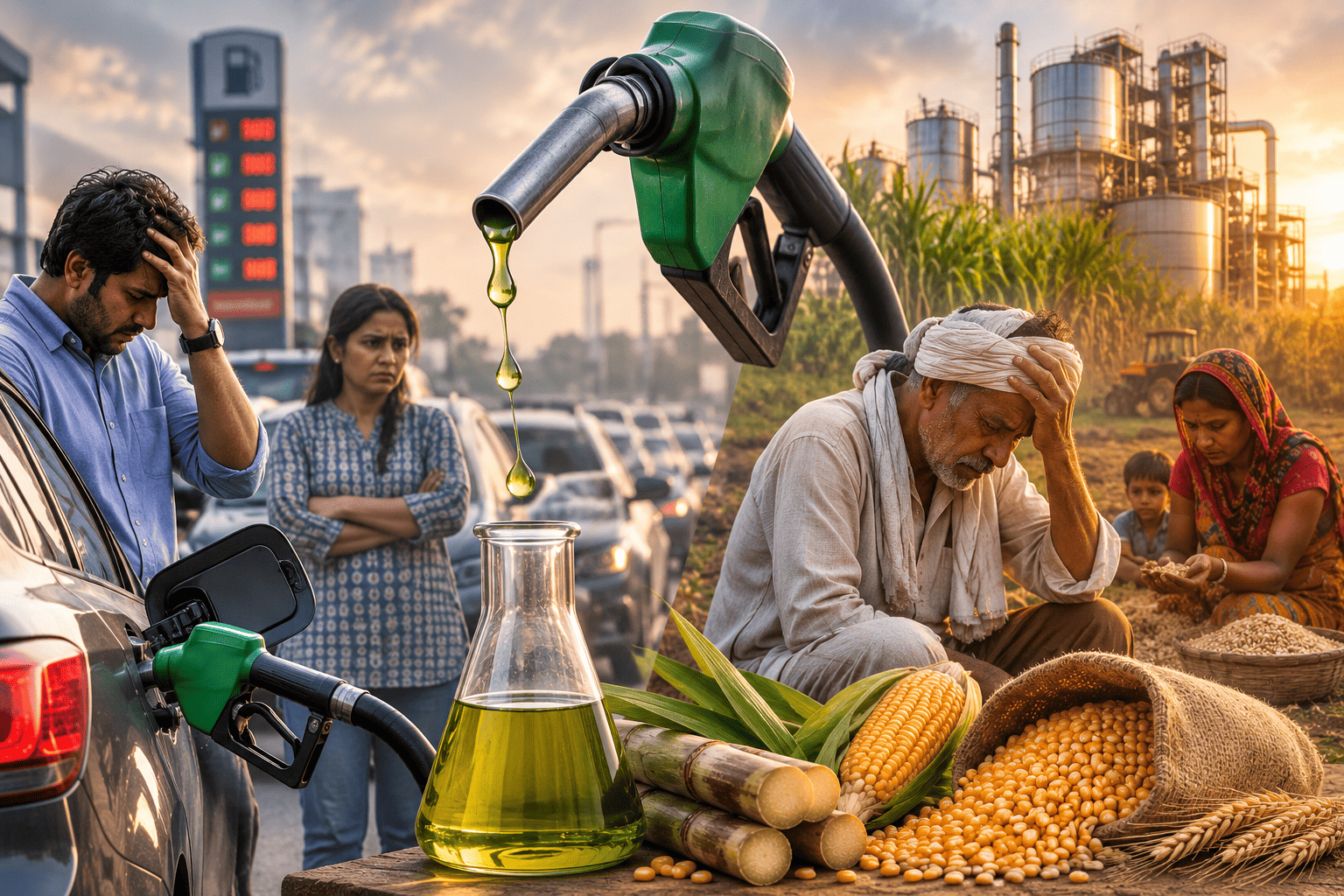
At the heart of this unfolding story is a complex web of intersecting issues: a rapid transition to high-blend ethanol fuel, growing consumer complaints about damaged engines, and profound warnings regarding national food security. While the central government vigorously defends its policy as a triumph of green engineering and energy independence, critics claim that millions of citizens have been turned into involuntary participants in a massive fuel trial. As the country moves deeper into the 2026 supply cycle, the debate has evolved from a technical policy dispute into a mainstream consumer movement, sparking political friction and social media outcry across the country.
The E20 Petrol Policy and the Path to India’s Fuel Revolution
To trace the origins of the current debate, one must look at the unprecedented acceleration of the National Policy on Biofuels. In a bid to slash India’s massive crude oil import bills and curb carbon emissions, the union government aggressively advanced its target for achieving a twenty percent ethanol blend in gasoline. Originally slated for completion by 2030, the milestone was dramatically brought forward to the 2025–26 supply year. By mid-2025, officials proudly announced that the milestone had been met ahead of schedule, with E20 fuel becoming the mandatory baseline standard at petrol stations across India.
The speed of this rollout is unmatched globally.
While ethanol giants like Brazil and the United States spent decades gradually building their biofuel infrastructure and optimizing vehicle fleets, India transitioned from a maximum ten percent blend to a mandatory twenty percent blend in a remarkably short timeframe. This sudden leap was hailed by proponents as a historic victory for domestic energy security.
Learn how escalating US–Iran Tensions Rising: Fuel Prices & Shipping Routes Impact could affect crude oil supplies, shipping routes, and petrol prices worldwid
Does E20 Fuel Damage Older Car Engines in India?
E20 fuel, a blend of 20% ethanol and 80% petrol, has been introduced in India to reduce crude oil imports and lower carbon emissions. However, not all older vehicles were designed to run on higher ethanol blends. Cars manufactured before manufacturers introduced E20-compatible engines may experience issues such as deterioration of rubber seals, fuel hoses, gaskets, and certain metal components over prolonged use. Ethanol also absorbs more moisture than conventional petrol, which can contribute to corrosion in older fuel systems if they are not designed for higher ethanol content. While occasional use may not cause immediate damage, long-term use of E20 in non-compatible vehicles could lead to reduced engine performance, fuel system wear, and increased maintenance costs.
Which Indian Cars Are Not Compatible with 20% Ethanol Petrol?
Most passenger vehicles manufactured before automakers began certifying E20 compatibility may not be fully suited for E20 fuel. This generally includes many Maruti Suzuki, Hyundai, Tata Motors, Mahindra, Honda, Toyota, Renault, Nissan, Volkswagen, Skoda, and Kia models produced before their respective E20-ready updates. Since the rollout timeline differs by manufacturer and model, compatibility cannot be determined by age alone. Vehicle owners should check their owner’s manual, consult the manufacturer’s official website, or contact an authorized dealership to confirm whether their specific model is approved for E20 petrol. Using the recommended fuel helps maintain engine reliability and ensures warranty conditions are met.
Ethanol Blended Petrol Issues
For the average Indian commuter, the ethanol controversy in India is not an abstract policy debate, but a practical issue affecting daily life.
Diverting crops for ethanol production also raises concerns about water consumption, especially in states already experiencing India’s Water Crisis: Cities That Could Run Out of Water
Since E20 became the standard fuel at retail outlets, social media platforms and automotive forums have been flooded with complaints from frustrated vehicle owners. Motorists are reporting a wide array of ethanol blended petrol issues, ranging from minor performance lags to catastrophic engine failures. The corrosive nature of ethanol is proving to be a formidable adversary for standard automotive components. These are some of the remarks given by citizens itself
“The acceleration is slower, especially while overtaking, driving uphill, or using the air conditioner… My mileage dropped from about 18–20 km per liter to about 16–17 km per liter—a drop of more than 10 percent. I haven’t changed the way I drive; all that has changed is the fuel.”
“Vehicles that are not E20-compatible are unlikely to develop problems immediately after switching to the fuel. But with continuous use over time, ethanol can accelerate the wear of rubber hoses, seals, gaskets, and certain fuel system components if they were not designed for higher ethanol blends.”
“Many motorists still do not know whether their vehicles are E20-compatible or what changes they should realistically expect after switching to the fuel.”
“While I understand the government’s push for cleaner fuels, I believe more awareness is needed about how E20 may affect older petrol vehicles. Car owners should be properly informed so they can make the right decisions and avoid unexpected changes in performance and fuel economy.”
Chemically, ethanol is highly hygroscopic, meaning it actively absorbs moisture from the surrounding air. When blended petrol sits in a vehicle’s fuel tank for extended periods, this moisture absorption can lead to phase separation, where water and ethanol sink to the bottom of the tank. This mixture can cause severe corrosion in steel fuel tanks, clog fuel injectors, and degrade rubber hoses and gaskets that were not specifically engineered to withstand alcohol-based solvents. For many working-class families, a sudden fuel system failure can result in unexpected repair bills that put a serious strain on their monthly household budget.
Ethanol blending can help reduce emissions, but India continues to face wider environmental concerns, including the India Air Pollution Crisis.
The government and state-run oil companies have repeatedly tried to reassure the public, releasing detailed statements emphasizing that the E20 blend underwent rigorous scientific testing prior to its rollout. They point to extensive field trials conducted by the Automotive Research Association of India, which reported no significant long-term damage to modern test fleets. Yet, these assurances have done little to quiet the growing consumer backlash, as the disconnect between controlled laboratory trials and real-world consumer experiences continues to widen.
Vehicles Mileage drops while consumers suffer
Beyond the threat of mechanical damage, consumers are expressing anger over a noticeable drop in daily fuel efficiency.
It is a matter of basic physics: ethanol contains roughly one-third less energy than pure gasoline.Consequently, vehicles running on high-ethanol blends must consume more fuel to cover the same distance
Even the government’s own technical assessments admit that fuel efficiency can decline by up to six percent in legacy vehicles running on E20, while real-world fuel consumption can rise proportionally.
For the millions of two-wheeler and budget-car owners who rely on their vehicles for daily livelihoods, this drop in mileage translates to a direct financial hit. While the cost of petrol remains high, drivers are finding that their fuel tanks empty faster, forcing more frequent trips to the petrol pump.
The anger is further compounded by a lack of transparency. Many fuel stations do not feature clear, prominent signage indicating the exact percentage of ethanol in their pumps, leaving consumers feeling misled at the point of sale. Because there is no option to buy premium, ethanol-free gasoline in most parts of the country, motorists feel trapped. They are forced to pay standard prices for a fuel that delivers less energy, while simultaneously bearing the long-term risk of accelerated engine wear and tear.
The Technical Divide Between Certified E20 Engines and Legacy Vehicles
The mechanical friction highlight a stark technological divide in India’s massive vehicle fleet. Modern vehicles manufactured after April 2025 are designed from the factory with material-compliant components and re-calibrated engines engineered specifically to handle E20 fuel. For these newer models, the risk of material degradation is significantly minimized, and onboard computers can adjust ignition timing to offset some of the energy loss. However, the vast majority of vehicles currently operating on Indian roads are legacy models built under older emission and fuel standards.
Vehicles engineered for pure petrol or E10 blends simply lack the metallurgy and synthetic compounds required to resist the corrosive effects of twenty percent ethanol over several years. The protective coatings inside older fuel tanks can peel off, leading to rust particles entering the engine, while fuel pumps are forced to work harder to deliver the lower-energy fuel. This has created an unfair dynamic where the poorest motorists, who cannot afford to upgrade to brand-new, E20-compliant vehicles, are the ones bearing the highest risk of mechanical failure.
The automotive industry itself has been placed in a delicate position. While manufacturers have complied with the government’s mandates to produce E20-compliant vehicles, they are generally unwilling to honor warranty claims for older models that suffer fuel-system damage from the new mandatory fuel. This leaves legacy vehicle owners stranded in a regulatory grey area, paying the price for a national policy that did not sufficiently protect the vehicles they already owned and paid taxes on.
Balancing the Scales: The Critical Food Versus Fuel Debate in India
While motorists worry about their engines, economists and agricultural scientists are sounding the alarm over a much larger systemic threat: the food versus fuel debate. To meet the immense raw material demands of the national E20 mandate, India has had to dramatically scale up its production of ethanol feedstocks. Initially, the program relied primarily on sugarcane molasses. However, because sugarcane is an incredibly water-intensive crop, a succession of erratic monsoons forced the government to restrict sugarcane-based ethanol production to protect domestic sugar supplies.
To fill the massive supply gap, the government pivoted sharply toward grain-based ethanol, heavily incentivizing the diversion of food crops like maize and broken rice into distilleries. This shift has triggered a highly controversial reallocation of agricultural resources. Because state-run oil marketing companies offer guaranteed, highly attractive prices for ethanol feedstocks, farmers are rapidly shifting their cultivation away from essential pulses, oilseeds, and coarse grains toward maize.
This aggressive crop reallocation risks triggering significant domestic food price volatility. Critics argue that converting fertile agricultural land from food production to fuel production is a dangerous gamble in a nation that still battles malnutrition and food inflation. By prioritizing industrial fuel distilleries over kitchen tables, the country’s agricultural policy is creating a parallel crisis where reducing foreign oil imports might come at the cost of rising food insecurity.
Gadkari Dismisses Engine Damage Claims as Ethanol Controversy Reaches Boiling Point
The intensifying national debate over India’s aggressive biofuel transition took a dramatic turn this week following a series of highly candid media statements by Union Minister for Road Transport and Highways, Nitin Gadkari.
As public anxiety climbs over the mandatory twenty percent ethanol blend in gasoline, the veteran minister mounted a fierce defense of the government’s green energy timeline. The ongoing friction, widely known as the ethanol controversy in India, has transformed from a boardroom regulatory discussion into a heated consumer rights movement across the country.
Addressing the public outcry in an exclusive mid-July 2026 interview, Gadkari categorically rejected widespread claims that the government’s E20 petrol policy is systematically ruining vehicle engines. He asserted that the pushback is largely fueled by a coordinated “negative campaign” sponsored by interest groups that profit from the nation’s multi-trillion rupee fossil fuel import ecosystem.
According to the minister, the strategic shift toward alternative fuels is a non-negotiable step toward reducing pollution, supporting local farmers, and securing India’s energy sovereignty in an increasingly volatile global landscape.
However, Gadkari’s robust defense has done little to soothe the anxieties of millions of daily commuters and transport operators. For many, his suggestion that motorists who do not want to use blended fuel can simply choose to purchase pure petrol by paying a higher premium has only added fuel to the fire. With high-octane, ethanol-free gasoline priced nearly sixty percent higher than standard fuel, critics argue that this “choice” is economically unviable for the vast majority of Indian households.
Mileage Drops Are a Fact, But Engine Damage Claims Are Social Media Myth
In his latest media address, Gadkari tackled the most persistent consumer complaints head-on: the noticeable drop in fuel efficiency and alleged mechanical breakdowns. He openly acknowledged that because the calorific value of ethanol is lower than that of pure petrol, motorists will experience a marginal decline in vehicle mileage.
The minister clarified that this reduction in fuel range is a matter of basic physics, but emphasized that real-world efficiency is heavily influenced by heavy traffic and poor city driving conditions rather than the fuel chemistry alone.
According to the Press Information Bureau (PIB), India has accelerated the rollout of the Ethanol Blended Petrol (EBP) Programme to improve energy security and reduce dependence on imported crude oil.
Addressing the rising wave of online complaints regarding ethanol blended petrol issues, Gadkari challenged critics to produce verified evidence of engine failures caused strictly by the E20 blend. He noted that official investigations into several highly publicized vehicle breakdowns revealed that adulterated fuel, rather than the legally mandated ethanol mix, was the actual culprit. He reassured legacy vehicle owners that state testing bodies had cleared the fuel only after exhaustive material trials, and that car manufacturers have already been directed to upgrade vulnerable rubber components during routine servicing at no extra cost.
According to the Ministry of Petroleum and Natural Gas, India’s Ethanol Blended Petrol (EBP) Programme aims to reduce crude oil imports while promoting cleaner fuels.
Despite these official assurances, ground-level skepticism remains incredibly high. Independent mechanics and consumer forums continue to document cases of accelerated corrosion and fuel-system degradation in pre-2023 cars and two-wheelers. The disconnect between the ministry’s laboratory findings and the everyday experiences of commuters continues to widen, keeping the national conversation highly polarized as the monsoon driving season gets underway.
What’s ahead for ethanol controversy?
As India progresses through 2026, the government is not slowing down its green energy agenda.
Even as the E20 controversy persists, Gadkari recently finalized the legal framework for E100 fuel, paving the way for the mass-market launch of 100% ethanol-powered flex-fuel vehicles. Major manufacturers like Maruti Suzuki and Toyota are already preparing their first waves of compliant mass-market models, signaling that the clean-energy transition is rapidly accelerating.
Ultimately, the success of India’s ambitious biofuel journey will depend on how effectively the government can address the genuine pain points of its citizens. Bridging the gap between macro-environmental targets and micro-economic realities will require greater transparency, better consumer protection for legacy vehicle owners, and a cautious approach to agricultural resource management. Only by building trust at the fuel pump can India successfully navigate this historic energy transition.

Leave a Reply