
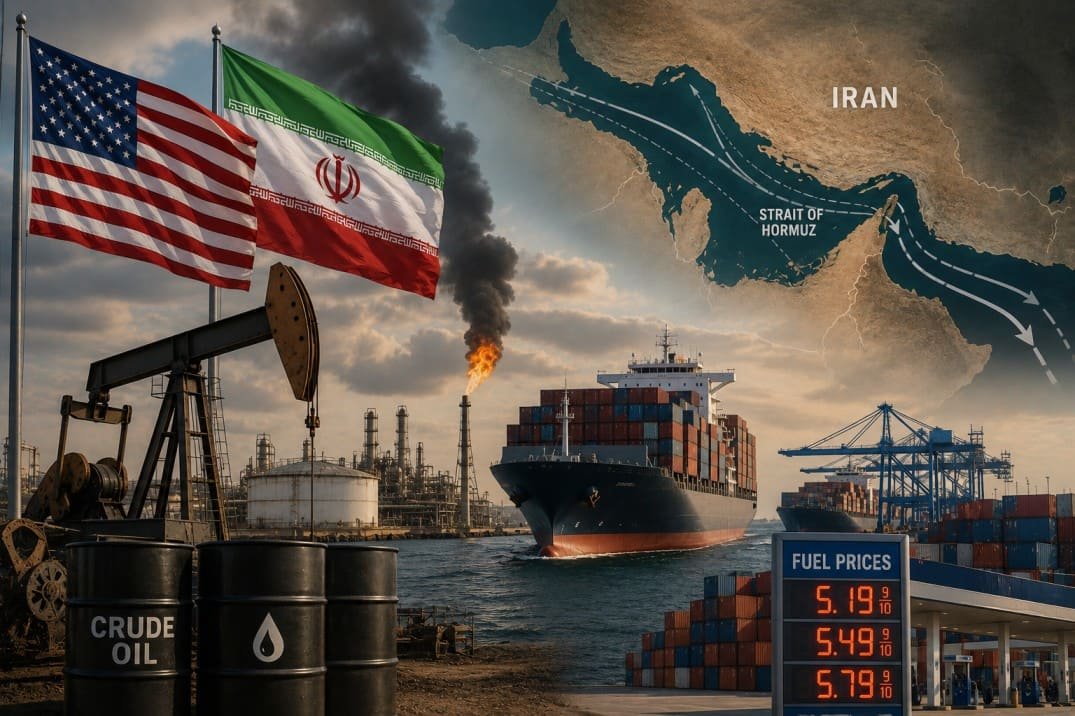
The global economy relies heavily on peaceful seas and steady energy pipelines to keep international trade moving without interruption. When geopolitical conflict erupts in West Asia, shockwaves travel rapidly through global financial markets, energy exchanges, and supply chain hubs.
With US and Iran tensions rising across critical maritime corridors, security risks have escalated to levels not seen in years.A fight which disrupted the trade routes which have affected the citizens. These mounting friction points threaten key transit bottlenecks, drive up wholesale energy costs, and leave logistics operators facing unprecedented operational challenges.
What is happening as US and Iran tensions rise in vital trade routes
At the center of this developing situation are two crucial maritime passages that handle a vast share of global commercial trade. The primary bottleneck is the Strait of Hormuz, a narrow waterway situated between Oman and Iran through which approximately twenty million barrels of crude oil pass every day, representing nearly one fifth of total worldwide consumption. Nearby lies the Bab el-Mandeb Strait, which serves as the southern gateway to the Red Sea and the Suez Canal. As naval standoffs, drone activity, and vessel interceptions increase in these localized zones, commercial fleet operators are forced to weigh the safety of their crews against the urgency of delivering essential cargo.Disruptions to shipping routes could compound trade challenges examined in Will Trump’s Tariffs Trigger a Global Economic Slowdown?.
Why Middle East conflicts are driving up global fuel prices
Energy commodity markets tend to react to the potential for disruption long before physical supplies are completely blocked. When military threats emerge near major export routes, energy traders immediately build a geopolitical risk premium into international crude benchmarks like Brent crude.
At the same time, marine insurance underwriters adjust their risk models, raising war risk coverage premiums for ocean tankers by up to ten times above standard baselines. These compounding expenses, combined with higher operational overhead, mean that elevated crude prices at major trade hubs quickly translate into higher diesel and gasoline costs at fuel pumps worldwide, according to market tracking by IEA Energy Statistics.
What is the global impact on shipping routes and consumer prices
To avoid high risk zones in the Red Sea and Persian Gulf, major container carriers are increasingly diverting their vessels around the Cape of Good Hope at the southern tip of Africa.
This extended detour adds between three thousand five hundred and four thousand nautical miles to the journey, stretching transit times between Asian manufacturing centers and European ports by ten to fourteen days.
The longer voyages force ships to burn up to sixty percent more fuel, absorb available container capacity, and disrupt port schedules around the world. As highlighted by OECD Shipping Reports, these logistics delays and freight surcharges ultimately pass through to consumers in the form of higher prices for imported goods, electronics, and daily essentials .When crude oil prices surge on global trading floors, the financial pressure flows directly down to everyday households.
The impact of higher crude oil prices is also relevant to India’s fuel transition, explored in Ethanol Controversy in India: What E20 Fuel Means for Drivers.
Rising energy costs immediately show up at local gas pumps, where higher petrol and diesel prices make daily commutes, school runs, and personal travel far more expensive for families. Beyond personal vehicles, spiked fuel costs push up operational expenses for public transit systems, freight deliveries, and agricultural production. As farmers pay more for fuel to run machinery and shipping companies add freight surcharges to truck loads, retail grocery stores are forced to raise prices on basic foods, produce, and household goods.
These compounding daily expenses compress household budgets, erode purchasing power, and make routine living costs noticeably higher for average citizens around the world.
Strategic solutions and multilateral initiatives ahead
Navigating these persistent economic pressures requires a combination of immediate security responses and long term strategic planning. In the short term, international naval coalitions are implementing coordinated convoy systems and maritime escorts to protect merchant vessels passing through high risk corridors, while governments consider releasing emergency stocks from Strategic Petroleum Reserves to stabilize energy markets.
Looking ahead, regional infrastructure investments are prioritizing terrestrial bypass pipelines, such as overland routes across the Arabian Peninsula, to reduce total dependence on vulnerable maritime chokepoints. Until these diplomatic, security, and infrastructure measures take full effect, businesses and consumers around the world will continue to feel the economic weight of volatile fuel prices and extended delivery timelines.
Whether these deep-seated tensions ever fully resolve depends on balancing complex geopolitical interests, but a complete end to the friction remains unlikely in the near future.
While temporary ceasefires, diplomatic dialogues, and tactical de-escalation measures often provide brief moments of stability that temporarily lower oil prices and ease maritime fears, long-term peace faces major hurdles due to persistent mistrust, core disputes over nuclear programs, and widespread regional proxy dynamics.
Global powers may establish managed to secure alternative terrestrial trade pipelines to insulate supply chains, but as long as strategic waterways remain focal points for regional leverage, periodic spikes in energy costs and ocean freight volatility are expected to persist as a structural feature of global trade.

Leave a Reply