
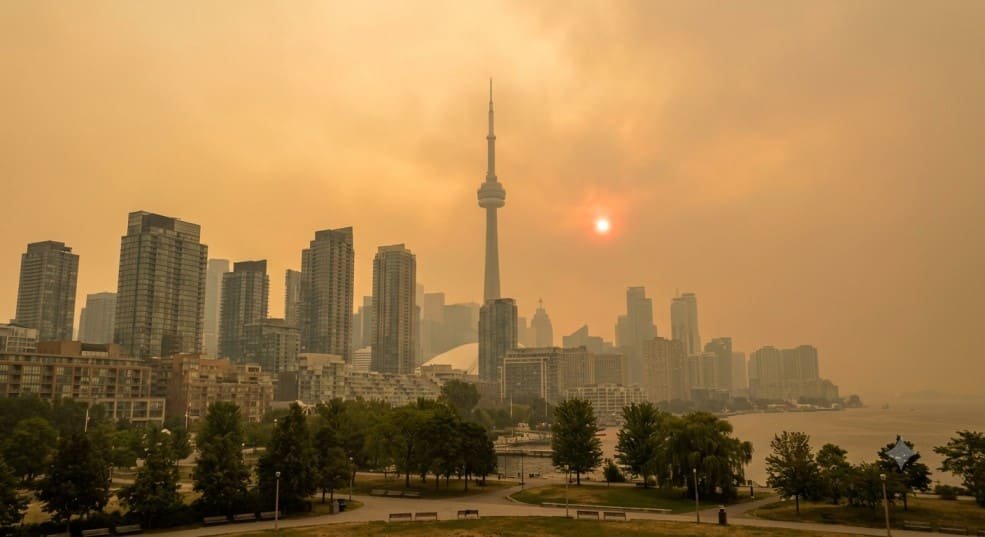
The financial center of Canada recently made global headlines when a thick, yellowish haze enveloped its famous skyline. Clouds of smoke from hundreds of raging forest fires in northwestern Ontario drifted hundreds of kilometers south, triggering the condition of wildfires in Toronto worst air quality rankings on international air monitoring indexes. The sudden environmental shift turned bright summer afternoons into dim, eerie evenings, forcing city officials to issue high-priority safety warnings and urge residents to remain indoors.
Understanding this atmospheric crisis requires looking at how the smoke traveled, how everyday life was disrupted, how local residents observed the changing environment, and what actionable solutions exist to protect public health both now and during future wildfire seasons.
How the Toronto Wildfire Smoke is getting out of control
The origin of the smoke stems from an aggressive breakout of over one hundred active wildfires burning across the remote boreal forests of northwestern Ontario.
Unusually hot, dry conditions and lightning strikes created a volatile landscape where fires spread rapidly across dry timber and brush, destroying wilderness areas and forcing emergency evacuations in northern communities.
High-altitude jet streams acted as a atmospheric highway, carrying massive volumes of ash, carbon monoxide, and fine particulate matter directly toward southern Ontario and the Lake Ontario basin. A stalled high-pressure weather system trapped this dense layer of smoke close to the ground. At the same time, Toronto was enduring a historic heatwave with downtown temperatures soaring past 37 degrees Celsius. This combination of trapped heat and stagnant air prevented the smoke from scattering, locking the city under a dense blanket of toxic haze.
A thick haze of smoke blocked views across the city of sights including the Empire State Building and the Statue of Liberty.
New York has extended its heat emergency plans and activated its air quality emergency protocols – with hundreds of cooling centres and KN95 masks being made available citywide.
Real-time air tracking from the IQAir Global Air Quality Tracker recorded Toronto’s Air Quality Index spiking into hazardous territory, briefly placing the city ahead of historically polluted megacities. Environment Canada issued an orange air quality warning across the Greater Toronto Area, warning that fine particles measuring 2.5 microns or smaller were reaching concentrations far above safe limits.
What People Are Facing on the Ground
For residents in the Greater Toronto Area, the poor air quality went far beyond an unpleasant smell or cloudy view; it immediately impacted daily health and municipal operations. Microscopic particulate matter penetrates deep into lung tissue and can enter the bloodstream, causing health issues for healthy individuals as well as vulnerable populations.
Wildfires are a part of the natural life cycle of Canada’s vast boreal forest, but they have become more frequent since 2015, said Laura Chasmer, a professor of geography and the environment at the University of Western Ontario.
Hospitals and walk-in clinics across the city reported a surge in patients seeking care for acute respiratory issues, including chest tightness, severe coughing fits, burning eyes, and persistent migraine headaches.
Senior citizens, infants, pregnant individuals, and people living with pre-existing conditions like asthma or chronic obstructive pulmonary disease faced elevated risks of medical emergencies. Outdoor workers, including construction crews, delivery personnel, and transit staff, had to endure continuous exposure to the heavy air while carrying out their physical duties. Learn how rising temperatures, extreme heat, and ambitious sustainability initiatives are reshaping Dubai’s future in the face of global climate change.
In response to the health emergency, the city closed outdoor public pools, canceled supervised beach activities, and modified community summer programs. Major public recreation events were rescheduled or altered to prevent large crowds from spending prolonged periods outdoors during peak pollution hours.
Public Observations and Everyday Experiences
People across Toronto described the atmosphere as surreal, and unsettling. Many residents noticed a distinct metallic or campfire smell the moment they stepped outside, while others reported that the haze was visible even inside large transit stations, high-rise office corridors, and underground walkways.
On social media and local news forums, citizens shared photos of the sun rendered as a dark reddish disk behind thick layers of gray and yellow clouds.
Commuters noted that landmark structures like the CN Tower were almost completely hidden from view from just a few blocks away. Parents expressed deep concern over keeping energetic children indoors during summer break, while pet owners had to limit routine dog walks to just a few minutes to prevent pets from coughing or experiencing respiratory distress.
Many long-time residents reflected on how rare such events used to be, noting that smoke blanketed skies are increasingly becoming an unsettling summer norm rather than an isolated anomaly. The shared observation across the city was a feeling of confinement, as people relied on weather apps to check air quality indexes before deciding whether it was safe to open a window. Beyond travel safety, newcomers should also consider the true cost of living in Canada when planning their overall budget and long-term settlement.
Practical Solutions for Immediate and Long-Term Safety
Navigating a wildfire smoke emergency requires a mix of immediate personal protection measures and broader municipal planning strategies. Health authorities at Environment Canada Public Health Directives stress that reducing exposure to fine particulate matter is the most effective way to prevent short-term illness.
For immediate protection, individuals are advised to stay indoors with doors and windows kept tightly closed. Running HVAC systems on recirculation mode prevents dirty outdoor air from being drawn inside. Utilizing portable air purifiers fitted with high-efficiency particulate air filters can remove up to ninety-nine percent of airborne particles in closed rooms. If leaving the house is necessary, wearing a well-fitted N95 or KN95 respirator provides significant protection against fine particle inhalation that standard cloth masks cannot offer.
On a municipal and structural level, cities are establishing network infrastructure to build community resilience. Toronto opened dedicated clean air refuges in major civic centers like Metro Hall and Scarborough Civic Centre, offering filtered indoor environments for unhoused populations and residents without home air conditioning.
A Plot Twist in Global Pollution
For decades, the global consensus was simple: if you wanted to experience air thick enough to chew, you booked a flight to Delhi. Citizens of the Canadian metropolis spent years offering sympathetic nods to Indian capitals routinely topping global pollution leaderboards. In a bizarre plot twist of planetary proportions, Toronto managed to snatch the crown, not through industrial smog or traffic gridlock, but courtesy of hundreds of northern wildfires turning the Great White North into the Great Yellow Haze.
Understand the debate surrounding India’s ethanol policy, its impact on energy security, food production, and the country’s transition toward cleaner and more sustainable fuels.
It seems the tables have turned: while Delhiites can temporarily enjoy a rare moment of breathing room, Torontonians are left realizing that bad air isn’t just an Eastern export anymore it’s now a homegrown Canadian specialty.
Looking toward the future, public health experts advocate for retrofitting older residential and commercial buildings with advanced filtration systems, expanding urban green canopy projects, and strengthening regional forestry management to suppress blazes before smoke plumes reach major metropolitan centers. Citizens interested in exploring broader municipal climate adaptation frameworks can visit the official Toronto Environmental Protection Services portal to review real-time monitoring updates and safety guidelines.


Leave a Reply