
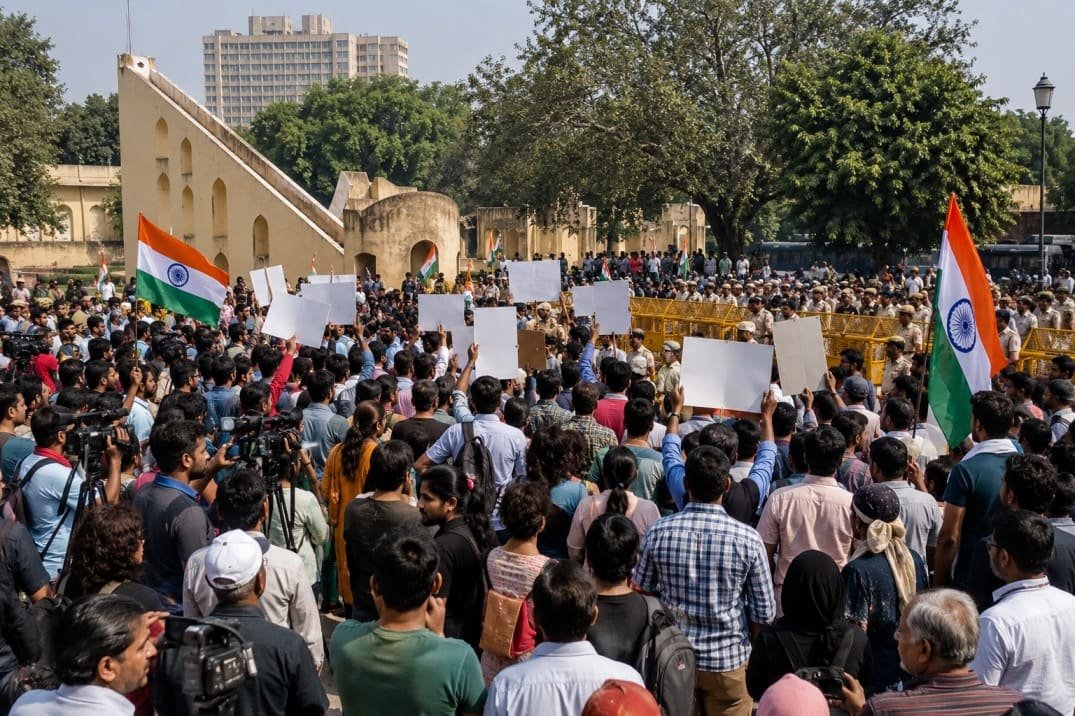
Central Delhi witnessed dramatic scenes today as thousands of students, youth activists, and civic organizations converged at Jantar Mantar for a massive rally.
The historic observatory site, long serving as India’s designated venue for public demonstrations, turned into a sea of banners, tricolors, and slogans. Organized primarily under the banner of the Cockroach Janta Party alongside major student unions, the demonstration represents one of the largest student-led mobilizations in the capital in recent years.
The gathering comes at a critical juncture, coinciding directly with the opening of the Monsoon Session of Parliament. Protesters from across nearby states began streaming into the national capital early in the morning, overwhelming the designated protest perimeter.
The surge forced law enforcement to scale up security measures across Central Delhi. To understand the broader context of civic rights in the capital. One can review the official guidelines issued by the Delhi Police Headquarters regarding public assemblies.
Despite tight administrative restrictions and heavy security deployment, demonstrators refused to disperse. Instead, they transformed the venue into a continuous vigil, voicing deep-seated grievances regarding nationwide educational transparency and systemic accountability.
What Triggered the Massive Jantar Mantar Protest 2026 Mobilization?
The primary catalyst driving thousands to the streets is widespread outrage over recurring national examination irregularities. The controversy stems from major paper leaks affecting the NEET-UG medical entrance examination, alongside alleged administrative flaws in central evaluation systems. Millions of students across India found their academic futures hanging in the balance, sparking anger among families and youth groups.
The tension escalated significantly over the weekend following the forced hospitalisation of prominent Ladakhi climate activist and education reformer Sonam Wangchuk. Wangchuk had joined the Jantar Mantar sit-in on an indefinite hunger strike in solidarity with the students.
When police personnel moved Wangchuk to Safdarjung Hospital citing health concerns, public outrage flared, drawing even larger crowds to the site.
When discussing government policies or public dissatisfaction, the government has failed in several areas. Prabh News covers on Why the Ethanol Controversy in India Is Heating Up in 2026.
Gen Z and the Stand for Institutional Accountability
The defining characteristic of the Jantar Mantar Protest 2026 is its heavy momentum driven by Generation Z—a demographic historically mischaracterized by political analysts as cynical or indifferent to civic affairs.
Born into a hyper-connected, digital-first environment, these high school graduates, NEET-UG medical aspirants, and university students have transformed online political awareness into swift, decentralized street activism.
Their participation in the Delhi rally is defined by exceptional information literacy, satirical pushback against elite rhetoric, and an unyielding refusal to accept administrative compromises or vague official promises.
While discussing student participation and education-related demands.
How Viral Content Inspired People to Take Action
Rather than relying on legacy political networks or institutional patronage, Gen Z organizers built their movement out of open-source digital tools and viral internet culture.
When derogatory remarks compared unemployed youth to domestic pests, social media manager Abhijeet Dipke and a cohort of digital-native creators inverted the insult into a badge of honor, creating the Cockroach Janta Party as a satirical platform
Using AI-generated visuals, meme-driven commentary, and transparent online manifestos, the digital campaign amassed millions of followers within days before transitioning into physical clean-up drives, city sit-ins, and ultimately the historic assembly at Jantar Mantar.
If the protest mentions Sonam Wangchuk or environmental activism, link Why Sonam Wangchuk Is Fighting for India’s Future.
Gen Z Demands Centered on Governance and Fair Opportunity
Far from acting on conventional party-line motives, Gen Z’s active presence at Jantar Mantar centers squarely on pragmatic governance and institutional equity. For millions of young candidates who spend years preparing for rigorous national entrance examinations, systemic paper leaks and revaluation flaws are not mere administrative glitches,they represent existential threats to social mobility and meritocracy. Consequently, their slogans do not advocate for ideological doctrines; instead, they demand concrete policy outcomes:
- Legally enforceable anti-leak frameworks
- Statutory independent audits of testing agencies
- Complete transparency under the Right to Information Act
“We are not fighting for political slogans or party banners; we are fighting for the sanctity of the exam hall, the integrity of our hard work, and the right to a predictable future.”
— A 19-year-old NEET aspirant at Jantar Mantar
By holding copies of the Indian Constitution alongside satirical placards, these young citizens have reframed public protest as a duty of democratic citizenship.
Their solidarity with fasting activist Sonam Wangchuk and hunger-striking student union leaders demonstrates a level of civic maturity that has caught political observers off guard.
Redefining Indian Civic Engagement for the Digital Era
The surge at Jantar Mantar reflects a broader structural shift in how young Indians relate to the state. Gen Z views public institutions through the lens of user experience and performance accountability: when a system fails, they expect immediate diagnostics, corrective action, and accountable leadership rather than defensive silence or bureaucratic deflection.
This outcome-oriented mindset explains why attempts to appease demonstrators with partial delays or minor procedural tweaks have fallen flat.
Ultimately, the 2026 mobilization at Jantar Mantar proves that Gen Z’s digital fluency is not a distraction from real-world politics, but a powerful catalyst for it.
By combining sharp wit, constitutional literacy, and relentless collective solidarity, these young protesters have established a new benchmark for civic accountability in India,one where the nation’s youth demand that public institutions answer to the people they were built to serve. India has the largest constitution in the world, a nation known to be build by the people and for the people. Yet, people have to come on streets to ask for basic rights and demand accountability.
Escalation at the Protest Site: Lathi Charge, Metro Closures, and Digital Blackouts
As the crowd swelled during the peak hours of the rally, tension between security personnel and student demonstrators reached a boiling point.
. Scores of innocent students and young aspirants sustained injuries in the commotion, while several student leaders were forcibly detained and removed from the site in police vans. Protesters on the ground reported that peaceful sit-ins turned volatile as security forces deployed water cannons and barricades to disperse the gathering.
To restrict the movement of incoming crowds, the Delhi Metro Rail Corporation shut down gates at key central transit points including Rajiv Chowk, Janpath, Patel Chowk, Central Secretariat, and Seva Teerth stations.
Simultaneously, mobile internet services were jammed in and around the Jantar Mantar area, leaving students unable to communicate or broadcast updates from the venue.
Despite these measures, support for the movement continues to expand nationally.
Prominent cultural figures and Bollywood celebrities have voiced their backing across digital platforms, calling attention to the severe health risks faced by Sonam Wangchuk during his prolonged fast.
Critics and opposition leaders have condemned the executive silence, pointing out that despite a life-threatening hunger strike by an acclaimed reformer and weeks of student demonstrations, no formal dialogue mechanism has been established by top ministry officials.
The Role of the Cockroach Janta Party and Student Alliances
The mobilization at Jantar Mantar represents a unique convergence of digital satire and street-level activism.
Founded by social media manager Abhijeet Dipke, the Cockroach Janta Party gained rapid online traction before organizing physical sit-ins across major Indian cities. The movement adopted its unusual name as a direct reference to judicial remarks made regarding unemployed youth, reclaiming the term as a symbol of resilience and collective resistance.
The movement rapidly gained momentum by building a broad coalition with established student unions, including the All India Students Association, the Students Federation of India, and various state-level youth organizations.
Prominent political leaders, including opposition members of Parliament and civil rights advocates, also visited the site today to extend their formal support.
The coalition’s ability to unite diverse groups,ranging from medical aspirants to civil society leaders,has amplified the demonstration’s impact, turning a localized agitation into a nationally watched political event. What began as a viral joke in May 2026 quickly transformed into one of India’s most significant youth movements in recent history
. Understanding how a satirical internet meme evolved into a full-scale physical march at Jantar Mantar reveals a complete shift in how young citizens engage with civic accountability.
The ‘Chalo Sansad’ Call and Police Response in Central Delhi
The high point of today’s demonstration was the planned ‘Chalo Sansad’ (March to Parliament) rally. Organizers called on thousands of supporters to march from Jantar Mantar toward the Parliament House as lawmakers convened inside for the legislative session. The move was intended to press the government directly on the floor of the House.
In response, the Delhi Police issued strict prohibitory orders under Section 163 of the Bharatiya Nagarik Suraksha Sanhita across the New Delhi district.
Authorities publicly clarified that no permission was granted for any march or procession beyond the designated Jantar Mantar boundary, citing high security concerns during the active parliamentary session. Multi-layered steel barricades, water cannons, and heavy personnel deployments were stationed along all roads leading toward Parliament.
Security forces utilized mild force and detentions to push the crowd back within permitted zones.
What Lies Ahead for the Movement and Education Accountability?
As the day progressed, the situation at Jantar Mantar remained tense yet structured, with organizers maintaining a continuous night-and-day presence. Representatives of the protesting groups stated that their agitation would not end until concrete assurances were made on the floor of Parliament regarding examination reforms.
Urgent petitions regarding the treatment of fasting activists and student protection measures have reached the High Court.
Concurrently, opposition parties are pushing for an immediate debate inside both Houses of Parliament.
Today’s events demonstrate the growing role of digital-first youth movements in driving real-world political accountability in India. Whether the protest leads to immediate executive resignations or statutory policy updates, the turnout at Jantar Mantar has placed education reform at the very center of the national policy debate. Where people gather in lakhs from around the country to raise the there voice. Bhagat Singh said it rightly said “If the deaf are to hear, the sound has to be very loud.”

Leave a Reply