
Breaking Point: The Quiet Shockwaves of the Modern Education Crises in India
While the country celebrates soaring economic growth and high-tech advancements, a silent emergency is brewing inside the nation’s classrooms. The compounding education crises in India have evolved past a minor policy hurdle; they now represent an absolute systemic emergency.
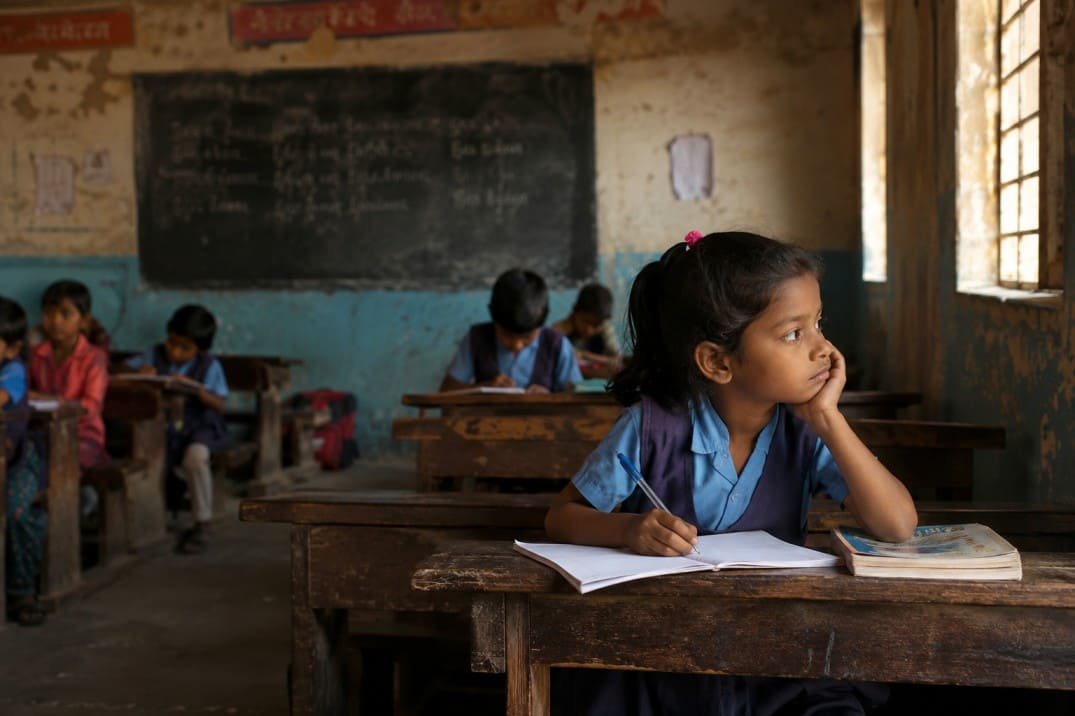
Despite near-universal primary school enrollment, millions of children sit in classrooms without absorbing foundational skills. Experts warn that unless immediate structural changes are implemented, India’s celebrated demographic dividend could morph into a massive unemployment liability.
The Hidden Epidemic of Learning Poverty in Rural Classrooms
The most alarming facet of the current emergency is not a lack of student attendance, but the total stagnation of classroom comprehension. According to recent findings from the Pratham ASER Centre, roughly 25% of youth aged 14 to 18 still cannot fluently read a basic Grade 2 level text in their regional language. This staggering manifestation of learning poverty highlights a brutal reality: kids are moving up through grades by memorizing text, completely missing out on actual cognitive growth.
“We are producing exam-taking machines rather than critical thinkers,” states a senior researcher at the NITI Aayog School Education Index. “The current curriculum prioritizes rote-memorization over conceptual understanding. When these students reach higher education, they struggle to apply simple logic.”
This pedagogical disconnect is heavily amplified by severe teacher shortages. In multiple rural regions across states like Bihar and Uttar Pradesh, single educators are left managing three to five separate grade levels inside a single room. The severe lack of personalized attention leaves struggling students entirely left behind.
Paper Leaks and Booming Coaching Cultures Devalue Traditional Degrees
Beyond primary schooling, the foundational trust in competitive testing has practically collapsed
The intensifying education crises in India reached a boiling point following the historic 2024 NEET exam scandal, where widespread question paper leaks and systemic institutional lapses upended the futures of over 2.3 million medical aspirants. The complete collapse of competitive testing integrity ignited a fierce political war, fueling massive nationwide protests by student organizations demanding the immediate resignation of Union Education Minister Dharmendra Pradhan over allegations of gross incompetence and bureaucratic denial. While the Education Ministry eventually conceded to a CBI probe and dismantled the top leadership of the National Testing Agency (NTA), the ongoing fight against the Education Minister has morphed into a deeper, generational struggle against an unregulated “coaching mafia” and a testing infrastructure severely vulnerable to institutional corruption.
Many students gave up on the education system, that was once respected and now has structural vulnerabilities inside the centralized assessment infrastructure are exposed. Outlaws weaponizing localized messaging networks have commodified exam papers, driving desperate students toward high-pressure, toxic coaching hubs in places like Sikar and Kota.
This hyper-fixation on clearing single, high-stakes exams has completely devalued standard schooling. Furthermore, macroeconomic metrics like the India Skills Report reveal that only 54.81% of active university graduates possess skills aligned with actual industry standards. Families are draining life savings on private schooling and coaching fees, only for graduates to meet an unforgiving, hyper-competitive job market.
The Widening Digital Divide in Schools
The shift toward modern, tech-integrated hybrid learning models has brought to light an unequal landscape across different regions. Even with significant recent budgetary allocations aimed at creating dedicated Artificial Intelligence infrastructure, grassroots realities remain stubbornly analog.
| Educational Resource Metrics | Current National Percentage |
| Schools with Functional Computer Labs | 57.2% |
| Educational Facilities with Active Internet Access | 53.9% |
| Workforce Possessing Formal Vocational Training | 4.1% |
This massive digital divide in schools deepens existing structural inequalities. While urban private school students routinely interact with smart dashboards and adaptive AI tools, millions of rural pupils remain entirely restricted to dilapidated physical text resources. Without basic computer literacy, a massive portion of the rural youth remains locked out of the modern digital economy.
Tracking the National Education Policy Reforms Roadmap
To address these deep-rooted Indian education system problems, policymakers are steadily leaning on structural overhauls. The long-term deployment of the National Education Policy reforms represents a critical blueprint to transition the country away from hyper-rigid, textbook-heavy paths.
1.Enforcing Foundational Literacy and Numeracy (FLN): Ages 3 to 8.
Prioritizing early childhood care frameworks like NIPUN Bharat to ensure absolute reading and arithmetic mastery before a child enters Grade 3.
2.Integrating Modular Vocational Training: Grades 6 to 12.
Introducing specialized textbooks like ‘Kaushal Bodh’ to normalize technical craftsmanship and trade training, reducing the singular fixation on theoretical university degrees.
3.Implementing the Academic Bank of Credits: Higher Education Access.
Utilizing single APAAR identity tracking to let students pause, pivot, and restart higher education by safely stacking multi-disciplinary micro-credentials at their own pace.
If India’s Education System Is Improving, Why Do Many Political Leaders Send Their Children Abroad?
Every election season, political leaders speak about transforming India’s education system. New schools are inaugurated, education budgets are announced, and ambitious reforms are promised. Yet a recurring public question continues to surface: if confidence in India’s education system is so high, why do some politicians and ministers choose foreign universities for their own children?
The answer is more nuanced than it first appears.
Many public figures, including politicians, business leaders, civil servants, and professionals, have children who study in countries such as the United States, the United Kingdom, Canada, Australia, and Singapore. ‘Pradhan’s daughter Naimisha was enrolled in an American university’. Many citizens question over such decisions made by highly influential people.
Their decisions are often influenced by factors such as globally ranked universities, specialized research facilities, international exposure, flexible academic programs, and stronger industry connections.
Critics argue that this trend exposes a gap between political promises and personal choices. They contend that if policymakers had greater confidence in the quality of India’s public universities and school system, more of them would choose domestic institutions for their families.
However, education experts caution against drawing sweeping conclusions. Many ministers and senior political leaders have children who studied entirely in India, graduating from institutions such as the Indian Institutes of Technology (IITs), the Indian Institutes of Management (IIMs), Delhi University, and Jawaharlal Nehru University. The choice of studying abroad is therefore not unique to politicians but reflects a broader trend among affluent families.
The larger issue, experts say, is not where ministers’ children study but whether every child in India, regardless of economic background, has access to quality education. Until government schools and universities consistently offer world-class infrastructure, research opportunities, and strong employment outcomes, families with the financial means are likely to continue exploring international education.
For many citizens, the debate is less about individual choices and more about accountability. They ask whether policymakers should ensure that the education system they oversee is one they would confidently choose for their own children. What makes the childern of these highly influential people to study in universities. That question continues to shape public discussions on education reform in India.
Grassroots Solutions Revitalizing the System
While macro policy changes take time to settle, localized state-level experiments offer genuine paths forward. For example, Uttar Pradesh’s aggressive rollout of ‘Mission Prerna’ has utilized targeted middle-management tracking, daily protected basic learning blocks, and strict administrative accountability to significantly boost reading levels across thousands of rural communities.
Simultaneously, civic-led interventions are filling critical infrastructure gaps. Mobile solar-powered learning vans equipped with offline coding apps are traversing remote districts, offering thousands of disconnected students their first safe introduction to computers.
Resolving this deep institutional crisis demands an honest recognition that universal enrollment is merely a vanity metric if it lacks underlying quality. India must urgently match its massive infrastructural ambitions with direct investment in its educators and classroom standards. Only by closing the digital divide and eliminating learning poverty can the country protect its youth and build an equitable, future-ready workforce.
ducation extends beyond textbooks, and travel often plays an important role in helping students understand India’s diverse geography, culture, and environment. If you’re planning a trip during the rainy season, explore Prabh News’ guide to the best destinations to visit during the monsoon in India, featuring scenic landscapes, popular hill stations, and essential travel tips for a safe and memorable journey.
The education crisis in India cannot be viewed in isolation. Factors such as poverty, malnutrition, and unequal access to healthcare continue to influence children’s ability to learn and succeed in school. Prabh News explores these interconnected social challenges in its article on Malnutrition and Poverty Distribution in India, highlighting why improving education requires addressing the broader issues that affect children’s growth and development.

Leave a Reply