
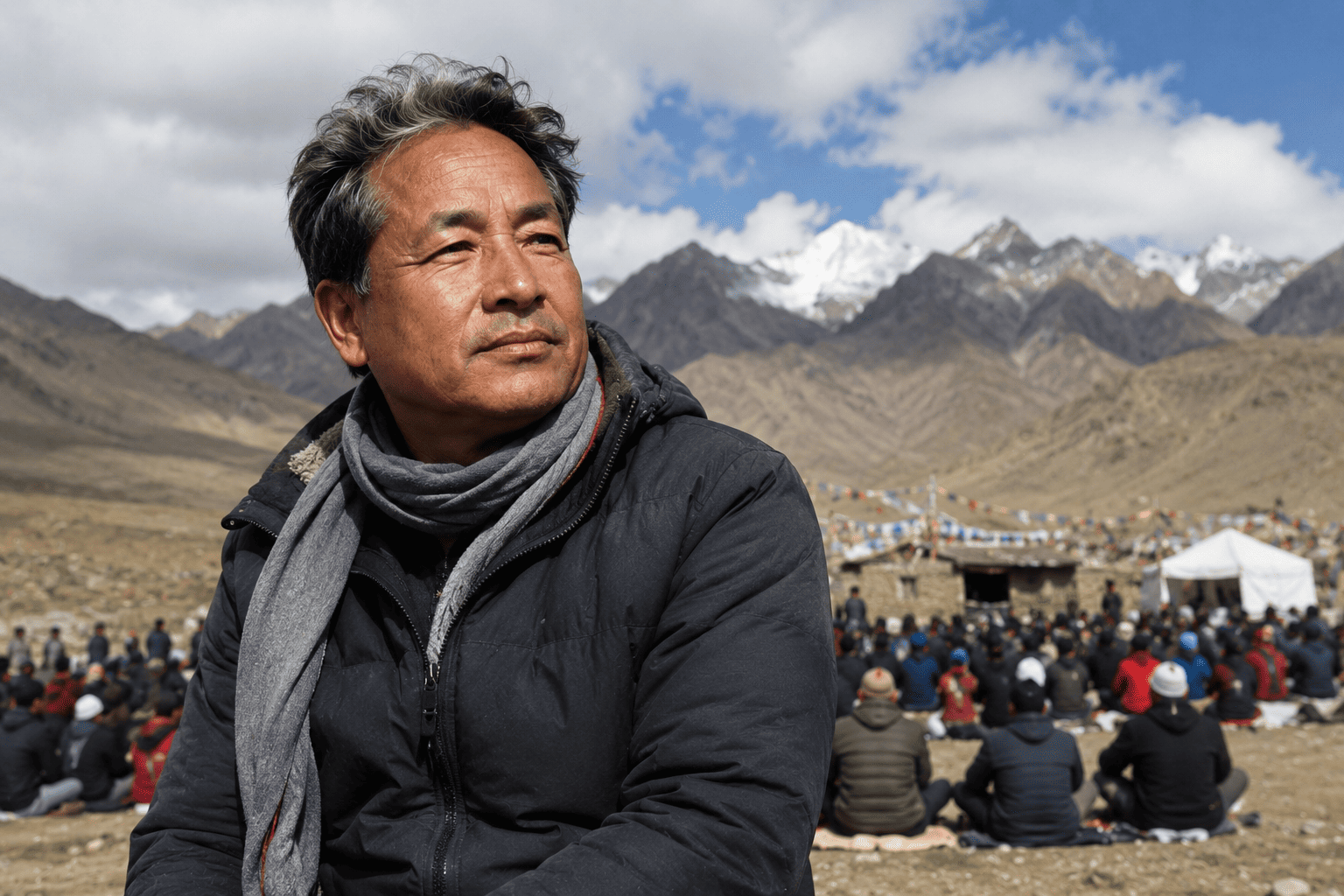
The political landscape of India has frequently been shaped by peaceful dissent, but few recent movements have captured the public imagination like the ongoing mobilization led by Sonam Wangchuk. Sitting at Jantar Mantar in New Delhi, his latest hunger strike has evolved into a movement of profound national significance. By anchoring his protest to issues that cross regional boundaries, the environmentalist has transformed a remote border dispute into a nationwide conversation about democratic accountability, ecological preservation, and institutional trust.
To understand this protest, one must look past the immediate imagery of an isolated regional standoff. It is a unified critique of how the state interacts with its citizens, its environments, and its youth. By bridging the ecological vulnerabilities of the high-altitude cold desert with the frustrations of millions of students across the Indian mainland, this movement challenges the conventional boundaries of public protest and forces a critical re-evaluation of how regional aspirations fit within the larger framework of Indian democracy.
An Academic’s Resolve: Choosing Dissent Over Comfort
Here is a scientist, renowned innovator, and Magsaysay Award-winning educator who could easily choose to stay confined within the peaceful walls of a research lab or live a profoundly comfortable, celebrated life. Instead, Sonam Wangchuk is deliberately spending his time enduring the harsh elements of public squares, undertaking grueling indefinite fasts, and placing his own physical health at severe risk out of a deep conviction that he is championing the urgent structural issues that impact India’s youth.
Whether one agrees with the specific demands of his agitation is an entirely separate discussion. What remains undeniable is the rare, stark choice of a globally recognized intellectual stepping onto the frontlines of street activism to act as a moral lightning rod for systemic accountability. The debate around FCRA Amendment Bill Explained also highlights the wider questions surrounding regulation, civil society organisations, and government oversight in India.
His physical presence at Jantar Mantar forces everyday citizens to examine the depth of their own civic responsibilities.
A Frontline Alliance: The Role of the Cockroach Janta Party (CJP)
The structural dynamics of the protest underwent a massive shift when Sonam Wangchuk formally aligned his fast with the ongoing sit-in organized by the Cockroach Janta Party (CJP). By embedding his struggle within the broader CJP movement at Jantar Mantar, Wangchuk transformed a primarily regional environmental crusade into an energetic, cross-demographic coalition. The partnership has successfully combined Ladakh’s existential climate anxieties with the acute frustrations of mainland India’s youth.
The CJP framework provided the agitation with an agile, tech-savvy organizational backbone capable of sustaining an extended urban demonstration.
This collaboration has helped position Wangchuk’s fast not as a solitary, isolated outcry, but as the moral anchor of a highly structured systemic critique. CJP’s primary machinery has taken over the logistical weight of the agitation, coordinating public outreach, broadcasting medical updates, and mobilizing student unions.
This organizational synergy ensures that the core demands for transparent governance, institutional responsibility, and local autonomy are amplified daily. It has effectively forced the national media to view Ladakh’s long-standing constitutional requirements through the immediate lens of contemporary youth struggles.
The Convergence of Ecological Protection and Educational Accountability
What distinguishes the current phase of the agitation from previous regional movements is its deliberate convergence with national mainstream issues. While Wangchuk remains a steadfast champion for the protection of Ladakh’s fragile glaciers and pastures against aggressive industrial exploitation, he has expanded his platform to address systemic flaws in the national education system.
Climate resilience is closely tied to public health and long-term development. You may also like our coverage on the Global Cancer Crisis 2050 to explore other challenges shaping the country’s future.
By aligning his hunger strike with the youth-led protests against structural irregularities in competitive national examinations, such as the NEET paper leaks, he has successfully broadened the demographic appeal of his movement. This tactical expansion ensures that his message resonates not just with environmentalists, but with millions of anxious families across urban and rural India.
This unique dual focus elevates the Sonam Wangchuk hunger strike to an issue of profound national significance by underscoring the shared vulnerabilities of the environment and the younger generation.
Wangchuk frequently notes that his life’s work is driven by two vital elements: education and the environment.
In his view, a nation that fails to protect its ecological foundations is just as compromised as one that fails to guarantee transparency and fairness to its students. By demanding systemic accountability from the highest levels of the education ministry alongside environmental safeguards for the mountains, the fast serves as a powerful mirror reflecting the institutional challenges facing modern India.
As climate concerns become increasingly urgent, events like the Europe’s deadly heatwaves demonstrate why environmental protection is now a global priority.
The visual impact of a highly respected educator and Magsaysay Award winner undergoing a prolonged fast, losing muscle mass, and facing serious health complications has renewed public focus on Jantar Mantar. The protest highlights a broader phenomenon where regional communities feel compelled to adopt extreme measures of peaceful resistance to gain a meaningful hearing in the national capital. This convergence challenges the mainstream political narrative by proving that local resource conflicts and national institutional reforms are deeply interconnected facets of a single, comprehensive demand for better governance.
The effects of global warming are already visible worldwide. Read more about Dubai and Global Warming to understand how rising temperatures are reshaping cities.
Current Developments, Medical Concerns, and Growing Public Solidarity
As the fast enters its consecutive weeks, the immediate physical toll on the activist has introduced a profound sense of urgency into the capital. Medical updates reveal that Wangchuk has lost nearly nine kilograms, with doctors warning that dropping blood pressure, low blood sugar levels, and muscle mass depletion pose severe, life-threatening risks. In response to this critical situation, public interest litigations have been moved in the Delhi High Court, seeking urgent judicial intervention to mandate proper medical supervision or force-feeding to avert a fatal outcome. Despite these escalating physical vulnerabilities, Wangchuk remains resolute, explicitly asking citizens not to plead for the cessation of his fast, but to focus their scrutiny on the state’s rigid refusal to initiate communication.
Simultaneously, the movement is actively shifting gears from a stationary protest into an active, nationwide mobilization. The CJP leadership has announced a high-stakes “Chalo Sansad” march timed deliberately with the opening day of the parliamentary Monsoon Session.
This escalation is designed to force the ongoing agitation directly onto the legislative floor, demanding immediate institutional accountability. Parallel symbolic fasts, public lectures on unemployment by prominent economists, and localized sit-ins across major academic hubs indicate that the protest is successfully expanding beyond the physical boundaries of Jantar Mantar into a wider national consciousness.
The media, youth even the famous bollywood actors Indian political leaders extend support to Sonam Wangchuk amid hunger strike
Omi Vaidya: “I Don’t Want Phunsukh Wangdu to Die”, Zeenat Aman: “We Must Not Watch a Great Mind Be Sacrificed”,
Rather than just posting online, actors Prakash Raj and Swara Bhasker physically visited the Jantar Mantar protest site to sit alongside the fast. Prakash Raj extended his solidarity on social media with the tagline “In solidarity with the youngsters of my country,” while Swara Bhasker emphasized that Wangchuk was put in this dangerous physical state because he is actively “fighting for children’s future.
The Insensitivity of State Silence and the Failure of Open Dialogue
The most striking and controversial dimension of the current standoff remains the complete lack of formal communication from the central administration. Despite weeks of high-visibility fasting, worsening medical parameters, and growing public unrest, the government has maintained a resolute, strategic silence. This absolute refusal to engage in an open dialogue reveals a deeper systemic issue within the modern governance framework, where prolonged peaceful dissent is met with institutional indifference rather than democratic negotiation. By opting to ignore a widely respected, peaceful innovator, the administration risks signaling that it values bureaucratic rigidity over the life and health of its citizens.
This policy of silence has drawn sharp criticism from civil society leaders and legal experts alike, who argue that the state is actively failing its core constitutional obligations. In a functioning democracy, a hunger strike by a figure of Wangchuk’s stature is intended to act as a profound moral pressure point, eliciting an empathetic and corrective response from leadership.
By choosing to look away, the current administration creates a dangerous precedent where the traditional, non-violent tools of democratic protest are treated as entirely inconsequential, deeply fracturing the trust between the governing elite and the populace. When the people are suffering at a scale to an extent they lost trust in the system itsef.How can a government choose to stay silent, and not even agree to have a dialogue.
A Disquieting Nationwide Reality: Protesting into the Void
The unfolding crisis at Jantar Mantar highlights a grim, contemporary political reality that is sending shockwaves through the national consciousness.
There is a growing, disquieting realization among the public that a citizen could literally fast to the point of death, and the state machinery might still refuse to react or show remorse. This extreme disconnect marks a stark departure from the historical traditions of Indian democracy, where the moral weight of a peaceful fast almost always compelled governments to come to the negotiating table.
The present scenario paints a chilling picture of an administrative apparatus that appears entirely immune to traditional forms of moral suasion.
This perceived institutional coldness has paradoxically supercharged the movement, transforming it into a definitive test of the nation’s collective democratic conscience.
Protesters and citizens are increasingly recognizing that if a globally recognized figure like Sonam Wangchuk can be left to suffer in silence without prompting an official response, then the voices of ordinary, marginalized individuals carry no weight at all. By exposing this profound indifference, the ongoing hunger strike has evolved far past its initial administrative and environmental goals
It has become an existential struggle to reclaim the core human value of open dialogue, empathy, and responsiveness within the grand project of Indian democracy.
Leave a Reply