
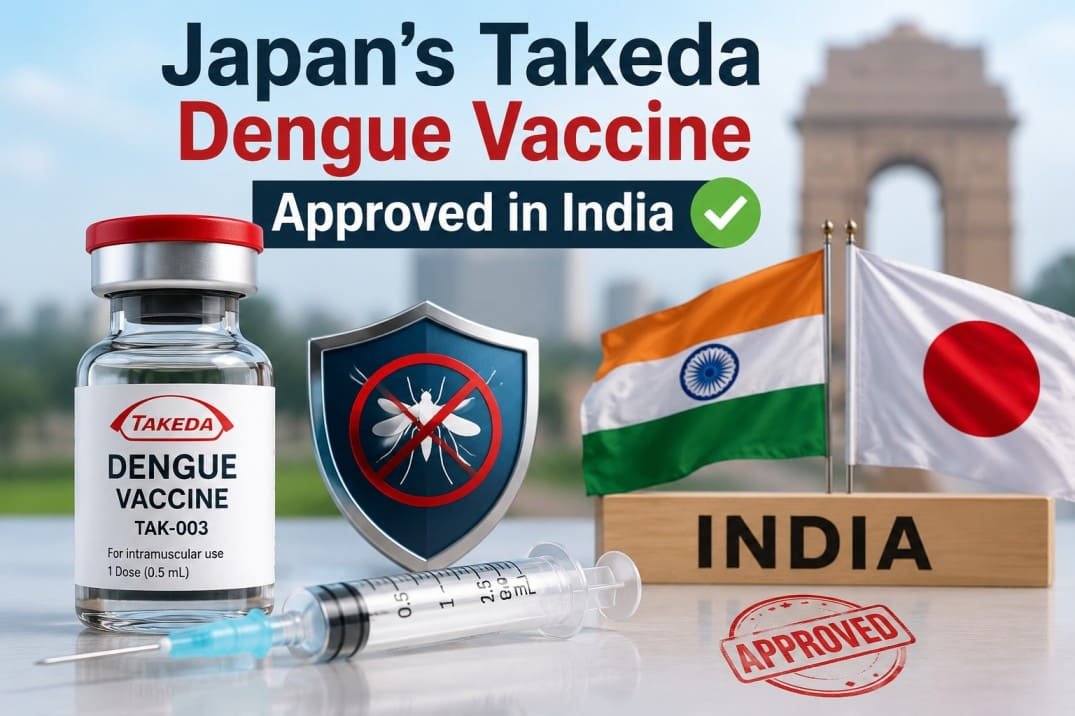
In a landmark victory for global public health, Japan’s Takeda dengue vaccine (Qdenga / TAK-003) has secured regulatory approvals in major endemic markets, bringing a crucial preventive tool to millions living in high-risk zones.
The Drug Controller General of India (DCGI) under the Central Drugs Standard Control Organisation (CDSCO) granted market authorization for the Takeda dengue vaccine for individuals aged 4 to 60. This decision marks a historic milestone for regions facing a relentless rise in mosquito-borne viral infections driven by shifting climate patterns, rapid urbanization, and expanding mosquito habitats.
Unlike earlier immunizations that required cumbersome blood screening prior to administration, the Takeda dengue vaccine can be given regardless of previous dengue exposure. This eliminates the need for pre-vaccination diagnostic testing and streamlines mass immunization campaigns across vulnerable communities.
Breakthrough Approvals for the Takeda Dengue Vaccine
Dengue represents one of the fastest-growing vector-borne threats in the world. According to data from the World Health Organization (WHO), global dengue incidence has increased dramatically over recent decades, placing over half of the world’s population at risk.
In India alone,a country that accounts for nearly 34% of the global dengue burden—reported cases exceeded 113,000 in 2025, with modeling studies suggesting the true infection count reaches tens of millions annually.
Global Footprint: The Takeda dengue vaccine is now approved in 43 countries across Europe, Latin America, and Asia,including the European Union, the United Kingdom, Brazil, Argentina, Indonesia, Thailand, Malaysia, and Vietnam. To date, more than 32 million doses have been distributed worldwide through public and private healthcare channels.
To meet surging international demand, Takeda Biopharmaceuticals partnered with Hyderabad-based Biological E Limited to scale up manufacturing. This strategic collaboration aims to supply up to 50 million to 100 million doses of multi-dose vials annually, ensuring equitable access for low- and middle-income endemic countries. Commercial availability in newly approved markets like India is projected for the first half of 2027.
How Effective Is the Takeda Dengue Vaccine?
The clinical foundation of the Takeda dengue vaccine relies on the pivotal Phase 3 Tetravalent Immunization against Dengue Efficacy Study (TIDES / DEN-301 trial). Involving over 20,000 children and adolescents across eight endemic countries in Latin America and Asia, the trial offers extensive multi-year safety and efficacy data.
Primary Clinical Trial Outcomes
| Clinical Endpoint | Protection Rate | Significance & Practical Impact |
| Symptomatic Dengue Prevention (12 Months) | 80.2% | Significant reduction in acute fever and clinical illness. |
| Hospitalization Reduction (18 Months) | 90.4% | Drastic drop in severe cases requiring emergency ICU care. |
| Long-Term Hospitalization Prevention (4.5 Years) | 84.1% | Sustained durability over extended monitoring periods. |
| Multi-Year Overall Protection | Up to 7 Years | Continued defense against all four circulating dengue serotypes. |
Local clinical evaluations,such as the Indian Phase 3 trial (DEN-302) in participants aged 4 to 60 years,further confirmed that the vaccine is well-tolerated, safe, and highly immunogenic.
Science and Mechanism: How TAK-003 Works
Dengue virus operates through four distinct viral serotypes: DENV-1, DENV-2, DENV-3, and DENV-4. A primary infection with one serotype confers lifelong immunity against that specific strain. However, a secondary infection with a different serotype carries a significantly higher risk of progressing to severe dengue, including dengue hemorrhagic fever (DHF) and dengue shock syndrome (DSS).
Overcoming Pre-Vaccination Screening Barriers
Earlier dengue vaccines were constrained by strict regulatory requirements mandating pre-vaccination blood tests to verify prior infection. In dengue-naive (seronegative) individuals, earlier formulations posed a risk of mimicking a secondary infection upon later exposure.
The Takeda dengue vaccine (Qdenga) overcomes this logistical hurdle:
- No Diagnostic Pre-Screening: Can be safely administered to both seropositive (previously infected) and seronegative individuals.
- Simplified Field Rollout: Allows public health agencies to deploy school-based or community-wide immunization programs efficiently without ordering pre-test blood draws.
WHO Endorsement and Integrated Public Health Defense
Recognizing its potential to curb severe disease, the WHO granted official prequalification to TAK-003. This designation confirms that the product meets stringent international standards for quality, safety, and efficacy, enabling procurement by global agencies such as UNICEF and the Pan American Health Organization (PAHO).
The WHO Strategic Advisory Group of Experts (SAGE) on Immunization recommends introducing the vaccine in settings with high transmission intensity.
Public health experts emphasize that while vaccination provides a strong primary defense, it works best alongside robust vector control and community awareness. For further details on seasonal health management, explore our guide on recognizing early mosquito-borne illness symptoms and read our breakdown of essential travel vaccination tips.
Key Guidelines for Patients & Healthcare Providers
- Dosing Regimen: Two 0.5 mL subcutaneous doses administered 3 months apart (Months 0 and 3).
- Eligible Age Group: Authorized for children and adults aged 4 to 60 years in approved jurisdictions.
- Storage and Handling: Formulated as a freeze-dried powder requiring reconstitution with a diluent prior to administration.
- Safety Profile: Post-marketing surveillance across tens of millions of administered doses shows a favorable safety profile, with mild local injection-site soreness being the most commonly reported reaction.
Leave a Reply