
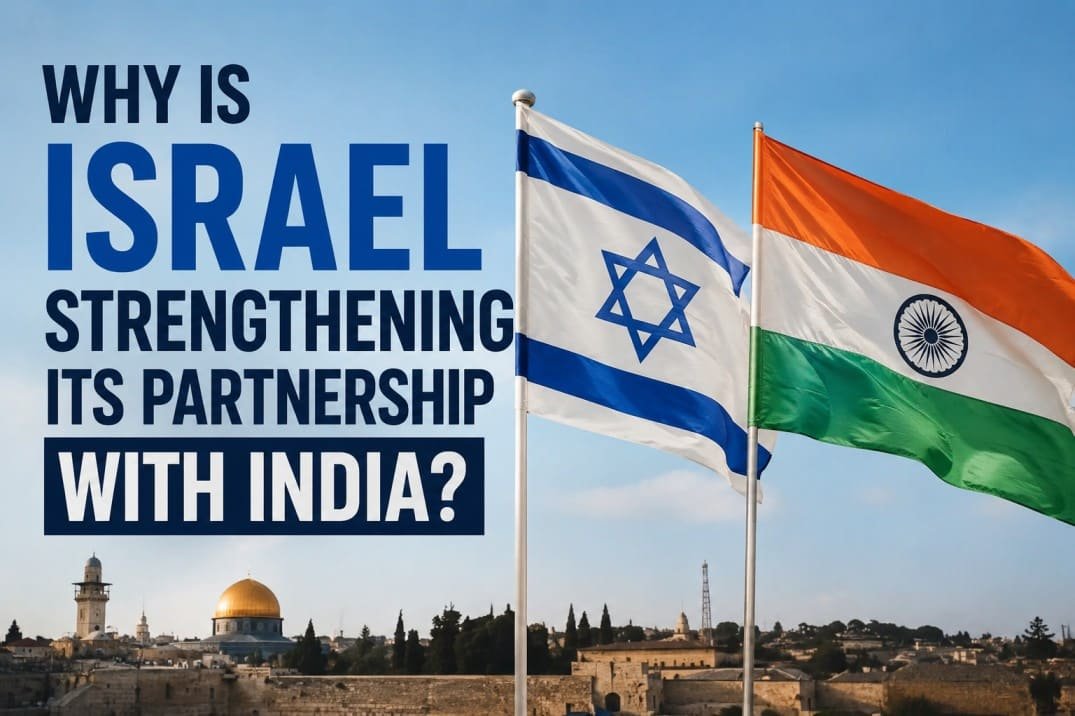
The Birth of a Modern Special Strategic Partnership
The geopolitical landscape of West Asia and the Indian Ocean region experienced a permanent shift when New Delhi and Tel Aviv elevated their diplomatic ties. During an official state visit to Israel, Prime Minister Narendra Modi and his Israeli counterparts formally upgraded their bilateral bond into the India-Israel Special Strategic Partnership for Peace, Innovation, and Prosperity.
This landmark transition, yielding seventeen formal agreements and twenty-seven major policy outcomes, sent a clear signal to global observers: Israel is systematically strengthening its partnership with India to secure its technological, economic, and defensive survival in an increasingly volatile world.
The reasons driving this alliance extend far beyond standard diplomatic niceties. For Israel, a nation with high-tech capabilities but limited domestic markets and demographic depth, India represents an ideal global counterparty. India boasts the world’s fastest-growing major economy, a massive domestic consumer base, and the largest technical workforce on Earth. By aligning their long-term foreign policies, both nations are building a resilient ecosystem that directly challenges conventional dependency on traditional Western supply chains.
Fueling Growth via Technology Driven Cooperation Initiatives
At the absolute center of this upgraded relationship is a shared commitment to technology-driven cooperation initiatives. Both administrations recognize that future global influence will be decided not just by conventional military might, but by dominance over emerging digital frontiers. To secure this baseline, the National Security Advisors of both nations now jointly lead a dedicated initiative on Critical and Emerging Technologies. This specialized framework bypasses standard bureaucratic delays to fast-track deep-tech research and commercialization.
The scope of this modern technological alliance covers several vital sectors:
- Artificial Intelligence Innovation: Both nations executed a formal MoU on Artificial Intelligence to co-develop civilian and industrial software applications.
- Next-Generation Infrastructure: Active commercial pipelines are expanding into quantum computing, advanced semiconductor manufacturing, industrial biotechnology, and the securing of critical minerals.
- Joint Cybersecurity Safeguards: The recent establishment of the Indo-Israel Cyber Centre of Excellence in India provides a collaborative hub to protect vital digital infrastructure from sovereign threats.
By nesting Israeli research directly within India’s massive software development sector, both countries are accelerating their path toward global technological leadership. This structural synergy allows startup innovations from Tel Aviv to find instant, multi-million-user scale across the Indian subcontinent.
Securing Capital via the Bilateral Investment Agreement
While technology provides the blueprint, modern capital frameworks provide the necessary fuel. A major breakthrough occurred on July 4, 2026, when the landmark India-Israel Bilateral Investment Agreement officially entered into force, replacing a highly outdated 1996 treaty. This updated legal mechanism provides a secure and highly predictable investment climate designed to dramatically increase cross-border investment activity between corporate entities in both states.
According to formal documentation released by the Ministry of Finance, the new BIA provides robust protections against targeted discrimination, manifestly arbitrary treatment, and direct or indirect expropriation. Crucially, the pact balances investor security with domestic sovereignty, explicitly preserving the regulatory right of both host governments to enforce public health, environmental protection, and national security measures.
This legal certainty is paired with active negotiations for a comprehensive Free Trade Agreement. The Ministry of Commerce & Industry noted that removing trade barriers will unlock billions in latent merchandise trade, specifically benefiting small and medium enterprises. To streamline these incoming commercial exchanges, both countries are actively conducting the India-Israel Financial Dialogue, which includes technical evaluations to link India’s Unified Payments Interface with Israel’s domestic fast payment systems.
Evolving Defense Cooperation Into Industrial Co Production
For decades, defense procurement served as the quiet baseline of bilateral engagement. However, in line with modern regional realities, Israel has fundamentally altered its defense export philosophy to match New Delhi’s Atmanirbhar Bharat (Self-Reliant India) and Viksit Bharat industrial frameworks. The old buyer-seller dynamic has been permanently archived in favor of an institutionalized model of defense industrial cooperation.
Following a comprehensive MoU on Defense Cooperation, both nations committed to the joint development and joint production of advanced weapon systems. This includes an unprecedented level of technology transfer, allowing Indian defense manufacturing hubs to assemble, maintain, and upgrade sophisticated military hardware locally. For Israel, shifting manufacturing capabilities eastward secures its industrial supply chains against European political friction, while simultaneously guaranteeing long-term manufacturing contracts with one of the largest standing militaries on earth.
Human Capital and Trans Regional Logistics Corridors
Beyond high-altitude electronics and corporate boardrooms, Israel is strengthening its partnership with India by integrating Indian human capital directly into its domestic economy. To address structural shortages within its manufacturing, agricultural, and construction fields, a migration framework was established allowing tens of thousands of additional Indian workers to legally migrate to Israel. This protocol places heavy emphasis on protecting workers’ safety and legal rights, while opening specialized pathways for Indian professionals working within high-skill sectors like data science.
Ultimately, Israel’s strategic pivot toward India is not a temporary diplomatic trend. It is a calculated, deeply institutionalized realignment based on mutual economic, military, and technological necessities. By binding its destiny to a rising Asian superpower, Tel Aviv ensures its long-term survival and position within the modern global order.
For a broader perspective on how this historic relationship is viewed by international state media, you can review this analysis detailing how the India-Israel strategic friendship is built on trust. For India, Israel has demonstrated its reliability as a defense and technological partner, even as New Delhi has maintained strong ties with Arab states as part of its broader Middle East strategy.
Beyond defense partnerships, India continues to face multiple security and environmental challenges. Explore our report on India’s strategic challenges.
Conclusion
The partnership between India and Israel has evolved far beyond a conventional diplomatic relationship. What began with cooperation in agriculture and trade has expanded into a comprehensive strategic partnership encompassing defense, intelligence sharing, cybersecurity, innovation, and counterterrorism.
For India, Israel offers cutting-edge technologies, reliable defense cooperation, and expertise in addressing modern security challenges. For Israel, India represents a trusted strategic partner, a major economic market, and an increasingly influential global power. This mutual trust has allowed both nations to deepen collaboration while adapting to changing regional and global dynamics.
This partnership was further highlighted during Operation Sindoor in May 2025, when Israel publicly affirmed India’s right to self-defense. Indian forces also employed Israeli-made defense equipment during the operation, reflecting the maturity of defense cooperation between the two countries. Israeli Prime Minister Benjamin Netanyahu later noted that India had used Israeli defense systems effectively, underscoring the growing strategic trust between the two nations.
Leave a Reply