
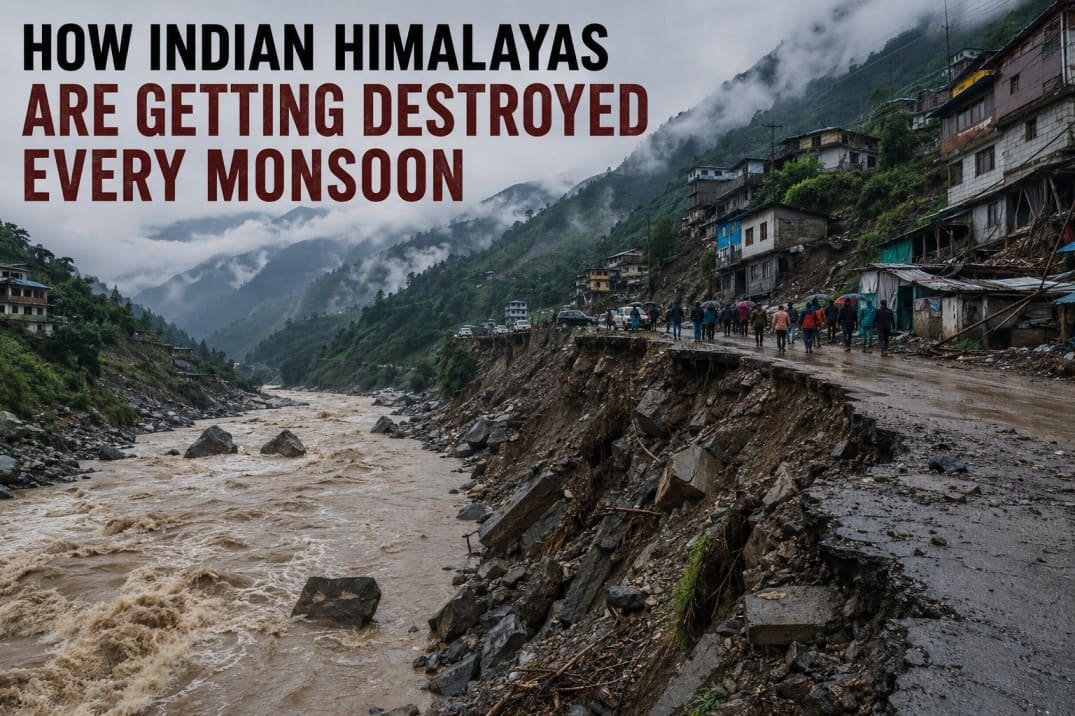
The Fragile Reality of Mountain Ecosystem Vulnerability
The afternoon sun was blazing unexpectedly bright over the Chenab Valley on July 6, 2026. For generations, the elders in these remote high-altitude villages knew that heavy rains were part of life, but what unfolded that afternoon was a terrifying departure from history. Without warning, a sudden, violent downpour transformed the quiet mountain streams into a roaring wall of brown sludge, boulders, and uprooted trees.
Within minutes, the debris-laden torrents slammed into the tail race tunnel of the 540-megawatt Kwar Hydroelectric Power Project in Kishtwar, burying vehicles and halting operations. Is that what nature has become?.
This nightmare is no longer an isolated incident. Just a year earlier, the catastrophic Chishoti cloudburst of August 2025 claimed dozens of innocent lives along the Machail Mata Yatra route. These recurring tragedies illustrate a grim reality: The Indian Himalayas are being systematically destroyed every single monsoon season.
What used to be a predictable period of nourishing rainfall has morphed into an annual cycle of terror, driven by a lethal combination of climate change in Himalayas and aggressive human intervention.
The vulnerability of the mountain ecosystem has reached a breaking point.
Environmentalists point out that the geological layout of the young, fold mountains of the subcontinent makes them naturally susceptible to shifting. However, the scale of recent disasters proves that nature is no longer acting alone. The entire geographical belt, stretching from Jammu and Kashmir through Himachal Pradesh and Uttarakhand down to Sikkim, is experiencing an unprecedented level of structural instability that threatens millions of lives downstream.
Decoding the Mechanics of Himalayan Monsoon Destruction
Understanding why the mountains are crumbling requires a close look at the altering atmospheric dynamics across South Asia. The International Centre for Integrated Mountain Development ICIMOD recently released its monsoon outlook, warning that even during years with below-normal seasonal averages, the risk of catastrophic flash floods and landslides remains exceptionally high.
The physics behind this paradox is as simple as it is terrifying: warmer air holds more moisture. Specifically, for every additional degree Celsius of warming, the atmosphere can retain roughly seven percent more water vapor.
Consequently, the traditional pattern of moderate rainfall spread evenly over several weeks has been replaced by short-lived, high-intensity cloudbursts. When these atmospheric bombs burst over fragile catchments, the ground simply cannot absorb the volume of water. The resulting surface runoff instantly turns into a deadly debris flow, carving out entire hillsides and obliterating everything in its path.
Adding to this atmospheric chaos is a phenomenon known as high-altitude amplification. The Hindu Kush-Himalayan region is warming significantly faster than the global average. This rapid warming causes an upward shift of the freezing level, meaning areas that historically received snow during the monsoon are now experiencing heavy rainfall. This accelerates the melting of glaciers and permafrost, which destabilizes rocky slopes from within and creates a highly volatile environment where even a minor rain storm can trigger a massive regional disaster.
Unplanned Infrastructure Development as a Catalyst for Ruin
While shifting weather patterns provide the fuel, human choices are pulling the trigger. The desperate push for rapid commercialization, massive hydropower expansion, and wider highways has severely compromised the structural integrity of the mountains. Unplanned infrastructure development across ecologically sensitive zones is directly accelerating the destruction seen every rainy season. Heavy machinery continuously cuts into the base of steep slopes for highway expansions, such as the ambitious Char Dham corridor, without proper slope stabilization or scientific drainage planning.
When hills are cut vertically to save costs and time, the natural angle of repose of the soil is disrupted. This leaves the remaining mountainside completely unsupported. When the heavy monsoon rains arrive, water infiltrates these raw, exposed cuts, lubricating the internal fault lines and causing entire mountain faces to slide downward onto roads and settlements.
Furthermore, the issue of improper muck disposal exacerbates the threat of flash floods in Himachal and Uttarakhand. Tons of excavated earth, rock, and concrete debris from tunnel drilling and dam construction are routinely dumped into nearby riverbanks and streams. When a cloudburst strikes, this loose material is washed downstream, drastically increasing the density and destructive power of the floodwaters. The rivers turn into liquid battering rams, easily destroying bridges, highways, and residential areas that might have survived a clean water flood.
Cascading Disasters and the Threat of Outburst Floods
The danger of Indian Himalayas environmental degradation is not confined to the immediate areas experiencing heavy rainfall. The warming trends and topographical changes are giving rise to complex, cascading disasters that are incredibly difficult to predict or manage. One of the most alarming manifestations of this is the rising frequency of Glacial Lake Outburst Floods (GLOFs) and Landslide Dam Outburst Floods (LDOFs). As glaciers retreat at an accelerated pace, they leave behind large lakes dammed by unstable loose rocks and ice moraines.
When an intense localized storm strikes above these high-altitude lakes, the sudden influx of water can breach the fragile natural dams. Millions of cubic meters of water instantly surge down narrow valleys, gathering velocity and debris as they descend. The impact downstream is catastrophic, often wiping out hydro projects, wiping away vital communication links, and submerging historic towns before early warning systems can even register the threat.
Simultaneously, the degradation of permafrost, the frozen soil that acts as an internal adhesive holding steep rocky cliffs together, is causing major structural failures. As this subsurface ice melts due to rising global temperatures, mountain slopes lose their internal cohesion. This leads to massive landslides occurring even during relatively dry spells, leaving the topography fractured and highly vulnerable to the subsequent monsoon downpours.
It would be easy to blame every landslide on heavy rainfall. After all, the monsoon has shaped life in the Himalayas for thousands of years.
But something has changed.
Roads have been carved through mountains at an unprecedented pace. Hillsides have been blasted to build highways, tunnels and hydroelectric projects. Hotels have climbed unstable slopes to accommodate growing tourism, while forests have steadily made way for construction.
Each project may appear small in isolation. Together, they are quietly changing how the mountains respond to rain.
When the clouds finally burst, weakened slopes collapse far more easily than they once did.
That is why many environmental scientists no longer describe these events as purely natural disasters. Instead, they call them disasters intensified by human activity.
The Himalayas have never been ordinary mountains. Stretching across five countries and supplying water to hundreds of millions of people, they are often called Asia’s water tower. Yet, beneath their breathtaking beauty lies a fragile geological structure that has always been vulnerable.
Unlike ancient mountain ranges elsewhere in the world, the Himalayas are still rising because the Indian and Eurasian tectonic plates continue to collide. The rocks remain fractured, slopes remain unstable, and rivers continue carving new paths through the landscape.
For centuries, forests helped hold these mountains together. Thick vegetation slowed rainwater, strengthened the soil and absorbed excess moisture.
Today, much of that natural protection has disappeared and hence it is sending a warning single, a cry for help.
Redefining Regional Policy to Save the Shattered Highlands
The annual devastation of the northern highlands makes it clear that the current approach to mountain governance is completely unsustainable. India must urgently transition from a reactive, relief-centric model to a predictive, climate-adaptive strategy. The first critical step involves implementing comprehensive micro-zonation and updated hazard mapping across all mountain states. Disaster management bodies like the NDMA must utilize advanced satellite imaging and artificial intelligence to identify high-risk zones where all heavy construction must be strictly banned.
Furthermore, engineering practices in the mountains require a complete overhaul. Instead of relying on aggressive, unscientific hill cutting, infrastructure projects must adopt bio-engineering techniques. Using native vegetation, deep-rooted grasses, and geo-textiles can naturally stabilize slopes and control soil erosion. Rigorous enforcement of environmental safeguards regarding waste management and muck disposal must be maintained, with heavy penalties for corporations that dump debris into active river basins.
Ultimately, protecting these sacred landscapes requires listening to the indigenous communities who have lived in harmony with the terrain for centuries.
Local ecological knowledge must be integrated into modern disaster preparedness frameworks. By establishing community-driven early warning networks and restoring traditional mountain aquifers, we can begin to build localized resilience. The Indian Himalayas are crying out for intervention; preserving them requires accepting that progress cannot come at the cost of ecological survival.
While the monsoon reveals the fragile reality of the Himalayan ecosystem, it also transforms many parts of the country into breathtaking landscapes. If you’re planning to travel during the rainy season, explore Prabh News’ guide to the best destinations to visit during the monsoon in India, featuring scenic hill stations, lush valleys, and important travel tips for safe monsoon tourism.
The environmental challenges facing the Himalayas are part of a much larger global climate story. Rising temperatures are affecting ecosystems from snow-covered mountains to desert cities. To understand how extreme heat is reshaping urban life, read Prabh News’ in-depth analysis of Dubai and Global Warming, which explores whether one of the world’s fastest-growing desert cities can remain sustainable in an era of climate change.
Climate change is only one side of the environmental crisis. Air pollution, industrial emissions, waste management, and unsustainable development continue to threaten both public health and natural ecosystems across India. Prabh News examines these growing environmental challenges in detail, highlighting why tackling pollution requires stronger government policies, scientific planning, and active public participation.
Leave a Reply