
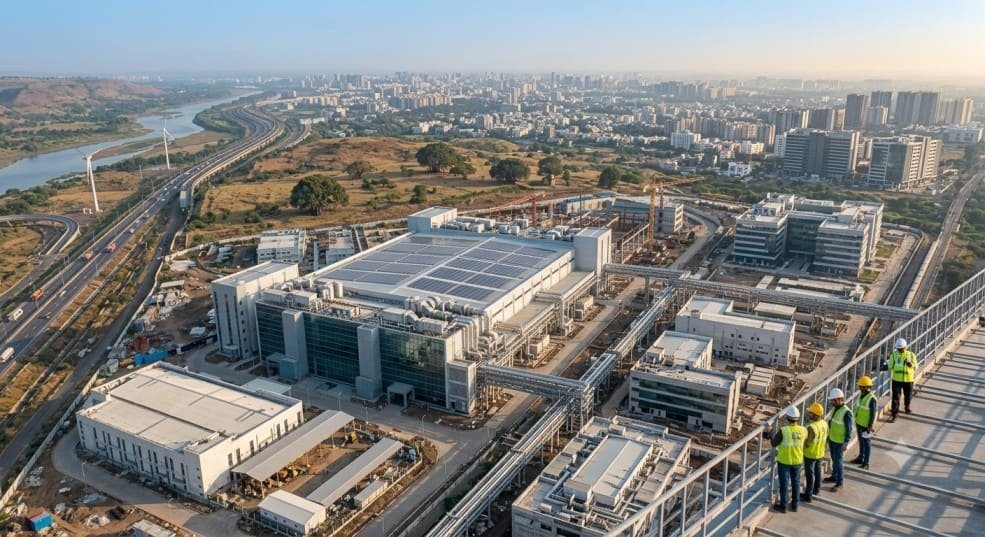
Global tech giants and domestic industrial conglomerates are pouring capital into semiconductor manufacturing in India. Over $19 billion (₹1.64 lakh crore) in investments across 12 major chip fabrication and packaging projects have been greenlit as part of India’s national deep-tech manufacturing expansion.
From commercial chip production at Micron’s memory campus in Sanand, Gujarat, to Tata Electronics’ mega-fab in Dholera, global supply chains are pivoting toward South Asia. But what is driving this massive wave of Semicon India investment?
1. Expanding Fiscal Support Under India Semiconductor Mission 2.0
A primary driver behind why India’s semiconductor industry is attracting billions in investment is the aggressive policy support from the central government.
Building on the foundation laid by the original India Semiconductor Mission (ISM), the Union Cabinet launched India Semiconductor Mission 2.0 (Semicon 2.0) with an expanded budget outlay of ₹1.275 trillion ($13.23 billion). While initial semiconductor manufacturing subsidies offered flat 50% capital expenditure support, ISM 2.0 expands financial incentives directly into critical ancillary sectors,such as semiconductor-grade equipment, specialty chemicals, raw gases, and Indian-designed IP. These targeted fiscal subsidies significantly lower operational barriers for global chipmakers entering the market.
2. Scaling OSAT and ATMP Packaging Facilities Nationwide
Rather than focusing solely on long-lead fabrication plants, India has rapidly commercialized OSAT and ATMP packaging facilities to capture early market share in advanced assembly and testing. Key projects driving this infrastructure include:
- Tata Electronics: Partnering with Taiwan’s PSMC, Tata is building India’s first commercial front-end silicon fab in Dholera, Gujarat (an $11 billion project), alongside a ₹27,000 crore packaging facility in Morigaon, Assam.
- Micron Technology: Having established its $2.75 billion advanced packaging facility in Sanand, Gujarat, Micron has commenced commercial shipments of memory modules.
- Kaynes Semicon & CG Power: Specialized OSAT and ATMP packaging facilities in Gujarat are ramping up commercial production to serve automotive, AI, and industrial sectors.
- HCL-Foxconn JV: Developing non-memory semiconductor packaging infrastructure in Uttar Pradesh.
According to updates published by the Press Information Bureau (PIB), these units establish an end-to-end supply chain covering chip design, wafer fabrication, and advanced 3D packaging.
3. Positioned as a Global Electronics Manufacturing Hub
Multinational corporations are actively building resilient supply chains away from single-region concentration under the China Plus One supply chain strategy. India’s transition into a global electronics manufacturing hub offers a strategic, stable alternative backed by robust industrial infrastructure.
Concurrently, India’s domestic chip consumption is expanding rapidly, driven by domestic smartphone manufacturing, electric vehicles (EVs), 5G telecommunication networks, and data center deployment. Industry projections estimate the domestic semiconductor market will grow from $38 billion to over $100–110 billion by 2030, offering foreign investors direct access to a massive local consumer base.As semiconductor innovation continues to power artificial intelligence, cloud computing, and next-generation devices, these developments are part of broader Top 5 Global Tech Trends in 2026 Reshaping the World, highlighting how emerging technologies are transforming industries worldwide.
4. Unmatched Chip Design Talent Pool in India
While hardware fabrication capabilities are expanding rapidly, India has long been a global powerhouse in integrated circuit (IC) design. Over 20% of the world’s chip design workforce is located in Indian technology hubs such as Bengaluru, Hyderabad, and Noida.
Through government initiatives like the Design Linked Incentive (DLI) scheme, global firms are leveraging this talent pool to build unified design-to-assembly ecosystems within the country.
Climate has been changing with rapid industralisation prabh news covers on Dubai’s Climate.
India Betting $22 Billion on Chips—But Is Its Infrastructure Ready?
Driven by an ambitious $22 Billion manufacturing push, the government is aggressively positioning the nation as a global electronics manufacturing hub through India Semiconductor Mission 2.0 and targeted semiconductor manufacturing subsidies. While this massive wave of Semicon India investment is successfully attracting tech giants and expanding OSAT and ATMP packaging facilities across key hubs like Gujarat and Assam, the long-term success of semiconductor manufacturing in India hinges on an “Opportunity vs. Infrastructure Vulnerability” dynamic: while the massive capital influx drives unprecedented modernization across industrial corridors, long-term viability ultimately depends on overcoming critical operational vulnerabilities in clean water supply systems required for ultra-pure water processing, establishing secure specialty chemical pipelines, and guaranteeing the absolute, zero-fault power grid stability necessary for uninterrupted 24/7 fabrication.
Prabh news Covers Why NYC Running Out of Water? The Truth (2026)
The Road Ahead for Semiconductor Manufacturing in India
Driven by global supply chain diversification, soaring domestic demand, and flexible semiconductor manufacturing subsidies under India Semiconductor Mission 2.0, the country is cementing its status as a premier global electronics manufacturing hub. As major fabs and OSAT and ATMP packaging facilities move into full commercial production, the influx of global capital into India’s semiconductor industry will continue to accelerate.

Leave a Reply