
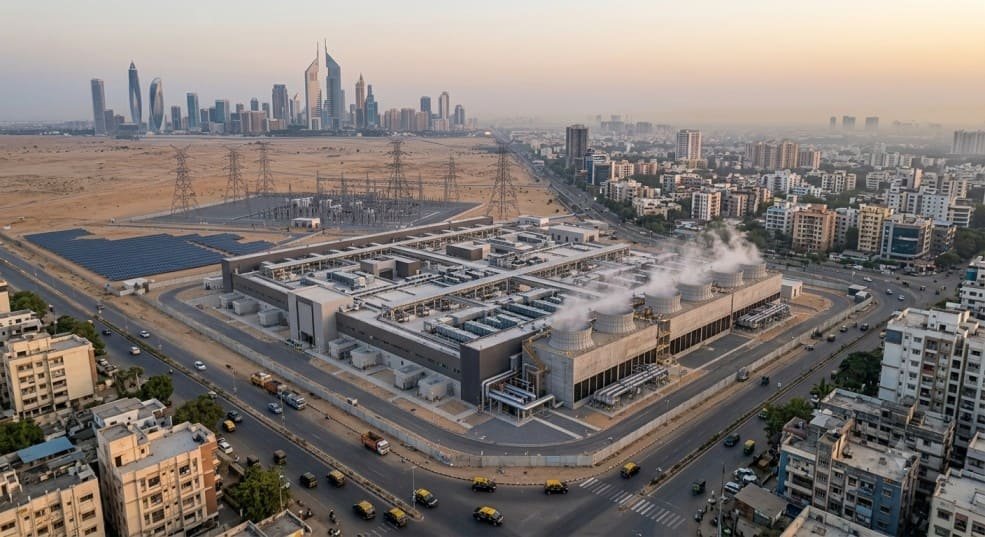
The modern internet operates on a persistent, unseen engine. Behind every prompt submitted to an artificial intelligence model, every automated workflow in a enterprise, and every synthetic image generated in seconds lies a vast web of physical hardware running in specialized facilities.
As generative artificial intelligence transitions from a novelty into a core component of world commerce, the global tech industry has encountered a stark physical reality: the digital cloud relies entirely on heavy brick-and-mortar infrastructure that consumes immense amounts of electricity and water.
With environmental regulations tightening across Western nations and electrical grids in Europe and North America reaching maximum capacity, technology conglomerates are looking elsewhere to build high-density computing parks.
Emerging digital powerhouses, most notably India and the United Arab Emirates, have stepped forward to meet this demand. However, this massive infrastructure migration has sparked an intense debate over whether these regions are securing a digital future or inadvertently becoming the world’s primary dump sites for resource-heavy technology.
The Physical Appetite of Artificial Intelligence
Traditional internet platforms operate on predictable, transactional computing loads. Retrieving a webpage, transmitting an email, or streaming high-definition video requires a server to fetch stored files and stream them across networks. Artificial intelligence workloads operate on a fundamentally different mechanical model.
Training neural networks and serving continuous user prompts requires thousands of graphics processing units running continuous mathematical calculations. This operational shift has transformed server architecture:
- Escalating Rack Density: Standard corporate server racks traditionally drew 5 to 10 kilowatts of power. Modern artificial intelligence server racks require anywhere from 30 to over 100 kilowatts per rack to maintain high-density compute clusters.
- Continuous Energy Draw: Unlike consumer applications that experience predictable usage peaks, artificial intelligence clusters often run at near-maximum capacity 24 hours a day during training runs and continuous deployment.
- Extreme Heat Production: Concentrating high-voltage processors in dense server rooms generates extreme thermal output, requiring continuous industrial cooling solutions to prevent hardware failure.
- Resource Disparity: United Nations research indicates that processing an artificial intelligence task can consume orders of magnitude more power and water than a standard text-based search engine query, compounding total utility demands across billions of daily global interactions.
Read more about it on Wealth Engines of the Nation: The Top 10 Richest Cities of India
Why Western Tech Is Offloading Infrastructure to Emerging Markets
For decades, the bulk of the world’s server infrastructure remained clustered in North America and Western Europe. However, hyperscale developers are hitting severe local expansion limits in these established markets. Power grids in places like Ireland, Germany, and parts of the United States face severe capacity limits, leading to long delays for new utility connections and strict local environmental rules.
To maintain expansion rates, global technology platforms are routing massive capital deployments toward developing and emerging digital markets. Critics and environmental scientists refer to this pattern as a form of resource offloading:
- Regulatory Arbitrage: Western markets are enforcing stricter limits on carbon emissions, water extraction, and land usage for non-essential industrial developments.
- Speed to Connection: Developing markets often offer streamlined permitting processes and dedicated utility connections to attract foreign direct investment.
- Shifting Environmental Costs: By locating physical facilities abroad, primary technology providers can expand their overall computing capacity while insulating domestic electrical grids from severe supply shortages.
- Value Asymmetry: High-margin intellectual property, top-tier software revenues, and core business profits stay centers in corporate headquarters, while host regions retain the physical burden of land use, grid strain, and water consumption.
Why the Ethanol Controversy in India Is Heating Up in 2026 while discussing India’s energy transition and cleaner fuel initiatives.
India: The High-Stakes Balancing Act of Digital Sovereignty
India’s digital economy is expanding at an unprecedented pace, driven by widespread mobile connectivity, domestic technology manufacturing, and comprehensive data sovereignty regulations like the Digital Personal Data Protection Act. These regulations require citizen data to be processed within national borders, sparking an explosive construction boom in facility hubs across Mumbai, Chennai, Hyderabad, and Noida.
However, scaling digital infrastructure across the subcontinent comes with significant utility challenges:
- Capacity Surges: Official data from the Ministry of Electronics and IT highlights that India’s server capacity grew from ~375 megawatts in 2020 to roughly 1,500 megawatts (1.5 GW) by 2025, with long-term national planning projecting utility loads to reach 13.56 gigawatts by the early 2030s.
- Grid Impact & Fossil Dependency: While India is expanding solar and renewable energy installations, the continuous, 24-hour nature of high-density server operations often requires baseload power support from traditional coal generation during peak hours.
- Water Scarcity Concerns: Industry estimates from research bodies like CEEW show Indian facilities consuming over 150 billion liters of water annually for liquid and evaporative cooling, a metric projected to more than double by 2030, raising regional resource management concerns in water-stressed urban corridors.
- Subsidized Compute Incentives: Through initiatives like the IndiaAI Mission, the government is providing subsidized access to tens of thousands of GPUs to lower development costs for local startups, further accelerating domestic facility expansion.
Dubai and the UAE: High-Performance Computing in an Arid Climate
In the Middle East, Dubai and the wider United Arab Emirates have launched an aggressive national campaign to become premier global hubs for artificial intelligence, state-backed technology research, and international digital commerce. Supported by state-backed tech entities and major partnerships with global platforms, the region is rapidly scaling high-density computing parks.
Building large-scale server clusters in a desert environment presents a unique set of operational trade-offs:
- Extreme Ambient Cooling Demands: Operating high-density server racks in extreme desert climates requires significant energy expenditure purely for climate control and heat removal.
- Soaring Water Consumption: Industry projections indicate that facility water usage in the UAE is expected to expand from roughly 23.5 billion liters in 2025 to over 61 billion liters by 2030, driven primarily by continuous server cooling requirements.
- Clean Energy Integration: To cushion the grid impact, Dubai is deploying utility-scale solar generation at the Mohammed bin Rashid Al Maktoum Solar Park while tapping stable, round-the-clock power from the nation’s operational nuclear facilities.
- Infrastructure Bottleneck Removal: The UAE offers fast utility hookups and capital access, positioning itself as a key computing bridge between Europe, Asia, and Africa.
The core reason these markets are increasingly framed as “infrastructure dumping grounds” comes down to resource offloading and economic asymmetry: Western technology companies face severe power grid bottlenecks, strict local emissions caps, and public resistance to resource-intensive server facilities at home, prompting them to export the heavy, physical toll of AI compute to developing and emerging economies.
While Silicon Valley and European tech hubs retain the high-margin software patents, subscription profits, and corporate tax bases, host regions like India and the UAE absorb the physical side-effects,massive land footprints, intense electrical grid strain, and heavy thermal water usage.
Real-world metrics highlight the sheer scale of this transfer:
- India’s Grid Allocation: India’s Ministry of Power has had to formally lock in a massive 13.56-gigawatt power allocation specifically for data centers in national transmission planning for the early 2030s,up from just 1.5 gigawatts in 2025,while its national IndiaAI Mission has already deployed over 38,000 GPUs subsidized at roughly one-third of global market rates to attract compute operators.
- UAE’s Power & Water Surge: In the UAE, data center power capacity is surging 165% to hit 950 megawatts by 2028 (doubling electricity consumption to 12.6 terawatt-hours), while data center water consumption for server cooling in the region’s arid climate is projected to jump from 23.5 billion liters in 2025 to over 61 billion liters by 2030.
- Global Resource Extraction: A United Nations study revealed that global data center e-waste is set to reach 2.5 million metric tons by 2030, while total water usage across the world’s AI facilities could top 9.3 trillion liters,illustrating how the digital revolution’s physical burden is systematically shifting toward regions willing to trade local utilities for high-tech capital.
Navigating the Future: Sustainable Architecture vs. Resource Depletion
The ongoing race for global AI leadership has exposed a fundamental truth: artificial intelligence is not merely a virtual software evolution, but a heavy, resource-intensive physical industry. As power constraints and environmental regulations choke data center construction in Western hubs, the operational load is shifting rapidly toward developing and emerging powerhouses like India and Dubai.Why Sonam Wangchuk Is Fighting for India’s Future while discussing sustainable development, innovation, and environmental responsibility in India.
While absorbing this infrastructure expansion offers undeniable economic leverage, fast-tracked technology status, and sovereign compute capabilities, it forces host nations to carry a disproportionate environmental burden, from strained power grids to heavy thermal water usage for server cooling.
For India and Dubai, avoiding the trap of becoming mere “infrastructure dump sites” will require aggressive policy enforcement:
- Mandating Green Integration: Requiring hyperscalers to bring their own dedicated renewable energy generation and battery storage rather than drawing off municipal baseloads.
- Transitioning Cooling Paradigms: Enforcing closed-loop liquid cooling, direct-to-chip heat exchangers, and recycled water mandates to protect local aquatic resources.
- Retaining High-Value Value Chains: Ensuring local startups, researchers, and enterprises gain affordable access to local compute clusters rather than merely exporting raw processing capacity.
Ultimately, the future of the global digital economy will depend on whether emerging tech hubs can power the world’s algorithmic ambitions on their own terms, building resilient, sustainable infrastructure that serves national interests rather than just global cloud demands.

Leave a Reply