
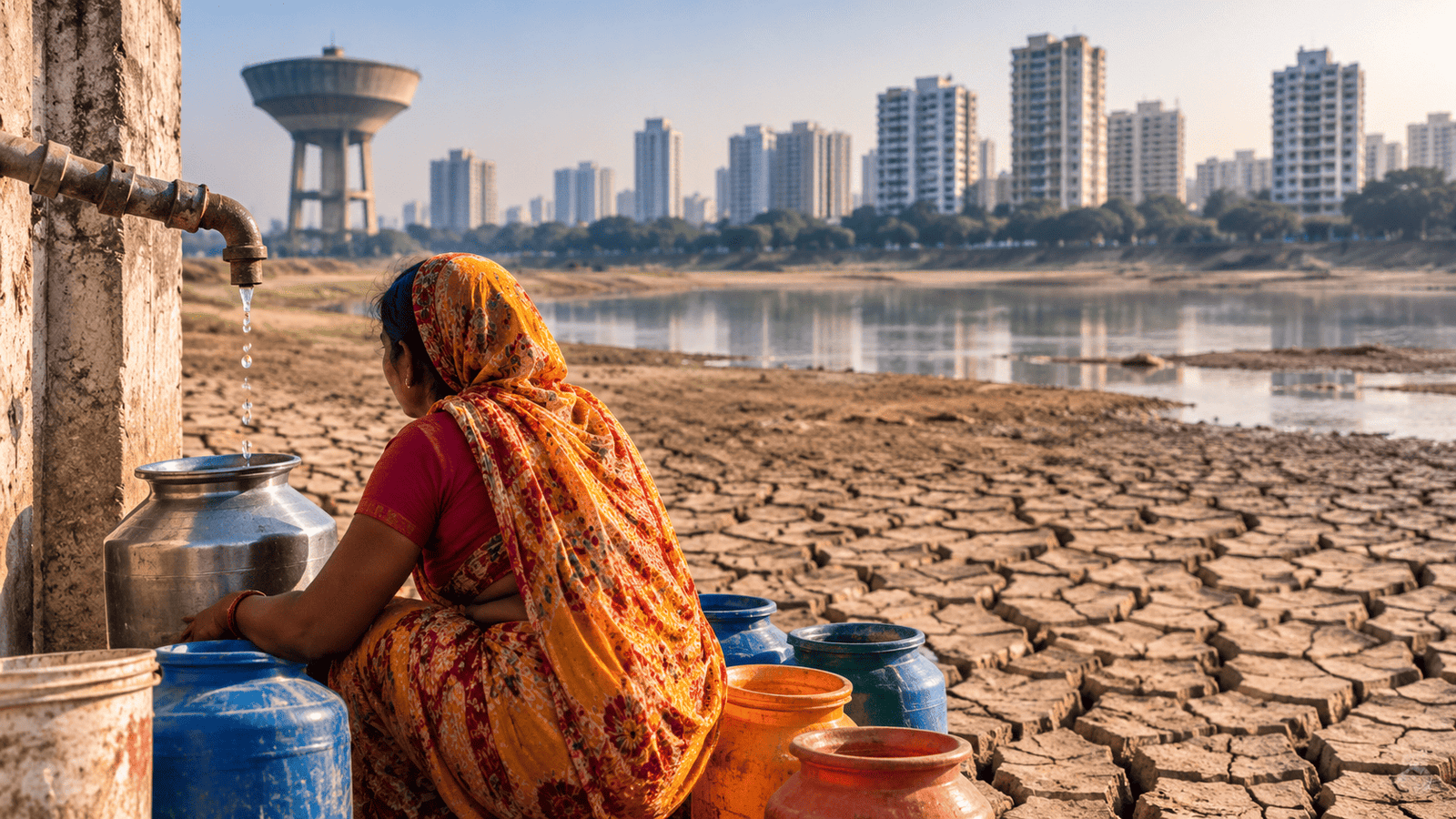
A compounding combination of intense summer heatwaves exceeding 40°C and severe structural infrastructure deficits has pushed several of India’s largest metropolitan areas to the edge of an unprecedented environmental emergency. The visual landscape of modern Indian urbanization is increasingly defined by long, winding queues of citizens holding bright plastic jerrycans waiting for municipal water tankers. What once seemed like a distant dystopian warning has transformed into an active, escalating emergency across major metropolitan hubs, threatening the socioeconomic stability of the world’s most populous nation.
The systemic breakdown of domestic urban water management, coupled with rapid, concrete-heavy real estate expansion, has broken the natural hydrological cycle. Cities are effectively paving over their own lifelines, transforming natural catchment lakes into commercial properties while drilling deeper into non-renewable prehistoric aquifers. The phenomenon known globally as Day Zero India, the precise calendar date when municipal taps run completely dry, is no longer an isolated historical event. It represents a recurring structural threat that exposes structural vulnerabilities within the nation’s fastest-growing economic engines.
The Structural Drivers Behind a National Emergency
Unchecked Subsurface Depletion and Aquifer Collapse
The foundational engine powering India’s urban expansion is the invisible extraction of deep subsurface water. For generations, individual property owners, housing societies, and industrial complexes have operated under a flawed assumption of infinite sub-surface abundance. According to data from the Central Ground Water Board (CGWB), India draws an estimated 25% of the global groundwater supply annually, making it the largest extractor in the world. When extraction consistently outpaces natural percolation, the subterranean geology alters permanently, leading to aquifer compaction and a permanent loss of storage capacity.
The Concrete Jungle Versus Natural Catchment Systems
Urban planning frameworks historically treated wetlands, marshes, and natural floodplains as vacant space waiting to be reclaimed for real estate development. This systemic error has directly fueled the current urban water scarcity.
Concrete and asphalt create completely impermeable surfaces, preventing rainwater from absorbing into the earth. Consequently, during intense monsoon bursts, cities experience devastating localized flash floods as stormwater races across paved roads directly into polluted rivers. The water is entirely lost to the sea, leaving the city parched just a few months later when the dry winter and summer seasons arrive.
Metros on the Edge: The Critical Hit List
Bengaluru: The IT Hub Parched by Its Own Growth
Bengaluru represents the most stark modern example of how uncontrolled technological and real estate success can outrun environmental limits. The city needs approximately 2,600 million liters per day (MLD) of freshwater but faces a severe daily deficit of roughly 500 MLD. Out of nearly 14,000 BWSSB-registered public borewells across the municipal limits, approximately 7,000 have run completely dry, forcing peripheral IT corridors like Whitefield, Sarjapur, and KR Puram to rely entirely on expensive private water tankers.
Bengaluru Water Demand vs Supply (MLD)
[████████████████████] 2,600 MLD Required
[███████████████     ] 2,100 MLD Available Supply
                       -> 500 MLD Daily Deficit
The severity of the crisis has triggered intense political friction.
Union Finance Minister Nirmala Sitharaman publicly targeted the local administration during a press conference, stating that it is worrying and sad that the global city of Bengaluru is suffering from a drinking water crisis.
She noted that when there is a drinking water crisis, the chances of contaminated water reaching people increase significantly. In response, Karnataka Deputy Chief Minister D.K. Shivakumar attempted to control public panic by stating that while there are severe challenges due to drying borewells, municipal teams are deploying resources to ensure there is no absolute water crisis in Bengaluru.
Urbanization has shrunk the city’s surface water spread area by 70% since the 1970s, as concrete surfaces now cover over 93% of the metropolitan area.
Prabh News covers Obesity Crisis in India while discussing the effects of water scarcity on public health.
Chennai: The Coastal Megacity Haunted by Day Zero
Chennai provided a global wake-up call when its four principal surface reservoirs dried up entirely, forcing the city administration to declare an official Day Zero. Over eleven million citizens suddenly found themselves completely reliant on long-distance trains and fleets of state-deployed water tankers just to survive daily life.
This severe crisis was caused by a devastating combination of successive deficient monsoons and extensive, historical urban encroachment on the city’s natural wetlands and salt marshes.
While subsequent monsoons eventually refilled the regional basins, the structural vulnerability remains unresolved. The intermittent nature of urban distribution networks masks the true extent of the vulnerability, with many residents receiving water for only a few hours a day. The coastal geography introduces another layer of environmental risk: as fresh groundwater levels drop near zero, heavy ocean water migrates inland, permanently contaminating coastal wells via saltwater intrusion.
Delhi: Geopolitical Friction and Contaminated Lifelines
The capital city of Delhi experiences an intricate, multi-layered problem combining geographical limits, high population density, and intense geopolitical friction. The city’s water demand has climbed to an estimated 1,250 million gallons per day (MGD), leaving the Delhi Jal Board (DJB) to grapple with a massive deficit of roughly 250 MGD. This deficit forces the capital to rely heavily on raw water allocations from neighboring states through cross-border canals, leading to frequent legal disputes and sudden political standoffs during seasonal droughts.
The ground reality for everyday citizens is exhausting. Nakul Kumar Narula, a local resident and secretary of a housing society in Dwarka, detailed the heavy financial toll on communities, stating that shortages have forced them to rely on multiple private tankers every week while asking residents to cut back on all non-essential water use. Getting government support is equally difficult.
Akhilesh Yadav, a residential manager, noted that even booking an official municipal tanker has turned into a lengthy process involving approvals, cash deposits, and multiple visits to government offices before water is finally delivered. Concurrently, high discharges of industrial ammonia frequently overwhelm local municipal water treatment plants, forcing temporary operational shutdowns that trigger sudden supply crises across residential colonies.
Socioeconomic and Public Health Implications
Macroeconomic Shocks and Industrial Contraction
The direct impacts of India’s water crisis extend far beyond domestic inconvenience; they pose a structural threat to the broader national economy. Water functions as a fundamental input for vital economic sectors, including manufacturing, thermal energy production, and heavy construction. When municipal and groundwater supplies become volatile, industrial units face forced operational shutdowns, directly disrupting supply chains and discouraging long-term private capital investment. Policy think-tank models warn that unmitigated water scarcity could cause a significant six percent contraction in India’s national GDP by the middle of the century.
The Public Health Burden of Unsafe Water
When clean public water systems fail, citizens are systematically pushed toward unregulated, unverified alternate sources. This shift drastically accelerates the public health burden across urban settlements.
Contaminated shallow wells and poorly maintained private tanker fleets serve as prominent vectors for waterborne pathogens. National disease surveillance data indicates over 30 million cases of waterborne diseases (typhoid, cholera, dysentery) reported annually resulting in a massive loss in human capital.
The lack of safe water access also disproportionately impacts women and young girls, who bear the primary household burden of tracking, waiting for, and collecting daily water.
Re-Engineering the Urban Hydrological Blueprint
The Scale of Rainwater Harvesting and Managed Aquifer Recharge
To prevent a widespread Day Zero India scenario, urban design must shift away from treating rainwater as a drainage nuisance and look at it as a primary resource. Comprehensive rainwater harvesting must move beyond basic rooftop pipes to include large-scale city initiatives.
Civil society projects, such as the citizen-led effort to dig one million open recharge wells across Bengaluru, offer scalable blueprints for modern urban water management. By directing clean surface runoff directly into shallow open wells, cities can actively replenish the water table, creating a reliable decentralized buffer against dry spells.
Decentralized Wastewater Recycling and Circular Economies
Modern metropolitan areas cannot afford the luxury of using potable drinking water for industrial cooling, construction, and toilet flushing. The integration of mandatory dual-piping systems in all new commercial developments ensures treated greywater is continuously recycled within the property.
Upgrading municipal sewage treatment infrastructures allows cities to treat municipal wastewater to secondary and tertiary standards, creating a stable circular supply loop.
Selling this highly treated reclaimed water to nearby industrial zones reduces the demand on natural river systems, leaving more fresh water available for domestic consumption.
Pathways to Long-Term Water Security
The escalating crisis across India’s premier economic cities proves that standard, reactive engineering solutions are no longer sufficient. Resolving this crisis requires a complete overhaul of urban water management, shifting away from fragmented crisis management toward data-driven, long-term resource stewardship. Municipalities must be legally empowered to protect remaining urban wetlands, clear historic drainage paths, and strictly regulate commercial groundwater extraction.
At the macro level, building resilience requires an integrated national strategy that balances rural agricultural irrigation practices with the growing demands of urban consumption. Mitigating the risk of cities running out of water depends on how effectively communities value, conserve, and manage every single drop of rain that falls across the urban landscape. Without structural reforms, the economic hubs driving India’s development risk grinding to a halt, restricted by the finite limits of their depleted water systems.
India’s water crisis is no longer a distant warning, it is a present-day reality that demands immediate action. Building resilience requires an integrated national strategy that balances agricultural needs with the growing demands of expanding cities while restoring rivers, protecting groundwater, and promoting sustainable water use. Governments, businesses, and citizens all have a role to play in ensuring that every drop is valued and conserved. Without bold policy reforms and collective action, the cities powering India’s economic growth could face an uncertain future defined by chronic water shortages. The choices made today will determine whether future generations inherit a nation resilient to water stress or one struggling to secure its most essential resource.

Leave a Reply