
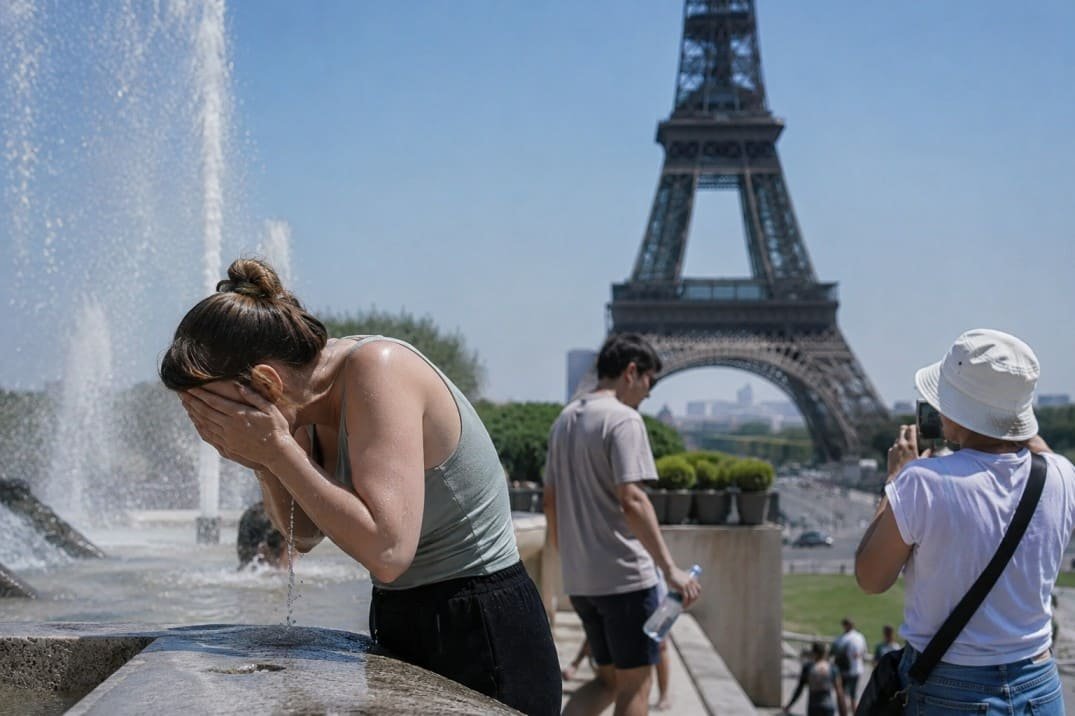
The illusion of the idyllic European summer holiday has officially dissolved into a high-stakes race for survival and shade. Across the continent, historic stone piazzas and famous coastal boardwalks sit empty during peak daylight hours as a relentless, cascading climate anomaly rewires daily life. The increasing frequency and terrifying intensity of the current heatwaves across Europe have transformed from a distant warning by scientists into an immediate, structural breakdown of public health and infrastructure.
According to the latest data released by the Copernicus Climate Change Service, Western Europe has just endured its hottest June on record.
Rather than providing a temporary reprieve, the calendar has rolled into a brutal July, bringing a third consecutive heat wave that shows no signs of breaking. From the historically temperate English countryside to the baking interior plains of Spain and France, nearly a hundred million people are learning what it means to live on the fastest-warming continent on Earth.
The crisis has rapidly evolved into a test of human and mechanical endurance. Commuters watch nervously as railway operators slash train speeds to prevent iron tracks from buckling under the thermal stress, while popular tourist attractions are forced to shut their doors early to protect workers. The narrative unfolding across European cities is clear: the climate infrastructure of the past is fundamentally unequipped to handle the volatile, high-heat realities of the present.
As Europe faces increasingly severe heatwaves, understanding how climate change is affecting cities worldwide provides valuable perspective
Inside the Record-Breaking July Inundation of Heat
The meteorological data driving these European heatwave trends reads like a worst-case scenario. In late June, peak temperatures soared to an astonishing 45.1°C in southern Spain, setting a terrifying baseline for the rest of the summer. Towns like Bilbao shattered all-time regional records by pushing past 42.7°C, while even traditionally Alpine nations like Switzerland watched Basel hit a historic 39°C.
The United Kingdom has found itself squarely in the crosshairs of this extreme summer heat. Recently, the Met Office confirmed a historic milestone at its Wisley monitoring station in Surrey, logging the eighth day this year where temperatures exceeded 34°C,breaking a national record that had stood unchallenged since the legendary, devastating summer of 1976. The UK Health Security Agency has taken the unprecedented step of expanding amber and red heat-health alerts indefinitely, warning that social care networks are nearing an absolute breaking point.
Extreme weather isn’t limited to Europe. Read how climate change and intense monsoons are reshaping the Indian Himalayas.
Compounding the terrestrial emergency is the emergence of “extreme” marine heatwaves across the southern North Sea and the English Channel. Oceans function as the planet’s primary thermal buffer, but Copernicus climate data shows sea surface temperatures rising to their highest levels in modern history. This marine warming effectively seals off the continent from receiving cooling ocean breezes, wrapping cities in a heavy blanket of stagnant, high-humidity air that refuses to dissipate.
Climate experts agree that global warming is increasing both the frequency and intensity of heatwaves.
According to the Intergovernmental Panel on Climate Change (IPCC), human-induced climate change has significantly increased the probability of extreme heat events worldwide.
Many residents who have lived here for several years havent experienced summers like this.
- Maria, 68, from Seville, Spain: “I’ve lived here my whole life, but the summers now feel much harder to manage. We stay indoors during the afternoon and wait until evening to go outside.”
- Nikos, 52, from Athens, Greece: “We worry not only about the heat but also about wildfires. When the temperatures rise and the wind picks up, everyone becomes more alert.”
The Silent Killer and the Rise of Tropical Nights
While wildfires and dried riverbeds capture major news headlines, public health officials are struggling against extreme heat, a hazard widely designated as Europe’s deadliest weather threat. Rapid statistical modeling indicates that the human toll from this summer’s thermal onslaught has already surpassed 20,000 excess deaths across the continent.
Germany alone has mourned over 5,120 fatalities, while France and Belgium have registered thousands of heat-attributable losses within a matter of weeks.
Southern Europe remains among the hardest-hit regions during extreme summer weather.
Spain frequently records temperatures exceeding 40°C during prolonged heatwaves. Cities such as Seville, Córdoba, and Madrid often experience several consecutive days of extreme heat.Portugal has also witnessed record temperatures in recent years, leading authorities to issue wildfire warnings across multiple districts.
Italy continues facing intense heat, especially across Rome, Sicily, Sardinia, and Naples. Historic cities become particularly challenging for residents and tourists because urban areas trap additional heat through concrete buildings and roads.France has experienced repeated national heat alerts over recent summers. Authorities have expanded cooling centres and emergency services to protect vulnerable populations.
The primary catalyst behind this spike in mortality is the proliferation of “tropical nights,” defined as evening periods where the ambient outdoor temperature fails to drop below 20°C.
Health experts from the WMO-WHO Joint Office warn that minimum nighttime temperatures are often vastly more telling than afternoon peaks. When urban brick and concrete structures hold onto daylight heat, the human body is completely denied its natural opportunity to cool down and recover, causing massive, underlying stress to cardiovascular and respiratory systems.
While Europe experiences record-breaking heat, some regions are becoming increasingly attractive for their milder climate and high quality of life.
The impact has rippled directly into everyday survival systems. Emergency ambulance services across the UK have reported a staggering 118% surge in emergency calls regarding suspected cardiac arrests. Simultaneously, major grocery chains are experiencing systemic food supply chain disruptions. Supermarket refrigeration and freezer units, built decades ago for a vastly milder climate, are failing under the strain, forcing stores to hastily erect signs apologizing to customers for completely empty, thawed-out shelves.
Systemic Vulnerabilities and the Urgent Push for Extreme Heat Mitigation
The ongoing climate change impact on Europe has laid bare a profound cultural mismatch: northern and western European societies built their entire civilizations, apartments, and public institutions to trap heat inside, not to keep it out. Over 50% of cold storage facilities and commercial warehouses are more than twenty years old, leaving the continent’s fundamental logistics infrastructure incredibly exposed to prolonged thermal duress.
In response to this shifting baseline, urban planners are rolling out emergency extreme heat mitigation blueprints to fundamentally remodel metropolitan environments. Major cities are investing heavily in replacing black asphalt with highly reflective “cool pavement” coatings, mandating the retrofitting of commercial fridges with insulated Perspex doors, and aggressively planting urban tree canopies to fragment dangerous heat islands. Public parks are increasingly treated as essential health infrastructure, remaining open late into the night to provide desperate citizens with access to shaded ground and cooler air.
Governments Are Strengthening Heatwave Response Plans
European governments are increasingly treating extreme heat as a major public safety issue rather than simply a seasonal inconvenience.
National weather agencies now issue heat alerts several days in advance, allowing local authorities to prepare emergency services, hospitals, and community organisations. Schools, care homes, and employers are also encouraged to implement heat safety measures to protect students, workers, and vulnerable populations.
The European Environment Agency (EEA) has emphasized the need for stronger climate adaptation strategies, including better urban planning, improved public health systems, and investments in resilient infrastructure.
As meteorologists look at global atmospheric models,including a rapidly strengthening El Niño pattern that threatens to supercharge global thermal metrics well into next year,the concept of a temporary summer seasonal event has been permanently retired. Europe is facing a continuous, structural evolution. Adapting to this hostile thermal landscape requires more than just individual behavioral adjustments; it demands an immediate, aggressive overhaul of how Western nations build, work, and protect their citizens from a thermometer that continues to climb.
Europe’s escalating heatwaves are more than just a seasonal weather event, they are a clear sign of a changing climate. From melting railway tracks and raging wildfires to strained healthcare systems and disrupted daily life, the effects of extreme heat are becoming increasingly difficult to ignore. Across the continent, people are adapting their routines while governments work to strengthen climate resilience and public safety.
As temperatures continue to rise, the challenge extends beyond Europe. The choices made today to reduce emissions, improve infrastructure, and prepare communities for extreme weather will shape the future for generations to come. Europe’s experience serves as a powerful reminder that climate change is no longer a distant concern, it’s a reality unfolding now.
Leave a Reply