
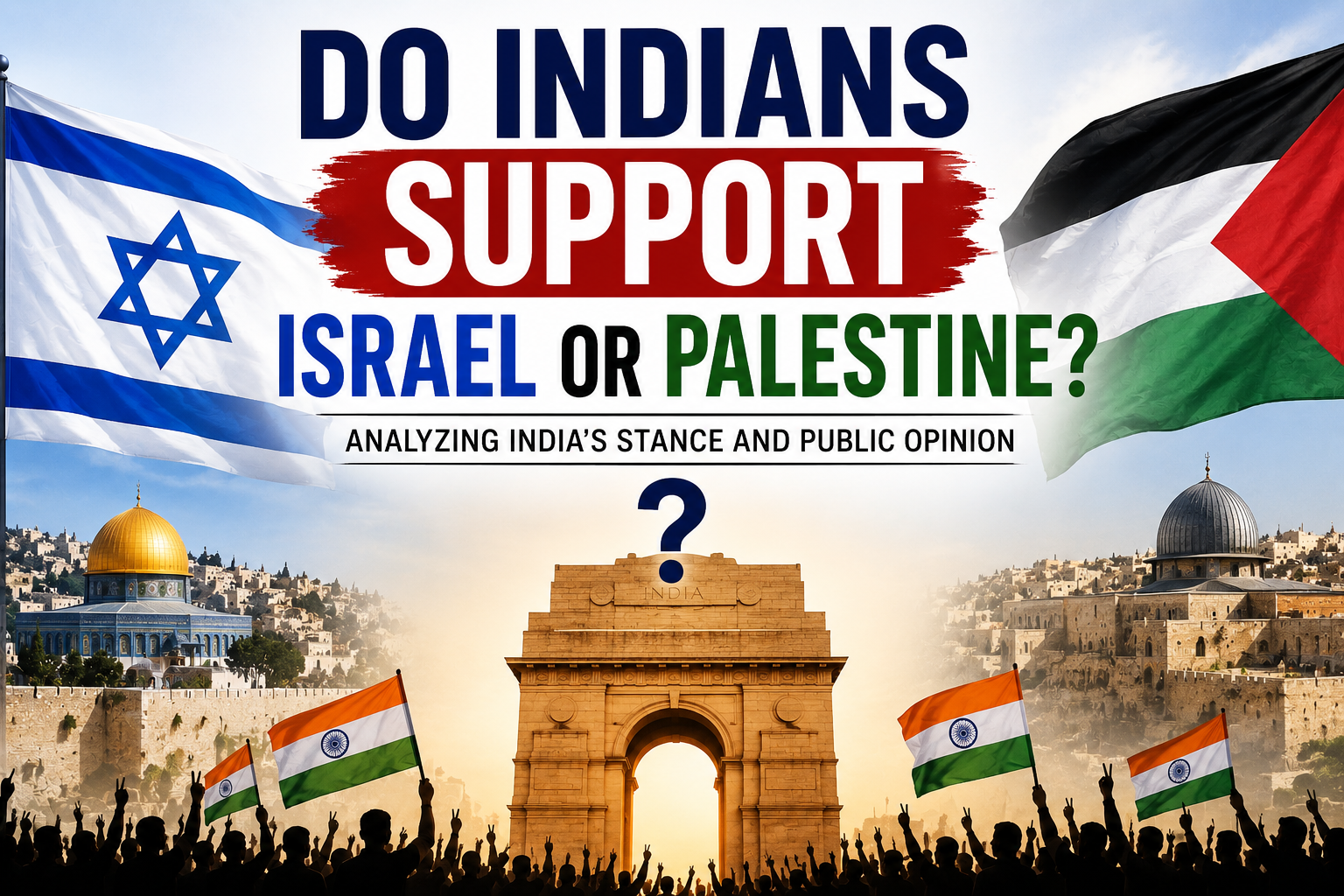
Tensions in the Middle East continue to dominate global headlines. The answer, however, is not as simple as choosing one side over the other. India’s position reflects a careful balance between historical commitments, strategic interests, humanitarian concerns, and public opinion.
India officially supports a peaceful two-state solution while maintaining strong diplomatic and economic ties with Israel. At the same time, India continues to express support for the legitimate aspirations of the Palestinian people. Among ordinary Indians, opinions are diverse and often influenced by political beliefs, media coverage, religious perspectives, and geopolitical considerations.
This article explains India’s official stance, the history behind its relations with both nations, public sentiment, and why the debate remains complex.
The Short Answer: Government vs. Citizens
The answer depends on whether we are discussing India’s government or Indian citizens.
The Government’s Approach
The Government of India maintains relationships with both Israel and Palestine. India has strengthened cooperation with Israel in defense, agriculture, technology, and innovation while simultaneously supporting the Palestinian cause through diplomatic engagement and development assistance.
Public Sentiment
Among Indian citizens, there is no single opinion.
- Pro-Israel Views: Some strongly support Israel because of security concerns and technological cooperation.
- Pro-Palestine Views: Others support Palestine due to humanitarian concerns and historical solidarity.
- Peace Advocates: Many believe both Israelis and Palestinians deserve peace and security.
This diversity reflects India’s democratic society, where citizens are free to hold different viewpoints.
India’s Historical Relationship with Palestine
India’s relationship with Palestine dates back to the country’s independence. After 1947, India generally supported Palestinian self-determination. Several reasons shaped this policy:
- Support for anti-colonial movements
- Solidarity with Arab nations
- Leadership within the Non-Aligned Movement
- Advocacy for international law and self-determination
India became one of the first non-Arab countries to recognize the Palestine Liberation Organization (PLO) as the representative of the Palestinian people. India also recognized the State of Palestine in 1988 and has consistently supported a negotiated two-state solution at the United Nations.
India’s Growing Strategic Partnership with Israel
Although India recognized Israel in 1950, full diplomatic relations were established only in 1992. Since then, bilateral cooperation has expanded significantly across multiple sectors.
1. Defense Cooperation
Israel is among India’s leading defense partners. Defense collaboration has become one of the strongest pillars of India-Israel relations, including:
- Advanced surveillance systems
- Missile technology and radar systems
- Border security and intelligence sharing
2. Agriculture and Water Technology
Israel has helped India improve agricultural productivity through Centers of Excellence across Indian states, focusing on:
- Drip irrigation
- Water conservation
- Desert farming and precision agriculture
3. Technology and Innovation
Israel is often called the “Startup Nation.” Indian companies actively collaborate with Israeli firms in Artificial Intelligence, cybersecurity, healthcare, renewable energy, digital technology, and smart cities.
India’s Official Position on the Israel-Palestine Conflict
India’s official policy aims to balance strategic partnerships with humanitarian principles. The key pillars include:
Support for Israel’s Security: India has condemned acts of terrorism and recognizes Israel’s right to protect its citizens within the framework of international law.
Support for Palestinian Rights: India supports a sovereign Palestinian state, peaceful negotiations, humanitarian assistance, international law, and civilian protection.
India frequently calls for restraint from all parties during periods of conflict.
Why Many Indians Support Israel
Several key factors explain why a significant number of Indians express support for Israel:
- Shared Security Concerns: Many Indians view Israel as a country that has dealt with long-term security challenges and terrorism. This creates sympathy among people who believe strong security measures are necessary.
- Technological Leadership: Israel’s achievements in innovation—such as defense tech, agriculture, medical research, and water management—directly benefit India’s development and attract admiration.
- Strong Bilateral Relations: Over the past three decades, India and Israel have developed close diplomatic and economic ties, increasing positive public awareness.
- Social Media Influence: Online platforms have amplified pro-Israel narratives, especially during periods of conflict. Viral videos, commentary, and influencer opinions often shape public perception.
Why Many Indians Support Palestine
Support for Palestine also remains significant across India, driven by distinct perspectives:
- Historical Solidarity: Older generations often remember India’s long-standing support for Palestinian self-determination. This historical position continues to influence public opinion.
- Humanitarian Concerns: Images of civilian suffering often generate sympathy for Palestinian civilians regardless of political affiliation. Many people distinguish between supporting Palestinian civilians and supporting militant organizations.
- Religious and Cultural Connections: Some communities feel cultural or religious solidarity with Palestinians. However, many supporters emphasize humanitarian values rather than religious identity.
- International Law: Many Indians believe lasting peace requires protecting civilian lives, respecting international law, and ensuring equal rights for both Israelis and Palestinians.
Factors Splitting Indian Public Opinion
Unlike official government policy, public opinion cannot be described with one answer. Individual opinions are deeply divided and heavily influenced by:
- Age and education
- Political ideology and religious beliefs
- News sources and social media exposure
- Evolving international events
The Role of Social Media
Social media has dramatically changed discussions around the Israel-Palestine conflict. Platforms such as X, Instagram, YouTube, and Facebook expose users to breaking news, opinion videos, political commentary, and personal stories. However, misinformation also spreads rapidly, further polarizing opinions.
Balancing Economic Interests and Regional Stability
India’s foreign policy focuses on national interests while maintaining diplomatic engagement with both Israel and Palestine.
| Partner Region | Key Strategic & Economic Priorities |
| Israel | Technology, defense systems, and industrial innovation. |
| Arab Nations | Energy imports, trade, and employment opportunities for millions of Indians in the Gulf. |
Maintaining positive relations across the Middle East is strategically important. India consistently supports peaceful dialogue instead of prolonged conflict. A stable Middle East benefits India’s energy security, trade routes, economic growth, and diaspora safety.
Debunking Common Misconceptions
- Myth 1: India Supports Only Israel
- Fact: False. India has expanded relations with Israel while continuing active diplomatic engagement with Palestine.
- Myth 2: India Has Abandoned Palestine
- Fact: False. India continues development assistance and supports the establishment of an independent Palestinian state through peaceful negotiations.
- Myth 3: All Indians Share the Same Opinion
- Fact: False. India is home to over 1.4 billion people with diverse political, religious, and ideological perspectives. No single opinion represents the entire country.
Future Outlook: Can India Act as a Mediator?
Most countries, including India, support a negotiated two-state solution, where Israel and a future Palestinian state coexist peacefully with secure and recognized borders. International organizations continue to encourage diplomacy, humanitarian assistance, and the protection of civilians.
Because India maintains cordial relations with both Israel and Palestine, some analysts believe India could contribute constructively to international peace efforts. However, mediation in such a complex conflict depends on many geopolitical factors and the willingness of all parties involved.
Unlike official government policy, public opinion cannot be described with one answer. Individual opinions are deeply divided and heavily influenced by factors like age, political ideology, and education. Interestingly, as global dynamics shift, the choices facing students are changing both at home and abroad—prompting a broader trend where many international and immigrant families are looking beyond Canadian education for their long-term futures.
Conclusion
India is expected to continue its balanced, pragmatic foreign policy. Ultimately, India’s approach seeks to balance diplomacy, national interests, and humanitarian principles rather than choosing one side exclusively. Among its citizens, the varying viewpoints simply reflect the country’s rich democratic diversity.
Israel’s achievements in innovation such as defense tech, agriculture, medical research, and water management directly benefit India’s development and attract admiration. Many policy analysts note that adopting swift execution strategies from global powers, as discussed in how India could learn from China’s governance model, is essential to maximizing the benefits of these technological partnerships.


Leave a Reply