
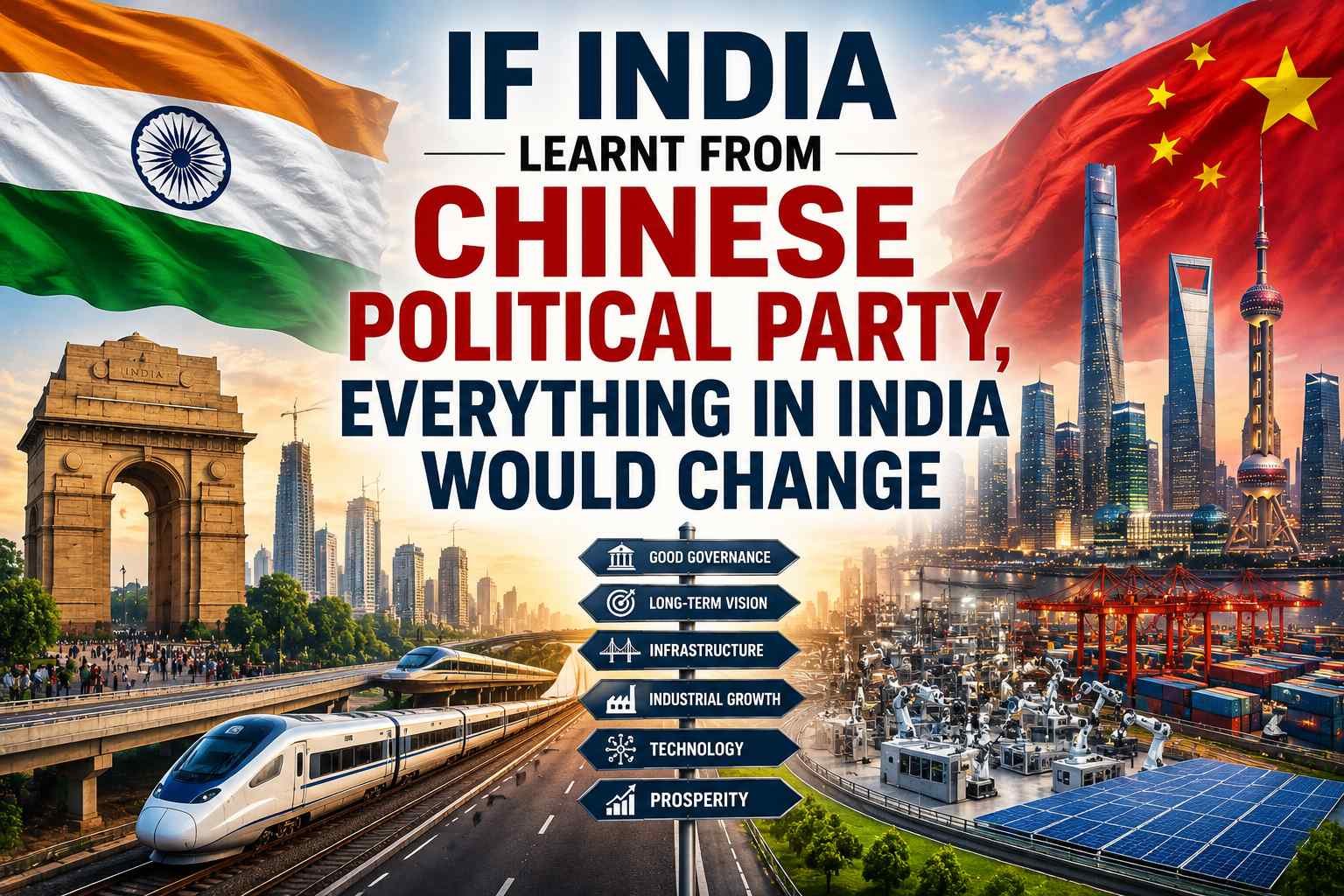
India and China are often compared because they are the world’s two most populous countries and among the fastest-growing economies. While India follows the world’s largest democratic system, China operates under a single-party political structure led by the Communist Party of China (CPC).
The statement “If India learnt from Chinese Political Party, Everything in India would change” does not necessarily mean India should abandon democracy. Instead, it raises an important discussion: Are there governance strategies, administrative efficiencies, and long-term planning approaches that India could adopt while preserving democratic values?
China has transformed from an underdeveloped nation into the world’s manufacturing powerhouse in just four decades. India has immense potential but often faces delays due to bureaucracy, political instability, policy inconsistency, and infrastructure challenges.
This article explores the lessons India can learn from China’s governance model without compromising its democratic identity.
Understanding the Chinese Political Party Model
The Communist Party of China governs nearly every aspect of policy implementation. Unlike countries with frequent government changes, China’s leadership follows long-term national development goals that often span decades.
Some defining characteristics include:
Long-Term National Planning
China introduces five-year plans that focus on industrial growth, technology, infrastructure, healthcare, and education.
Unlike short-term election promises, these strategies continue despite leadership transitions.
Faster Decision-Making
Major infrastructure projects often receive approvals quickly, allowing highways, railways, airports, and industrial parks to be completed in record time.
Strong Policy Execution
China is known not only for creating policies but also for ensuring their implementation through strict administrative accountability.
Why People Say “If India Learnt from Chinese Political Party, Everything in India Would Change”
Many experts believe India’s biggest challenge is not policy creation but policy execution.
India frequently announces ambitious projects, but implementation is often delayed because of:
- Political disagreements
- Bureaucratic hurdles
- Multiple approval layers
- State-central coordination issues
- Legal challenges
Learning from China’s execution model could significantly improve governance efficiency.
Infrastructure Development Could Accelerate
Infrastructure remains one of China’s greatest achievements.
China has built:
- High-speed rail networks
- Mega airports
- Smart cities
- Expressways
- Industrial corridors
- Modern ports
India has also made remarkable progress, but projects sometimes take years longer than expected.
Faster Project Approvals
If India adopted stronger administrative coordination similar to China’s, major projects could finish much sooner.
This would reduce costs while attracting more investors.
Better Urban Planning
Chinese cities are often designed with long-term population growth in mind.
India’s rapidly expanding cities could benefit from integrated transportation systems, planned housing, and sustainable development.
Manufacturing Could Reach New Heights
China became the “Factory of the World” through consistent industrial policies.
India is already promoting initiatives like:
- Make in India
- Production Linked Incentive (PLI)
- Digital India
However, consistent execution remains essential.
Industrial Zones
China established thousands of industrial clusters that encourage businesses to manufacture efficiently.
India could expand specialized manufacturing hubs to increase exports.
Supply Chain Development
Improved logistics and streamlined regulations would make India more attractive for global manufacturers seeking alternatives to China.
Bureaucratic Reforms Would Improve Governance
One area where India could learn significantly is administrative efficiency.
Many government services still involve lengthy paperwork and multiple approvals.
Potential improvements include:
- Complete digital governance
- Single-window business approvals
- Faster land clearances
- Performance-based administration
- Reduced procedural delays
These reforms would improve both public services and investor confidence.
Education and Skill Development Could Become More Industry-Focused
China heavily invested in technical education, engineering, vocational training, and research institutions.
India has a large young workforce, but stronger industry-academia collaboration could bridge skill gaps.
Technical Universities
Expanding technical education aligned with manufacturing and emerging technologies would prepare students for future industries.
Research Investments
Higher investments in innovation could strengthen India’s position in artificial intelligence, semiconductor manufacturing, biotechnology, and clean energy.
Economic Growth Could Become More Consistent
China maintained high economic growth for decades through coordinated planning and industrial expansion.
India already ranks among the world’s fastest-growing major economies.
However, adopting certain governance practices could further strengthen growth.
Key areas include:
- Infrastructure investment
- Export promotion
- Industrial competitiveness
- Business-friendly regulations
- Technology adoption
These measures could create millions of new employment opportunities.
Technology Adoption Could Transform Public Services
China has rapidly embraced digital governance.
Examples include:
- Smart transportation
- Digital payments
- AI-powered city management
- Online government services
India has already achieved significant milestones through UPI, Aadhaar, DigiLocker, and Digital India.
Further integration could improve service delivery and reduce administrative inefficiencies.
Can India Learn Without Copying China’s Political System?
Absolutely.
India’s democratic structure is fundamentally different from China’s one-party model.
Rather than adopting China’s political framework, India can learn valuable governance practices such as:
Long-Term National Vision
Policies that continue across governments can accelerate development.
Faster Execution
Reducing unnecessary delays benefits both citizens and businesses.
Accountability
Performance-based governance ensures better outcomes.
Infrastructure Priority
Modern infrastructure attracts investment and improves quality of life.
These lessons can coexist with democratic institutions.
Challenges India Must Consider
Not every aspect of China’s governance can be replicated.
India values:
- Freedom of speech
- Multi-party democracy
- Independent judiciary
- Federal governance
- Electoral accountability
Any reforms must respect constitutional values while improving administrative efficiency.
Global Lessons Beyond China
Many successful countries combine democratic governance with efficient administration.
Examples include:
- Singapore
- South Korea
- Japan
- Germany
India can study global best practices rather than relying on a single model.
Frequently Suggested Reforms for India
Experts often recommend:
Stronger Local Governance
Empowering municipalities improves public services.
Digital Administration
Reducing paperwork increases transparency.
Judicial Reforms
Faster dispute resolution benefits businesses.
Stable Economic Policies
Policy consistency encourages long-term investments.
Manufacturing Expansion
Boosting domestic production creates employment and strengthens exports.
What Would Change If India Adopted the Best Practices?
If India successfully adopted efficient governance methods inspired by China’s administrative model while preserving democracy, several positive changes could occur:
- Faster infrastructure development
- Better public services
- Increased foreign investment
- Stronger manufacturing sector
- Higher employment
- Improved urban planning
- Faster project completion
- Better policy continuity
- Enhanced global competitiveness
However, these improvements depend on institutional reforms rather than political ideology alone.
Conclusion
The phrase “If India learnt from Chinese Political Party, Everything in India would change” is best understood as an invitation to examine governance efficiency rather than advocate for a different political system. China’s rapid development demonstrates the impact of disciplined execution, long-term planning, and infrastructure investment. India, meanwhile, has unique strengths rooted in democracy, federalism, innovation, and a young population.
The real opportunity lies in combining India’s democratic values with stronger implementation, transparent governance, and strategic national planning. By adopting proven administrative practices—such as faster project execution, improved accountability, and consistent economic policies—India can accelerate development without compromising constitutional freedoms.
Ultimately, meaningful change depends not on copying another country’s political structure, but on adapting effective governance lessons to India’s own social, legal, and democratic context. With thoughtful reforms, India can strengthen its economy, improve public services, and enhance its position as a leading global power.
While governance and economic reforms are essential for national progress, sustainable development is equally important. Explore our related article on https://prabhnews.com/business/dubai-and-global-warmingto understand how infrastructure growth and climate resilience must go hand in hand.
hile internal governance models heavily shape a nation’s growth, external diplomacy is equally crucial. Explore our detailed breakdown on how India balances its relations between Israel and Palestine to see how these strategic principles play out on the global stage.”

Leave a Reply