
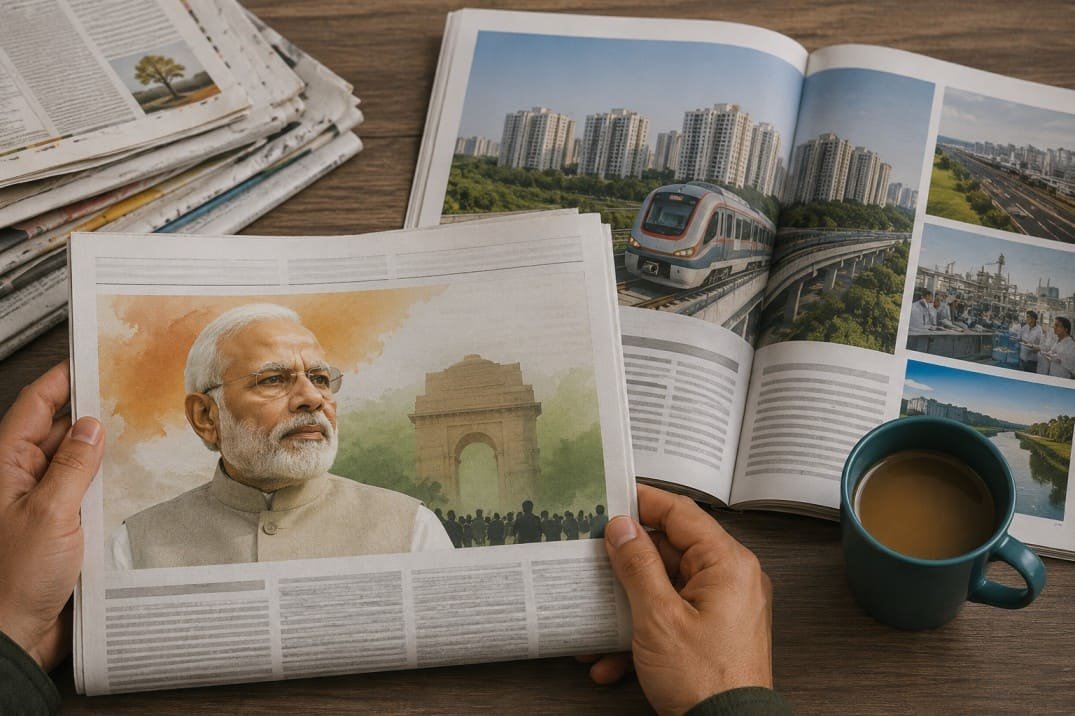
In democracy, effective communication between the administration and citizens plays a crucial role in delivering social welfare initiatives. The Ministry of Information and Broadcasting revealed in Parliament that the Modi government allocated 910.4 crore rupees for print media advertisements between fiscal years 2021 and 2025.
Major publications like The Times of India, Dainik Jagran, and Hindustan Times received substantial portions of these allocations. Understanding this spending reveals how public communication works alongside political outreach strategies. Also, whether the amount spent by the government is justified by it or not.
What Is Modi Government Print Media Expenditure
What constitutes this government advertising strategy is the systematic routing of public funds through the Central Bureau of Communication. Over five financial years, official data indicates that print media received massive funding to run full page announcements, policy awareness drives, and scheme launches.The Times of India secured the highest allocation at 78.22 crore rupees.Hindi regional dailies including Dainik Jagran and Amar Ujala followed closely to capture regional readers.Overall advertising across print, digital, and television platforms averaged nearly 1.5 crore rupees daily during the past decade.
Why Central Bureau Communication Allocates Funds To Print Media
Why does the Modi government continue investing heavily in physical print newspapers despite rising digital adoption? Officials state that traditional newsprint retains high trust, long shelf life, and wide circulation across rural households where internet connectivity varies. Print advertisements help communicate flagship programs like Ayushman Bharat, PM Awas Yojana, and public health advisories directly to target beneficiaries. Print media also offers multi-language penetration, allowing messages to reach diverse regional demographics without relying solely on smartphones.
The Impact Of Modi Government Print Ad Spend
The impact of such large expenditures on news organizations and public discourse? On the financial front, consistent government advertising revenue offers vital relief to legacy newspaper publishers struggling with soaring newsprint costs and declining private ad revenue. However, media analysts and critics argue that heavy dependence on state advertising creates a risk of subtle pressure on media independence. When major news outlets rely on state funds for profit margins, editorial freedom can face soft censorship during major national election campaigns. We do see Print add about schemes and national causes by the government. However, if we closely observe instead of providing the information about the scheme, it is more lilely to spread the propoganda that government has been taking a lot of intiative, where in reality the ground report is really different from what these advertisment claims.
Why Advertising Budget Is Shifting To Digital
Why is government communication spending gradually shifting away from traditional newsprint? Recent parliamentary submissions show a steady decline in yearly print advertising totals, dropping to 323.41 crore rupees in fiscal year 2025.
Politicians active on Social Media?
Rapid smartphone expansion across tier two and tier three cities drives this strategic transition. Digital platforms allow real time targeted delivery, interactive feedback, and higher engagement rates at lower costs. Social media campaigns and short form videos now reach younger demographics faster than daily morning newspapers.As governments increasingly use technology for public communication and policymaking, the shift toward digital platforms is also changing how public information is delivered. Read Why Governments Are Increasing AI Regulation in 2026 to understand the broader impact of technology on government policy.
Government departments now prioritize direct messaging via digital portals, messaging platforms, and online news apps. While print media remains essential for credibility and older audiences, digital media offers measurable performance metrics and instant amplification. In the recent uprising of the student protest Modi Made Reels on instagram to connect to the students and Gen-Z of the nation. MEA has also activated Snapchat and Instagram and are using more digital platforms to connect to wider audience
How Misuse Of Scheme Funds On Print Ads Feels Like Injustice To Taxpayers
Public anger has mounted over how hard earned tax money is being used for political self promotion rather than actual grassroots welfare. Millions of middle class citizens pay direct and indirect taxes with the expectation that public funds will improve healthcare, education, and rural infrastructure.However, as internet access grows, advertising budgets are steadily transitioning toward digital channels. Balancing legacy print reach with dynamic digital tools allows the Modi government to maintain comprehensive civic communication across India.India’s growing digital and economic influence is also attracting major global technology companies, as explored in The Strategic Apple iPhone Production Shift to India from China, which examines India’s changing role in the global technology and manufacturing ecosystem.
What critcs have to say?
Instead, critics point out that substantial funds allocated for welfare schemes end up diverted into glossy newspaper advertisements. When welfare schemes face ground level execution failure, underfunding, or delayed payments to beneficiaries, spending hundreds of crores on public relations feels like a direct injustice to the people of India. Taxpayers feel robbed when government publicity prioritizes brand building over fixing real economic problems and creating jobs.
Is the amount justified?
The debate over government spending on print advertisements is not just about the amount spent but about whether it delivers genuine public value. While advertising can be justified for informing citizens about important government schemes and services, taxpayers also expect transparency, accountability, and efficient use of public funds. Ultimately, such expenditure is justified only if it demonstrably benefits the public and provides better value than available alternatives.
Leave a Reply