
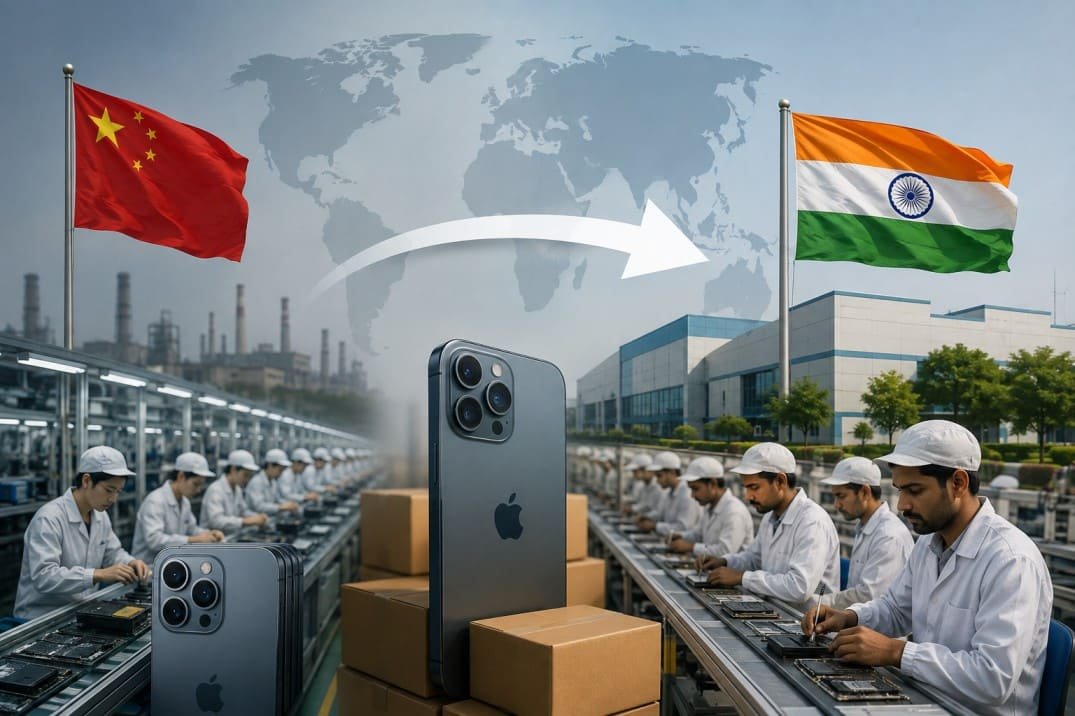
For over two decades, the tech giant built its supply chain foundation around Chinese manufacturing centers. Today, a monumental pivot is underway as assembly lines across southern India gear up to power global smartphone shipments.
What Is the Apple iPhone Production Shift to India
The Apple iPhone production shift to India from China represents a massive reorganization of global technology manufacturing. Apple is diversifying its supply chain by moving a significant share of assembly operations away from Chinese facilities to manufacturing hubs in Tamil Nadu and Karnataka. Indian factories now account for roughly twenty five percent of global iPhone output, assembling tens of millions of devices annually through production partners like Foxconn and Tata Electronics.
Why Apple Is Shifting iPhone Production Beyond China
Geopolitical friction between Washington and Beijing, alongside sweeping US tariffs on Chinese goods, turned Apple’s heavy reliance on Chinese manufacturing into a major financial risk. Severe operational disruptions at key Chinese facilities during peak launch windows underscored how vulnerable an overconcentrated production ecosystem could be.
To build long term supply chain security, Apple aggressively scaled up operations in South Asia, where India’s Production Linked Incentive scheme offered multi-billion-dollar subsidies that offset structural manufacturing costs. Due to this many countries have attracted investment into the country like sweden which is pretty evident as we can can see companies like IKEA’s presence in the Indian Market. Due to which it fosters the the trust of other countries also to invest in India.Local assembly surged 53 percent to reach 55 million units annually, allowing India to produce roughly 25 percent of all iPhones manufactured worldwide. Major partners Foxconn and Tata Group expanded operations across five massive assembly facilities in Tamil Nadu and Karnataka, transitioning from assembling basic entry level models to producing Apple’s entire premium lineup, including flagship Pro and Pro Max variants.
This expanding production network generated over 175,000 direct industrial jobs,early three quarters filled by women,and drove annual iPhone exports from Indian plants beyond $23 billion, officially turning smartphones into India’s single largest export product. Combined with a rapidly growing local consumer market where domestic iPhone sales continue to set record revenues, India has firmly established itself as a primary manufacturing power and an essential engine for Apple’s global strategy.
India’s rapidly changing technology landscape is also influencing how businesses and governments communicate with the public. Read Why Modi Govt Spent ₹910 Crore on Ads for an analysis of government advertising expenditure, its impact, and the growing shift from traditional print campaigns toward digital communication.
Impact of This Apple Supply Chain Transformation
This structural pivot is transforming global trade dynamics and accelerating economic growth in South Asia. The iPhone has become India’s top export product, driving billions of dollars in foreign trade and generating over one hundred thousand local manufacturing jobs. For consumers worldwide, this supply chain diversification ensures a more resilient production network that protects global supply lines against regional disruptions and trade barriers.
As tech manufacturing evolves, the global industrial map is being permanently redrawn. Apple’s ongoing expansion in India proves that supply chain resilience and strategic diversification have become the new benchmarks for technological success .Apple’s decision to diversify manufacturing reflects a broader shift in the global technology industry, where companies are adapting to changing regulations, supply chain risks, and geopolitical uncertainty. Similar trends are explored in our article, Why Governments Are Increasing AI Regulation in 2026, which examines how governments are reshaping the future of the tech sector
Timeline of the Apple iPhone Shift to India
Apple first began assembling legacy iPhone models in India around 2017 to bypass high import tariffs on fully built units. The primary expansion phase accelerated between 2020 and 2022, triggered by strict supply disruptions during global lockdowns and escalating US-China trade friction.
By late 2022, Apple began assembling current-generation devices in India within weeks of their global release. Domestic manufacturing capacity expanded rapidly through major contract partners Foxconn, Pegatron, and local industrial conglomerate Tata Group, which acquired assembly plants in Karnataka and Tamil Nadu. Indian production lines reached roughly twenty five percent of total global iPhone shipments, demonstrating a complete shift toward dual-hub global manufacturing.
How the iPhone Production Shift Has Impacted the Indian Economy
The influx of high-tech assembly lines has provided a substantial boost to the Indian macroeconomy across foreign trade, domestic employment, and industrial infrastructure.
Surge in National Exports and Foreign Exchange Earnings
Smartphones quickly emerged as one of India’s top exported categories, driven primarily by outward shipments of iPhones. Annual iPhone exports from Indian facilities crossed twenty billion dollars, providing significant support to the national trade balance and strengthening foreign currency reserves.
Creation of Local Manufacturing Jobs
Massive facility expansions in southern manufacturing corridors generated well over one hundred fifty thousand direct operational jobs, alongside hundreds of thousands of indirect positions in logistics, construction, and supporting services. A notable share of this newly created factory workforce comprises women entering the formal industrial sector for the first time.It has help created employment in India. Beyond electronics manufacturing, India’s increasing global importance can also be seen in sports, technology, and infrastructure, as explored in Can India Become a Global Sports Power by 2036?, reflecting the country’s expanding international ambitions.
Development of an Ancillary Component Ecosystem
The presence of primary assembly plants catalyzed a secondary wave of investments. Local and multinational suppliers established domestic facilities to manufacture enclosures, circuit boards, cables, and packaging materials. This shift gradually raised local value addition and established a self-sustaining electronics manufacturing ecosystem.
The strategic expansion of tech manufacturing in India demonstrates how policy incentives and industrial scale can alter global supply chains. Beyond diversifying risk for global corporations, this migration has permanently elevated India’s position in advanced electronics manufacturing.
Leave a Reply