
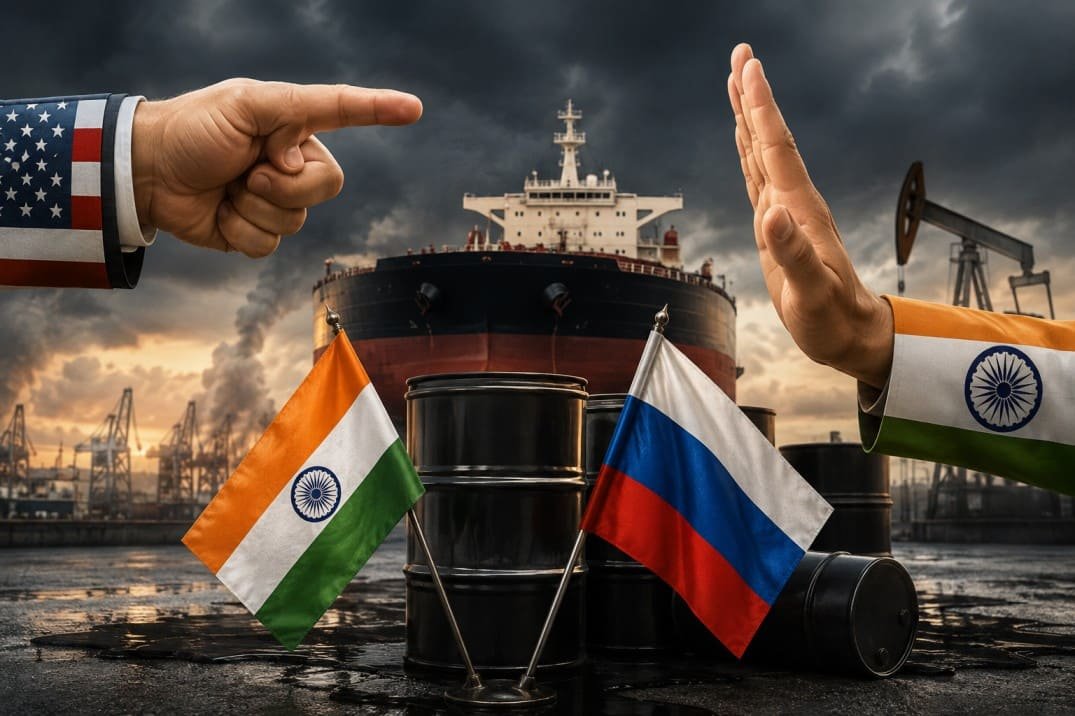
In an increasingly unpredictable global economy, energy security dictates national survival. Over the past two years, global oil flows have undergone a dramatic reconfiguration, placing India directly at the center of a complex geopolitical tug-of-war. As the world’s third-largest oil consumer, India relies on imports for over ninety percent of its total crude requirements. What began as a tactical decision to secure affordable fuel during global supply crunches has now transformed into a major diplomatic crossroads between New Delhi, Moscow, and Washington.
Record Russian Oil Imports
The sheer volume of crude oil traveling from Russian ports to Indian refineries has shattered historic records. Recent trade figures reveal that Russia now supplies over half of India’s total crude imports. In July 2026, Russian oil accounted for approximately 52 to 55 percent of all Indian oil purchases, reaching an unprecedented peak of nearly 2.8 million barrels per day.
This milestone marks a stark shift from pre-2022 levels, when Russian crude made up less than three percent of India’s import portfolio. Indian refiners, both state-owned and private, scaled up processing capacities specifically adapted to Russian grades. Consequently, Moscow has comfortably cemented its status as India’s primary energy partner, outpacing traditional Middle Eastern suppliers.The US threat of 100% tariffs over India’s Russian oil imports highlights how decisions in the global oil market can create wider economic and geopolitical consequences.
Why India Keeps Buying Russian Oil
Several economic and structural drivers explain why India continues to expand its reliance on Russian barrels. Primary among these is commercial pricing. Since Western sanctions diverted Russian crude away from European markets, Moscow offered steep discounts. These favorable pricing terms allowed Indian refiners to save billions of dollars, directly cushioning domestic consumers against global energy inflation.
India continues to purchase Russian oil which accounts for over half of its total crude imports,primarily to ensure national energy security, stabilize domestic fuel prices for over 1.4 billion citizens, and mitigate volatile global energy disruptions. Because India relies on foreign sources for nearly 90% of its crude needs, importing discounted Russian barrels saves refiners billions in foreign exchange, buffers consumers against inflation, and protects supply chains when Middle Eastern shipping routes face geopolitical instability.
Furthermore, Indian state and private refiners have tailored their processing capacities specifically for Russian grades, allowing them to refine these cargoes efficiently and maintain high export margins, while New Delhi upholds a diplomatic policy of “strategic autonomy” that prioritizes economic necessity over foreign pressure.Supply security forms the second critical factor. Ongoing maritime friction and security threats across key transit routes, such as the Red Sea and the Strait of Hormuz, periodically threaten energy shipments from Middle Eastern producers. Disrupted regional routes forced Indian refiners to lean even heavier on stable, seaborne Russian cargoes to ensure uninterrupted domestic fuel production.India’s expanding trade with Russia is also part of the broader debate around de-dollarisation and BRICS’ financial ambitions
The U.S. Tariff Threat: 100% Import Duties on Indian Goods
This expanding trade partnership has drawn sharp pushback from Capitol Hill. The United States Senate recently cleared the bipartisan Sanctioning Russia and Iran Act, which proposes punitive measures against major consumers of Russian fossil fuels. Under this proposed legislation, Washington could levy additional tariffs of up to 100 percent on exports from countries that rank among the top five buyers of Russian energy, a classification that directly includes India alongside China.
If enacted into law, a 100 percent tariff rate could severely undermine Indian exporters selling goods into the American market, particularly across key sectors such as engineering products, pharmaceuticals, and textiles. The prospect of punitive trade barriers forces New Delhi to carefully weigh the financial savings of discounted energy against potential losses in export revenue.
How much oil does India buy from Russia?
The energy disagreement introduces friction into what has otherwise been a strengthening bilateral partnership. Over the past decade, Washington and New Delhi deepened strategic cooperation across defence, technology, and regional security initiatives such as the Quad. However, unilateral trade measures risk straining diplomatic goodwill.
Indian policymakers argue that commercial energy decisions are guided strictly by domestic economic necessity rather than political ideology. Washington views continued energy purchases as indirectly funding Russian state revenues. How both capitals navigate this disagreement will test the resilience of their strategic partnership and determine whether trade friction spills over into broader diplomatic collaboration.
The tension over Russian crude purchases creates a delicate geopolitical balancing act, testing the strength of the India–U.S. strategic partnership. While Washington and New Delhi share vital interests in counterbalancing China in the Indo-Pacific, expanding bilateral defense ties, and advancing technology sharing, secondary sanction threats,such as the U.S. Senate passing the Sanctioning Russia and Iran Act of 2026 to authorize tariffs of up to 100%,introduce severe economic friction. Indian officials contend that forcing New Delhi off discounted Russian barrels would destabilize global energy markets and inflate prices worldwide, asserting that energy purchases remain a non-negotiable matter of national economic necessity.
Consequently, while broad diplomatic and security cooperation will likely endure through presidential waivers and quiet negotiations, persistent tariff threats risk sowing mistrust, dampening bilateral trade momentum, and forcing New Delhi to double down on its commitment to strategic autonomy.
India energy security strategy
Navigating this foreign policy challenge requires a delicate balancing act. Completely replacing Russian oil on short notice is practically impossible without causing severe supply shocks, widening trade deficits, and triggering domestic inflation. At the same time, risking steep tariffs on American trade poses real threats to economic growth.
To maintain strategic autonomy, India is expected to combine firm diplomatic negotiations with gradual supply diversification. By expanding crude purchases from Latin America, West Africa, and domestic renewable transitions while engaging Washington in trade discussions, New Delhi aims to safeguard its energy sovereignty without burning vital bridges abroad.
When severe disruptions and maritime blockades swept through the Strait of Hormuz—the world’s most critical energy chokepoint through which nearly a quarter of global seaborne crude transits many import-dependent Asian economies faced severe fuel shortages, skyrocketing spot prices, and widespread economic strain. Heavy consumers across Southeast and South Asia that relied strictly on Middle Eastern deliveries were hit with immediate supply shocks and severe pressure on their foreign exchange reserves.
In stark contrast, India found itself in a significantly better insulated position. By proactively diversifying its supply chain and securing long-term, non-Persian Gulf seaborne cargoes—most notably discounted Russian crude,New Delhi built a reliable energy cushion that bypassed the volatile Middle Eastern maritime routes altogether, ensuring uninterrupted domestic refining operations and keeping national fuel prices stable while neighboring economies struggled to cope.
Final Words
The evolution of India’s crude imports illustrates the delicate intersection between national necessity and global diplomacy. Securing over half of its oil supply from Russia has delivered crucial economic stability to millions of Indian consumers during a turbulent period. However, as tariff warnings intensify from Capitol Hill, New Delhi faces a defining test of its non-aligned foreign policy. Protecting long-term growth will depend on India’s ability to maintain energy security at home while successfully preserving key trade alliances across the globe.
Leave a Reply