
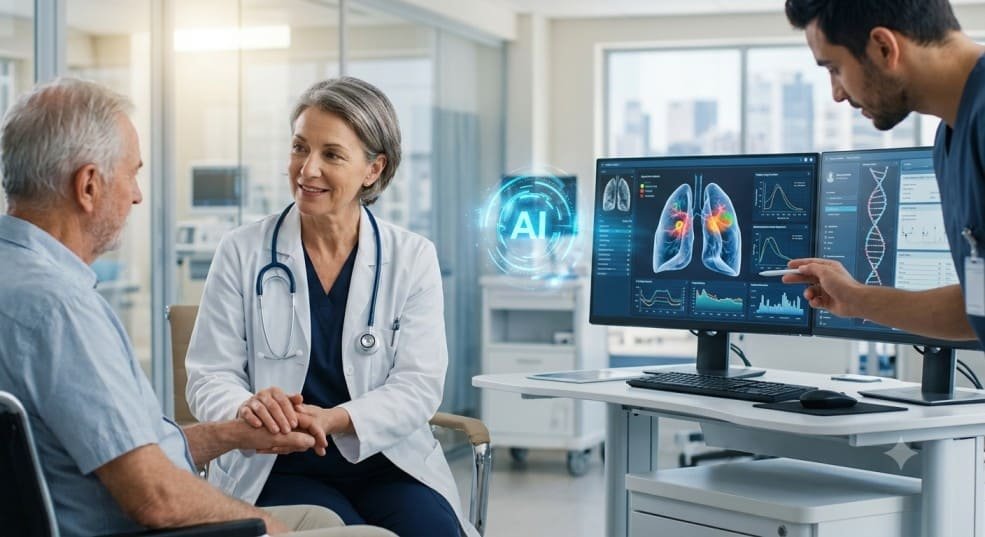
As artificial intelligence models demonstrate human-level performance on clinical licensing exams and diagnostic imaging scans, a central question looms over modern medicine: Is AI replacing doctors?
While sensational headlines suggest algorithms might soon render human physicians obsolete, current clinical data and expert consensus point to a radically different reality. Will AI replace physicians? The short answer is no. Artificial intelligence in healthcare is not displacing medical professionals—it is quietly becoming their most valuable co-pilot.
Is AI Replacing Doctors? The Reality Behind the Headlines
In the ongoing debate over AI vs doctor capabilities, technology is serving as an enhancer rather than a substitute. Recent industry data reveals a massive shift in clinical technology adoption.
According to survey data published by the American Medical Association (AMA), over 81% of physicians reported using medical AI tools in their daily practice. Rather than replacing doctors, these AI healthcare solutions handle high-volume administrative tasks, analyze complex dataset patterns, and flag medical anomalies for human review.
Key Applications Driving the Future of AI in Healthcare
To understand why the “will AI replace doctors” debate misses the mark, it helps to examine where clinical machine learning delivers immediate value in hospital workflows:
- Radiology & Medical Diagnostics: Radiology accounts for over 70% of all medical AI applications. The U.S. Food and Drug Administration (FDA) has cleared over 1,200 AI-enabled medical devices, primarily to assist radiologists in spotting subtle lesions, early-stage tumors, and vascular blockages.
- EHR Documentation & Ambient AI Scribes: Physician burnout has historically reached record highs due to charting demands. Ambient AI scribes now save clinicians up to 45% of documentation time per shift, significantly reducing administrative workload.
- Predictive Patient Monitoring: In intensive care units, predictive healthcare algorithms monitor real-time vital signs to help care teams identify sepsis or sudden cardiac risk hours before physical symptoms manifest.
Why Artificial Intelligence Cannot Replace Human Physicians
While algorithms excel at AI medical diagnostics across millions of data points, clinical medicine requires human capabilities that technology cannot replicate:
1. Complex Nuance and Clinical Judgment
Research compiled by the National Institutes of Health (NIH) indicates that while generative AI models achieve high scores on standard tests, their diagnostic accuracy drops significantly during complex, multi-system clinical cases. AI lacks physical examination capabilities and cannot synthesize unspoken patient context.
2. Patient Trust and Empathy
A study on patient trust in AI healthcare highlighted that over 78% of patients expect their primary care physician to validate any AI-generated health insights. Medical healing relies heavily on bedside manner, non-verbal cues, and compassionate doctor-patient relationships.
3. Ethical Accountability and Legal Liability
Medical ethics and legal frameworks demand accountability. Medical AI software cannot legally sign off on treatment plans, consent forms, or surgical procedures.
Real Life Application of AI replacing Doctors
In real-world practice, AI is taking over specific, traditionally doctor-led tasks through autonomous diagnostic tools. A prime example is LumineticsCore (formerly IDx-DR), an FDA-cleared autonomous AI system that screens patients for diabetic retinopathy in primary care clinics without requiring an eye doctor to interpret the images. The algorithm analyzes retina scans on the spot and outputs a binding diagnostic decision—either referring the patient to a specialist or clearing them for a year. Similar autonomous systems are deployed in emergency rooms for rapid triage, using computer vision to independently identify high-risk condition indicators on chest X-rays or head CTs, allowing high-risk patients to receive immediate emergency care before a human physician even opens the file.
The Verdict: How AI and Doctors Will Work Together
When asking “Is AI replacing doctors?”, the key insight is that technology changes how care is delivered, not who delivers it. The future of healthcare belongs to collaborative intelligence,a hybrid model where artificial intelligence in medicine manages data processing and administrative overhead, leaving human physicians free to deliver compassionate, complex, and personalized care.
As clinical workflows evolve, the real shift isn’t machine versus human, but rather an upgraded paradigm of care. Physicians who harness AI healthcare tools will be equipped to spot conditions earlier, streamline time-consuming charting, and spend more meaningful face-to-face time with their patients. At the same time, patients benefit from faster diagnostic turnarounds without sacrificing the empathy, ethics, and clinical intuition that only a human doctor can provide. Ultimately, artificial intelligence isn’t taking the stethoscope out of the doctor’s hands—it is giving them a far clearer lens through which to see.
Leave a Reply