
Understanding the Shift in Modern Artificial Intelligence
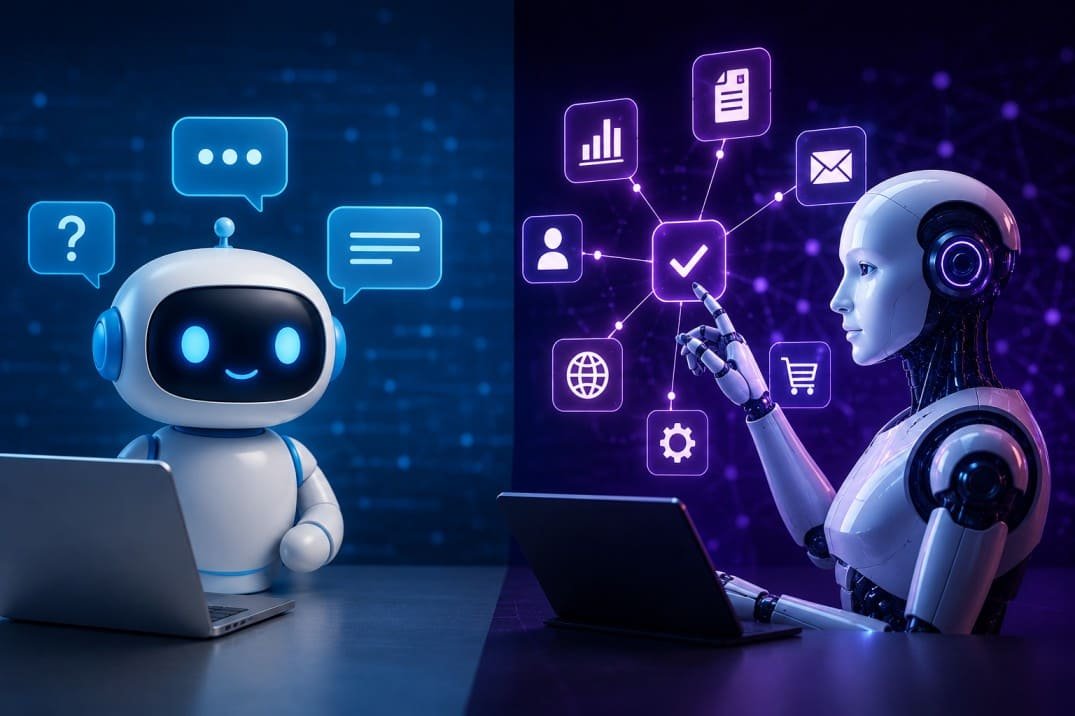
Imagine walking into an office where a helpful assistant stands at the front desk. When you ask for the company hours or request a copy of a brochure, the assistant hands you the exact document immediately. That smooth exchange is helpful, efficient, and direct. Now imagine a second assistant who not only answers your initial inquiry but also notices your scheduled meeting, reviews your previous account history, updates your contact details across internal software, coordinates with your team manager, and sends out a customized calendar invitation before you even think to ask.
This transformation represents the exact shift happening in the digital landscape today. For years, businesses relied on basic automated tools to handle digital communication. However, as modern software evolves, a distinct divide has emerged between simple text assistants and fully active digital workers. The debate surrounding AI Agents vs Chatbots is no longer just a technical discussion among software engineers. It has become a foundational question for organizations looking to streamline operations, lower overhead, and deliver exceptional experiences. Understanding how these technologies differ, why the transition is taking place, and what impact it will have is essential for anyone navigating the current digital revolution.
What is the Real Difference in the AI Agents vs Chatbots Debate?
What is a Conversational Chatbot?
To understand the core comparison of AI Agents vs Chatbots, one must first look at how standard conversational technology functions. A traditional chatbot operates primarily as a conversational interface designed to deliver immediate responses to incoming user requests. When a customer or employee types a question into a chat window, conversational chatbots analyze the text, identify the underlying intent, and produce a relevant answer based on predefined scripts or broad language models.
These digital tools excel at handling linear, predictable interactions. For instance, if a user asks about shipping policies, account balances, or office operating hours, a conversational chatbot can retrieve that specific data instantly. However, the defining characteristic of standard conversational chatbots is that they remain strictly reactive. They wait patiently for a human prompt, deliver an answer, and then stop working. Their memory is typically limited to the active conversation session, and their ability to trigger external software actions without manual intervention remains minimal.
What is an Autonomous AI Agent?
In contrast, artificial intelligence agents represent a major evolutionary leap forward. Rather than simply responding to a user prompt with text, an autonomous AI system receives a high level goal, evaluates the situation, breaks the objective down into sequential logical tasks, and executes those tasks independently. These systems do not merely talk about work; they actively carry it out across multiple platforms and databases.
An artificial intelligence agent possesses dynamic reasoning, context retention, and advanced tool usage. Instead of asking a user to manually fill out forms or click external links, an autonomous AI can read information from a customer database, verify records in financial software, write fresh entries into a project management board, and send tailored updates to team members. While a chatbot stops working the moment it delivers a sentence, an agent continues working behind the scenes until the ultimate business outcome is fully achieved.
Why Are Businesses Shifting Toward Autonomous AI and AI Workflow Automation?
From Reactive Responses to Proactive Execution
The rapid shift toward autonomous AI technology is driven by a fundamental operational realization: answering questions is only a tiny fraction of modern business work. Answering a customer inquiry about a delayed package is helpful, but resolving the issue requires tracking the shipment, contacting the logistics provider, issuing a store credit, and updating the inventory log. A chatbot can explain the return policy, but an artificial intelligence agent can process the return end to end.
Organizations are embracing AI workflow automation because manual copy and paste work between software tools creates massive friction and consumes valuable labor hours. When companies replace passive tools with intelligent agents, they eliminate repetitive administrative work. Employees no longer spend their days acting as human bridges between disconnected software platforms. Instead, autonomous systems operate continuously in the background, taking initiative, spotting exceptions, and executing multi step procedures with remarkable speed and accuracy.
Integration Across Complex Enterprise Systems
Another primary reason for this transition is the deep system integration that modern enterprise architectures demand. Conversational chatbots are typically restricted to a single chat widget on a website or inside a messaging application. They exist within a narrow conversational bubble and rarely possess authorization to make permanent changes to underlying business databases.
Conversely, artificial intelligence agents are engineered to connect deeply with enterprise resource planning systems, customer relationship databases, human resource portals, and financial ledgers. They utilize advanced software interfaces to read data, write updates, and trigger automated scripts across an entire software ecosystem. This deep level of connectivity allows organizations to achieve true end to end automation, turning chaotic manual handoffs into smooth digital procedures.
What is the Impact of AI Agents vs Chatbots on the Future of Work?
Elevating Productivity and Operational Efficiency
The impact of choosing autonomous tools over basic conversational software is felt immediate across every organizational department. In sales and marketing, artificial intelligence agents do not simply answer pricing questions; they identify promising visitors, analyze previous enterprise interactions, enrich account records with public data, schedule sales calls directly on team calendars, and launch personalized follow up campaigns.
In operations and internal administration, AI workflow automation drastically reduces cycle times. Tasks that once required days of manual oversight, such as onboarding new personnel, auditing expense reports, or managing vendor invoices, can now be completed in a matter of minutes. This massive leap in efficiency allows businesses to scale their daily operations exponentially without forcing a linear increase in administrative costs or workforce burnout.
Transforming Customer Experience and Business Growth
From a customer standpoint, the difference between these two technological approaches represents a complete shift in satisfaction. Customers have grown weary of static conversational chatbots that loop endlessly through decision trees or deliver generic help center links when faced with complex issues.
When businesses implement intelligent agents, customer interactions transform from frustrating self service attempts into effortless problem resolution. Customers no longer need to repeat their context across multiple representatives or complete manual paperwork. The agent recognizes who they are, understands their entire service history, predicts their immediate needs, and resolves their issues in real time. This elevated level of service builds strong brand loyalty, boosts client retention, and directly accelerates long term revenue growth.
Navigating the Future of Intelligent Automation
The ongoing evolution of digital software marks a clear line of demarcation in how work gets done. While conversational chatbots played a crucial role in introducing the world to interactive automated dialogue, they ultimately represent an early chapter in digital transformation. The future belongs to capable, interconnected artificial intelligence agents that do not merely talk about tasks, but actively complete them with autonomy and precision.
As organizations evaluate their digital strategies, the core question is no longer whether to adopt conversational technology, but rather how deeply autonomous AI can be integrated into daily operations. By embracing AI workflow automation, enterprise leaders can liberate human creativity, eliminate operational bottlenecks, and set a new benchmark for speed and service. The transition from passive automated chat to active digital execution is underway, and those who harness the full power of autonomous systems will lead the next generation of business innovation.

Leave a Reply