
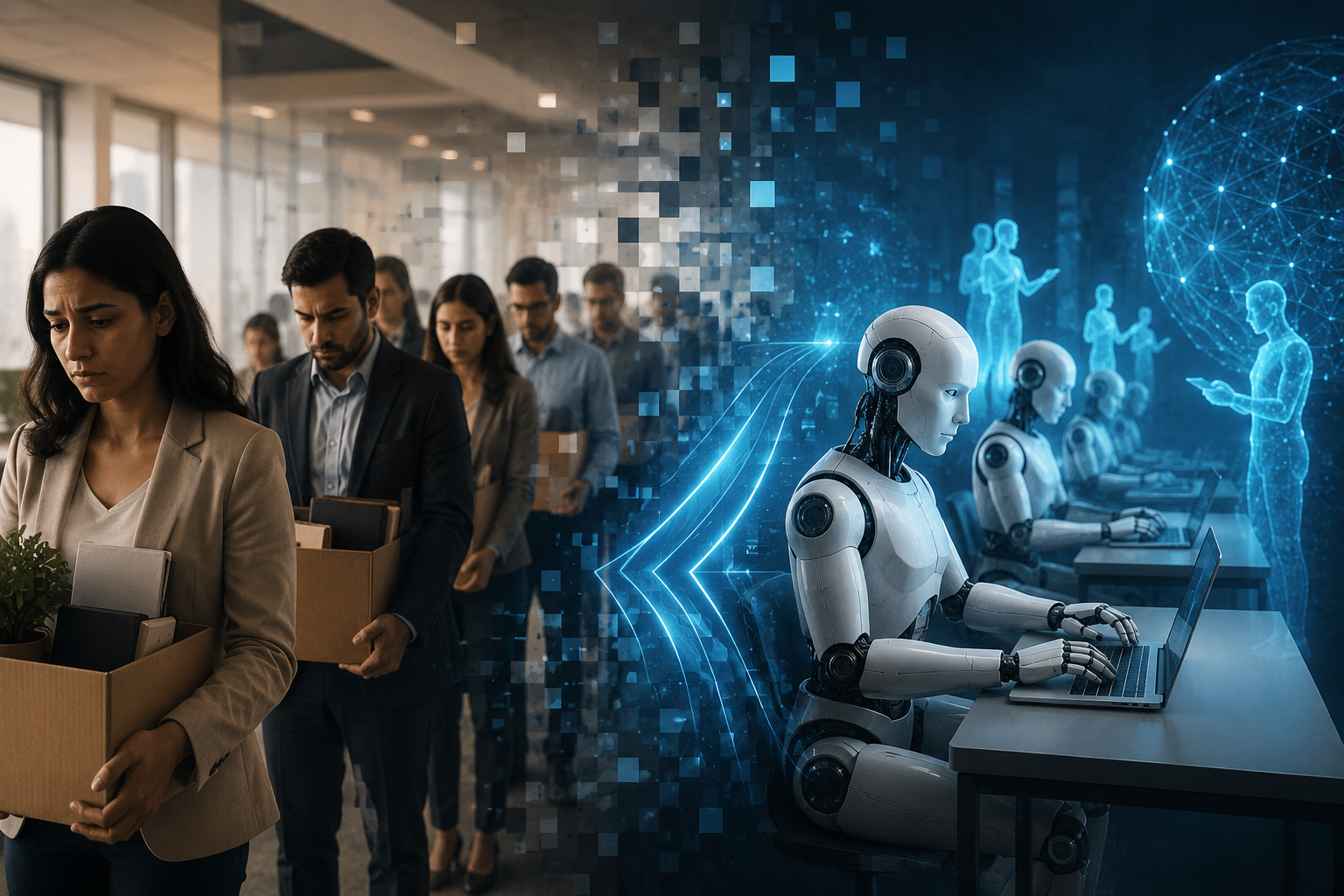
The global corporate landscape is undergoing a quiet yet rapid transformation. Walk into a modern enterprise today, and you will notice that the hum of administrative processing, basic software development, and routine market analysis has changed tone. Advanced generative models, multimodal platforms, and autonomous enterprise agents now handle complex digital workloads that once required full departments. This evolution has elevated conversation around workplace security, placing the AI corporate role redundancy risk 2026 at the center of strategic executive board meetings and career planning alike.
What is AI Corporate Role Redundancy Risk 2026
The AI corporate role redundancy risk 2026 refers to the probability that traditional white-collar positions will become obsolete as artificial intelligence automates cognitive business tasks and digital workflows. Unlike previous technological revolutions that primarily affected physical labor and manufacturing, this wave directly targets cognitive, digital execution. Corporate redundancy occurs when an enterprise realizes that an automated system or autonomous software agent can execute tasks with greater speed, higher consistency, and lower operating expense, thereby rendering the original human job specification redundant.
High-Exposure Corporate Roles in 2026
Roles involving routine data collection, middle management reporting, entry-level coding, and standardized customer communication face elevated exposure. Middle management layers that primarily aggregate status updates or coordinate resources are increasingly replaced by real-time automated analytics platforms. In entry-level software engineering, coding assistants now handle routine debugging, documentation, and unit testing. Similarly, basic legal research, initial audit sampling, tier-one helpdesk ticketing, and data reconciliation are being absorbed by specialized AI tools, significantly shrinking traditional junior onboarding paths.
Why Corporate Roles Face AI Redundancy Risk in 2026
The acceleration of job vulnerability stems from a fundamental leap in system capability as businesses shift from passive text generators to autonomous execution tools. Modern enterprise AI systems do not simply answer questions; they can plan multi-step workflows, interact directly with enterprise resource planning databases, and execute complex business decisions with minimal human intervention.
Rapid Transition to Autonomous Agentic AI
Enterprises are aggressively deploying autonomous software agents to handle end-to-end operational procedures. These intelligent agents handle complex customer escalations, generate dynamic financial projections, and execute supply chain adjustments without continuous human hand-offs. As a result, companies need fewer human intermediaries to manage everyday workflows.
Margin Optimization and Economic Efficiency
Persistent economic pressures drive executive leadership toward lean operating models. Utilizing automated software allows enterprises to scale operational output significantly without incurring corresponding headcount expenses, payroll taxes, or physical office footprints. Process efficiency and productivity gains remain top enterprise priorities, making workforce optimization an attractive lever for margin growth.
Current Shifts and Realities Driving Corporate Restructuring
Recent economic data highlights a measurable shift in white-collar employment metrics. Major industry surveys show a negative global net employment impact tied to AI adoption, reversing earlier periods where technology investments generated net hiring increases. While automation expands hiring in specialized machine learning and governance fields, it simultaneously reduces administrative, clerical, and entry-level analyst headcounts across tech, finance, and professional services. Furthermore, corporate research indicates that junior roles in AI-exposed sectors are seven times more likely to require advanced skills like leadership and strategic judgment compared to non-exposed roles, effectively compressing traditional career ladders.
The restructuring of the global knowledge economy is supported by empirical shifts across major enterprise sectors, evidenced by over 165,000 white-collar corporate role adjustments tied directly to automation and intelligent workflows logged globally in 2026 alone. This operational pivot is driven by a widespread move toward flat corporate structures, where major tech firms and consulting institutions systematically cut middle management layers and leverage real-time AI dashboards for direct project oversight and performance tracking. To sustain this shift, organizations are orchestrating a massive resource reallocation, boosting corporate learning and development budgets by over 30% year-over-year as leaders prioritize retraining high-performing existing staff over hiring new mid-level talent. This institutional focus is anchored by a surge in Chief AI Officer (CAIO) appointments, with over 40% of Fortune 500 companies now maintaining dedicated C-suite leadership tasked specifically with integrating agentic workflows and evaluating labor efficiency gains.
What is the Impact of AI Corporate Role Redundancy Risk
The widespread rise of automation risk is fundamentally reshaping workforce structure, hiring expectations, and organizational design. For employees, job security now depends heavily on human-centric capabilities that machines cannot easily replicate, such as high-level strategic vision, deep emotional intelligence, ethical reasoning, and complex negotiation. The traditional junior career ladder is dissolving, forcing early-career professionals to demonstrate immediate supervisory and analytical value. For corporations, while AI integration yields historic productivity increases and faster time-to-market, it also presents significant cultural challenges, requiring delicate change management, workforce reskilling initiatives, and robust governance frameworks.
The shift toward intelligent automation is not an ending, but a profound pivot in human work. As routine execution and data processing migrate seamlessly to autonomous software, professional value centers around human empathy, creative leadership, and ethical judgment. Navigating the AI corporate role redundancy risk 2026 requires continuous adaptability and proactive upskilling, opening up clear opportunities for professionals to focus on work that is uniquely human.

Leave a Reply